Sunday Morning, Farringdon Road

I’ve always been passionate about art, and a few years ago I stumbled upon a little-known group of early-20th century artists known collectively as the East London Group. I was instantly captivated and wanted to find out more about them.

The brothers Harold and Walter Steggles were perhaps the most successful of the 30 or so artists who exhibited as part of the East London Group during the 1920s and ’30s – these two ‘Brothers In Art’ form the focal point of an exhibition currently on show at the Beecroft Gallery in Southend (until 3 April 2022) – but my personal favourite is a man called Cecil Osborne. Cecil exhibited at the first Group show in 1929 and one of the paintings he exhibited then is the inspiration behind this blog post.

I won’t write too much about the Group itself here – there’s little point in duplicating the information that you’ll find on their website – but one of the key themes of the East London Group was the idea that the inspiration for art is all around us: you only had to look out of your window…

An only child, Cecil Osborne was born on 6 January 1909, the son of Arthur Cecil Osborne (a coachman) and his wife Mabel Goldstone. Appropriately for a future member of the East London Group he was born in the parish of Bromley-by-Bow in Poplar. Cecil James Osborne (he doesn’t appear to have used the middle name) was baptised at the parish church of St Michael & All Angels, Bromley-by-Bow on 21 February 1909.
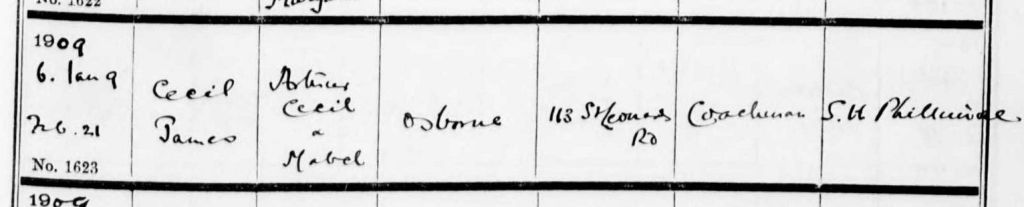
Baptism of Cecil James Osborne, St Michael & All Angels, Bromley-by-Bow
London Metropolitan Archives reference: P88/MIC/011 p.203

Cecil was brought up by his mother (his father doesn’t seem to have been ‘on the scene’ for very long) and by 1921, the family (including Mabel’s sister, Flora), were living at 221 Farringdon Road Buildings, Clerkenwell. This was to be Cecil’s home for the next ten years or so, and it was from the window of 221 Farringdon Road Buildings that he painted his masterpiece.
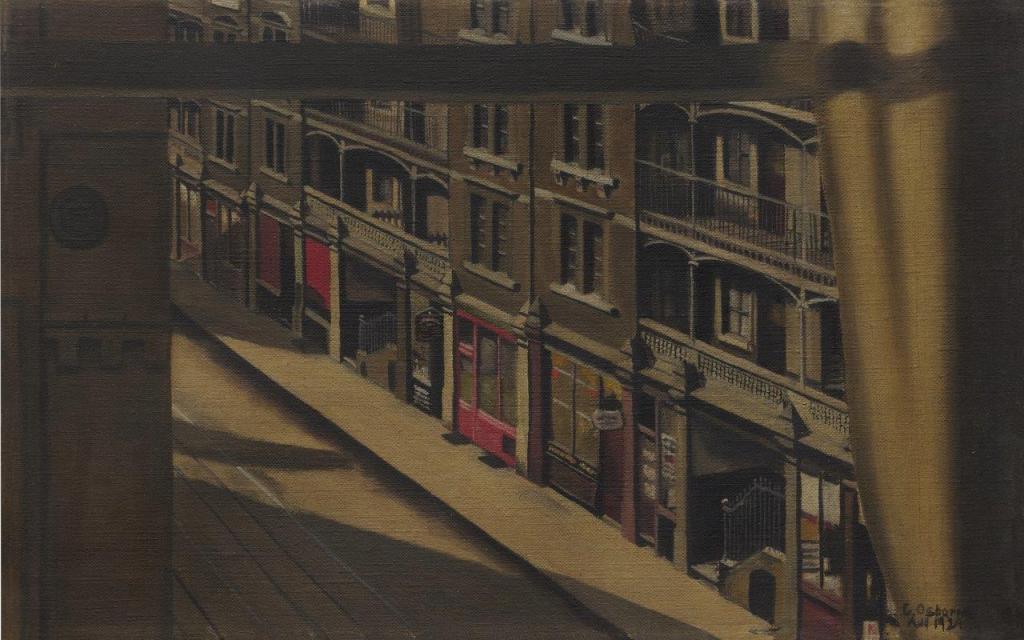
Osborne, Cecil; Sunday Morning, Farringdon Road; Brighton and Hove Museums and Art Galleries
Photo credit: Alan Waltham, East London Group https://www.eastlondongroup.co.uk

Setting to one side, for a moment, the obvious artistic merits of the painting, it’s the view itself that has always fascinated me. From a historian’s point of view it’s a relatively rare example of the celebration of an ‘ordinary’ urban scene, captured, not by the camera, but by a gifted artist. It’s a view from a building which is no longer there, of a building across the road, which is also no longer there. It’s a moment captured in time…

Both buildings have a fascinating history of their own. Farringdon Road Buildings were built in 1870 as ‘model dwellings’ by the Metropolitan Association for Improving the Dwellings of the Industrious Classes. The buildings comprised five, six-storey blocks set at right angles to Farringdon Road. The Osborne’s apartment was in the last of the five blocks as you headed down Farringdon Road towards the City, on the corner of Bowling Green Lane. You can just see the block on the extreme right of this photograph.
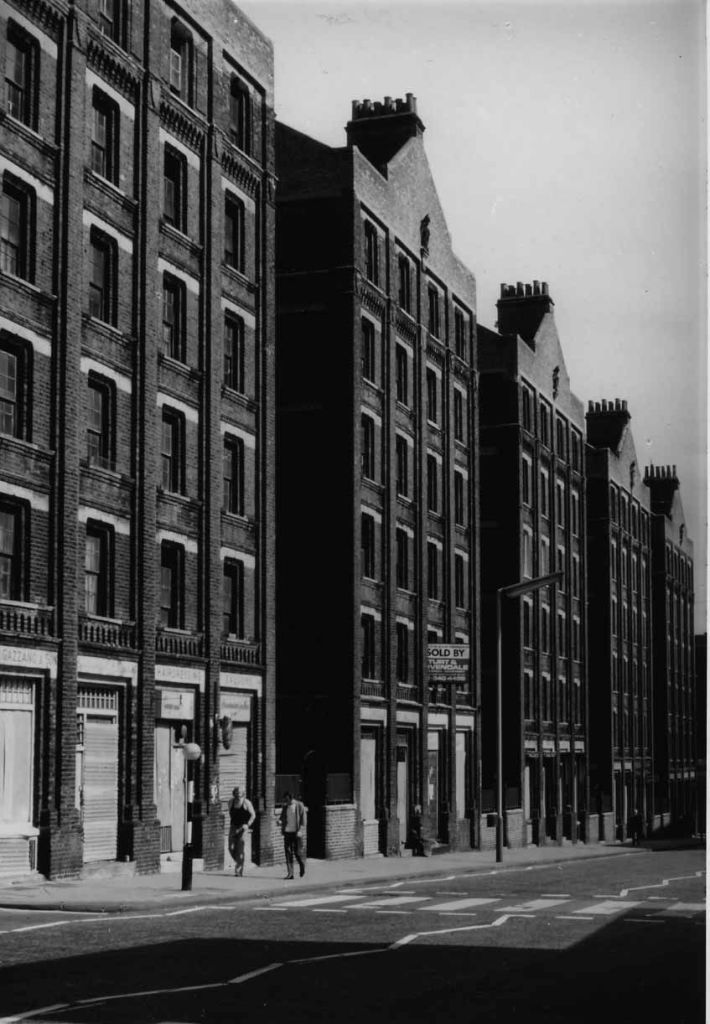
Farringdon Road Buildings from the north-west, early 1970s

Looking out of his window across the road to the left, Cecil would have seen the imposing residential block known as Corporation Buildings. Built as model dwellings in the 1860s they were the first council houses ever built in the UK.

Corporation Buildings, Illustrated Times, 14 January 1865, p. 21

The building on the left in this image from 1865, also appears in Cecil’s painting, at which time it was in use as a bookbinder’s warehouse.

The apartments in Corporation Buildings were well-ahead of their time. Each had a WC, a scullery and a fireplace – unheard of in other contemporaneous working-class dwellings. Each of the blocks was entered via an ornate staircase and we can make out two of these in Cecil Osborne’s painting. Using large-scale, historical maps, we can work out fairly accurately the view that he had.
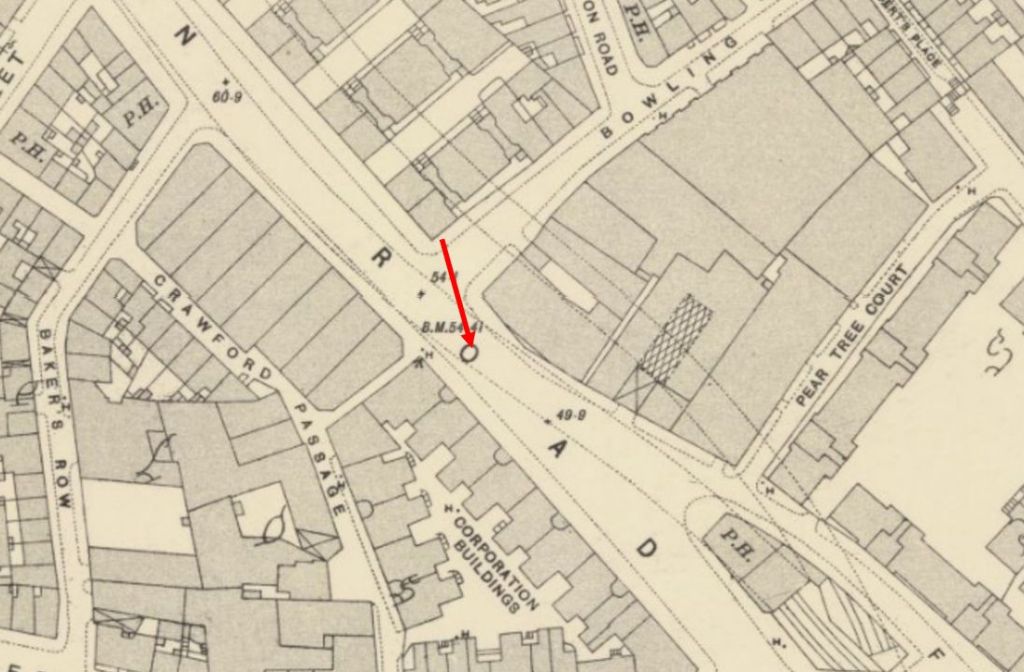
Ordnance Survey Map London (Land Registry Edition) VII.44 (detail)
Revised: 1894,  Published: 1922.  Reprinted: 1936
National Library of Scotland https://maps.nls.uk/view/231272250

Corporation Buildings were pulled down in the 1970s to make way for the Guardian Newspaper’s new offices. Later, a multi-storey car park was built where Farringdon Road Buildings had once stood. This has now also been pulled down to make way for a new housing development.
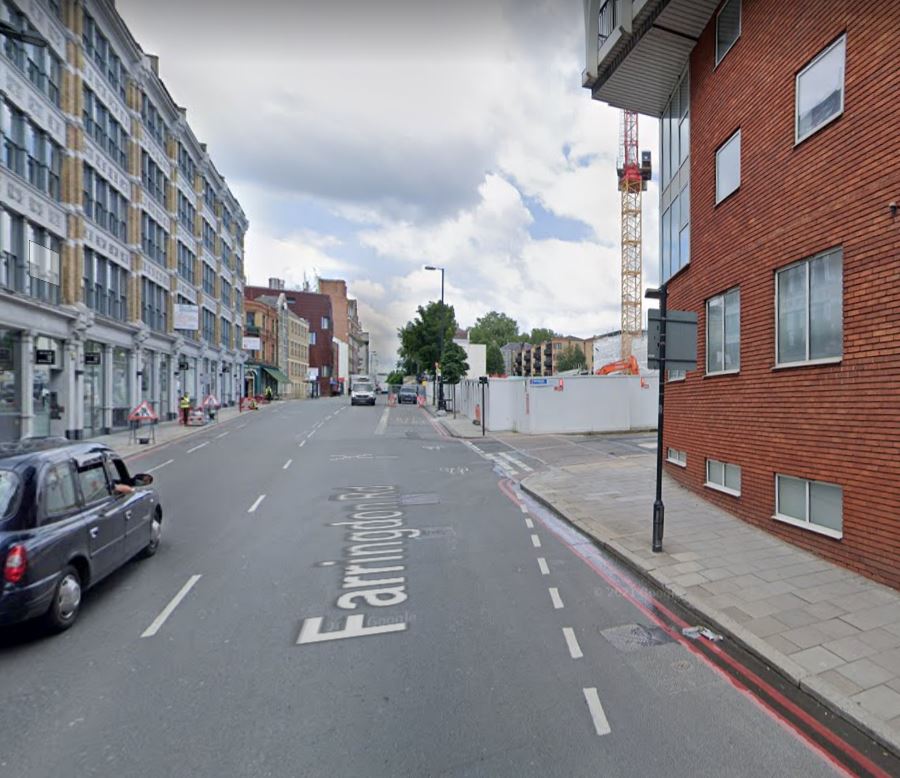
Google Maps, Street View (accessed December 2021)

We can’t get up high enough (until the new building goes up!) to recreate Cecil’s view but this is a shot that I took last year which roughly approximates the view. Not being 50 feet tall, it’s as close as I could get!
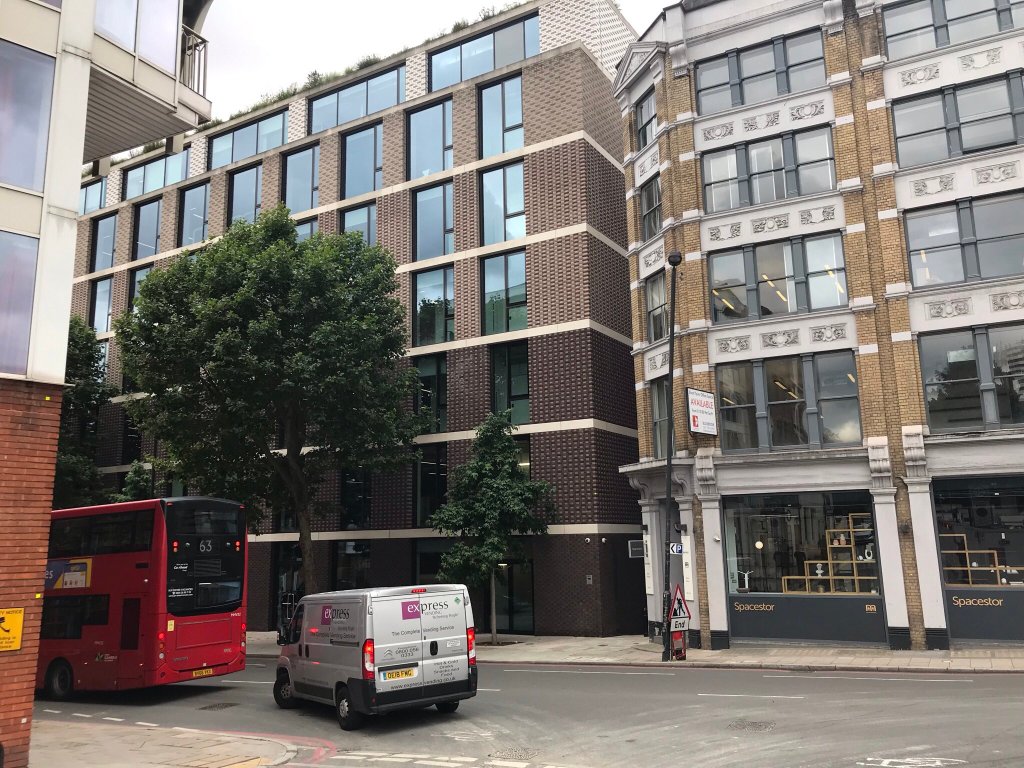
Farringdon Road, Clerkenwell. Photograph by the author, August 2021 © David Annal

I’m always fascinated by the way that we can use documents and maps to find connections between images from bygone days and the world as it is today. And when your starting point is an exquisite piece of art it somehow makes the journey even more rewarding.

Cecil Osborne, his mother Mabel (née Goldstone) and cat, pictured ca.1930, probably at 221 Farringdon Road Buildings, Clerkenwell. Photo credit: the artist’s family (with thanks to Alan Waltham, East London Group)

Further reading: From Bow to Biennale: Artists of the East London Group by David Buckman (2012) https://www.eastlondongroup.co.uk/shop/Books-c54020018

© David Annal, Lifelines Research, 6 March 2022

Posted in Local History, research, Stories | Tagged , , , , , , , | Leave a comment

The original and best

This blog is dedicated to the memory of genealogist Lorine McGinnis Schulze who passed away recently. I had the pleasure of working for Lorine over the past few years, transcribing several early English wills for her. Lorine’s enthusiasm for the subject was infectious. RIP Lorine.

What would we do without wills? When it comes to making real progress with your research, the difference between working with a family that left lots of wills and one that didn’t is considerable. Even a smattering of wills across a few generations can make all the difference.

And yet, compared with other documents such as birth, marriage & death records, census returns and parish registers, wills (and other associated probate records) don’t get the exposure that they deserve – and as a result, our familiarity with the records tends to be less extensive than it might be.

There’s a lot to say on the subject of wills but I want to focus here on one particular aspect – and it’s an area which I believe hasn’t really been explored enough.

Probate – the act of ‘proving’ a will – is a long and complex process. In order to understand the records that survive to today in the archives of the various ecclesiastical probate courts, we need to familiarise ourselves with the procedure. We don’t necessarily need to develop an expertise in all the legal practicalities of the process (although that would help!) but we do need to grasp some basic concepts.

And one of the most important things to understand is that the process will almost always generate two copies of every will:

  • the original, signed by the testator and brought into the court by the executor(s)
  • a copy, created by the probate court, entered into a register and known as the registered copy

The original will would have been written on paper or parchment – sometimes by the testator themselves but more often by a professional clerk – and signed by the testator. If the testator was unable to sign his or her name, they made a mark of some sort instead, frequently a cross or an ‘x’. It’s worth noting that the absence of a signature is not necessarily evidence of illiteracy – many wills were written right at the end of the testator’s life, often within a day or two of their death, so a ‘mark’ could simply be the result of ill health. In order to be a legally valid document, the will had to be signed by two or more witnesses and the requirement was that the testator and the witnesses should all sign their names (or make their marks) ‘in each other’s presence’.

The will may then have been deposited into the care of a solicitor or a bank or it might have been kept at home in a safe place but either way, after the testator’s death, the first task for the executors named in the will would have been to take the will to the relevant probate court and ask to be granted the right to administer the deceased’s estate.

Assuming that everything was in order, the executors could then go away and do whatever they were required to do under the terms of the will leaving the will itself in the hands of the court officials. (Thanks to Andrew Millard for pointing out that the executors would have been given a copy of the will which ‘rarely survive unless inherited within a family or among solicitor’s papers.’)

Then, once the probate process was complete, the court made their own copy of the will. The courts kept large registers for this purpose and even in the smaller courts, the clerks were kept busy: by the early 1850s, the Prerogative Court of Canterbury (PCC), the senior court of probate in England and Wales, was proving around 8000 wills a year – an average of over 650 per month. The records of the PCC include a total of 2263 registers!

The text of the will would be copied, word-for-word, into the register with the details of the grant of probate added at the foot (usually in Latin before 1732).

So we know that there are (usually) two copies of every will, but how can we use this to our advantage?

In most cases, where a collection of wills has been digitised and made available online, it’s either the registered copies or the originals that we have access to. Occasionally, we can see both but where we can’t, it’s important that we’re aware of the probability that another copy of the will that we’re looking at exists.

When we’re looking at a registered copy of the will, we need to be aware that the ‘signatures’ recorded here are the work of the clerks. To view the actual signatures, both of the testator and of the witnesses, we need to see the original will. The signatures can then be compared with those on other documents to test theories in your research: a match with a signature in a marriage register, for example, could help to prove that the groom and the testator are the same person.

Comparison of signatures found on original wills with those on earlier documents providing evidence in each case that the same person signed both documents.

The original will is also likely to include additional details, not all of which are recorded in the register. As part of the probate process, clerks at the court would make notes on the original will. They would routinely record details of the grant of probate (again, usually written in Latin before 1732) including the date and place that the will was proved, the name(s) of the executor(s) and the name of the court official who granted the probate (usually acting as a ‘surrogate’ on behalf of the bishop or archdeacon).

There might be other notes too, particularly if one or more of the executors named in the will was unable or unwilling to perform the duty asked of them. If someone chose to renounce their right to act as executor, the court could appoint someone else in their place and the same might happen if one or more of the named executors had died before the testator. However, as long as one of the named executors was willing and able to take on the role, there would be no need to appoint anyone else.

These details will usually appear in the probate clause in the register but there are occassionaly items which are only to be found on the original. If you’re lucky you might find a note relating to the testator’s death: the date of death is occasionally recorded and if the testator died in unusual or unexpected circumstances (e.g. if they died overseas or at sea) you could be in for a treat.

The original will of Henry Mead, mariner of Wapping, for example, includes a note, written in Latin:

Testator obiit infra duos annos in nave the Adventure Galley in P[ar]tibus Indie Orientalis

Detail from the original will of Henry Mead, mariner of Wapping, 1698.
The National Archives reference: PROB 10/1313

Which translates as:

The testator died within the last two years in the ship the Adventure Galley in the East Indies

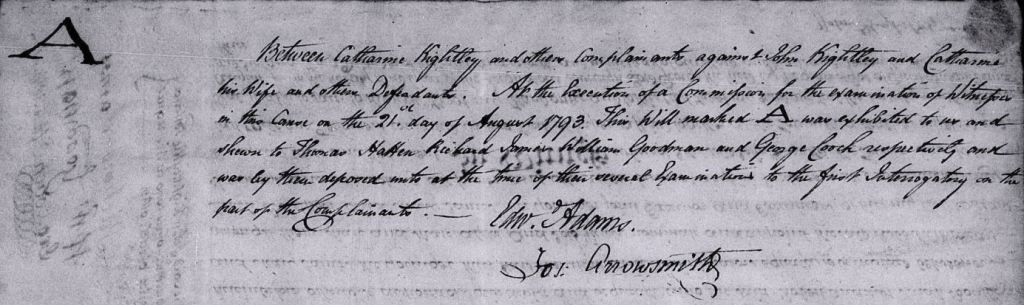
If there was a dispute regarding the will, there might be a note to this effect: perhaps the will was contested by a disgruntled relative or it might have been used as evidence in a court case. The original will of John Kightley of North Crawley, Buckinghamshire for example, includes a note referring to the will having been exhibited in Chancery.

Will of John Kightley of North Crawley, Buckinghamshire, Archdeaconry of Buckingham
Buckinghamshire Archives reference: DAWf 105/16

You may even find that the original will was accompanied by some entirely separate documents which the court didn’t feel it necessary to copy into the register. Take the case of Norris Stephenson…

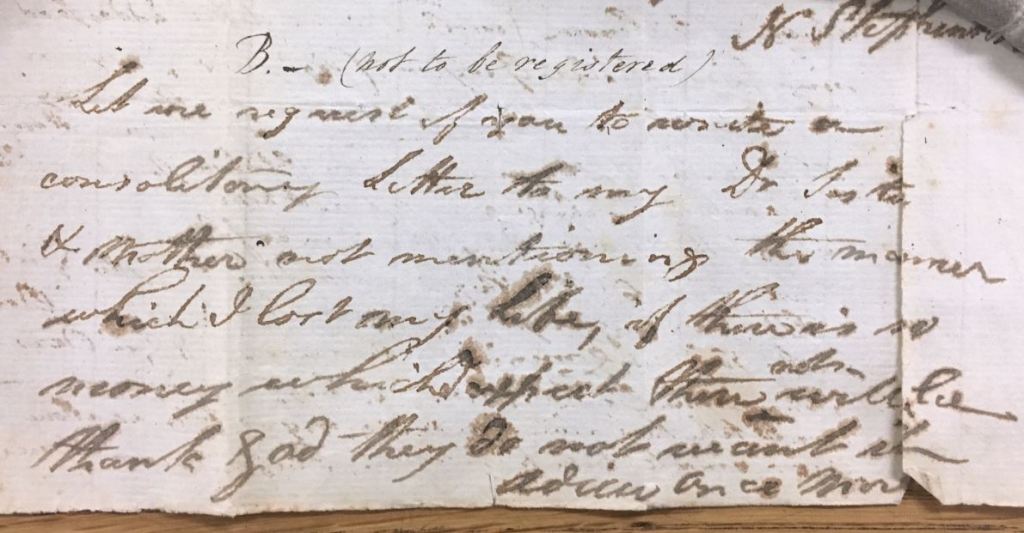
Norris was a Surgeon in the 15th Regiment of Foot and died while on active service in Surinam in February 1806: his will was proved at the Prerogative Court of Canterbury in September 1808. The bundle of documents that makes up his original will comprises three separate documents and on one of these there are two notes (labelled A and B) next to which someone has written the words, ‘not to be registered’. The second of these notes adds considerably to the story of Norris’s life and death:

Let me request of you to write a consolitory [sic] Letter to my D[ea]r. Sister[s] & Mother not mentioning the manner which I lost my Life, if there is no money which it appears there will not be thank God they do not want it.
Adieu once more.

Norris Stephenson died a horrible death from dysentry and evidently didn’t want his sisters and his mother to know. If all we had was the registered copy of the will, this fascinating detail would have been lost.

Due to the manner in which original wills tended to be stored (not quite to the standards that we might expect in a modern archive!) the documents can often be in a poor condition: mould, water damage, rodent/insect damage and even fire could all contribute to the less-than-perfect preservation of our ancestors’ original wills. Charles Dickens, who had an interest in these matters described the offices of the Prerogative Court of Canterbury as:

… an accidental building, never designed for the purpose, leased by the registrars for their Own private emolument, unsafe, not even ascertained to be fire-proof, choked with the important documents it held, and positively, from the roof to the basement, a mercenary speculation of the registrars, who took great fees from the public, and crammed the public’s wills away anyhow and anywhere, having no other object than to get rid of them cheaply … That, perhaps, in short, this Prerogative Office of the diocese of Canterbury was altogether such a pestilent job, and such a pernicious absurdity, that but for its being squeezed away in a corner of St. Paul’s Churchyard, which few people knew, it must have been turned completely inside out, and upside down, long ago.

David Copperfield by Charles Dickens (1850) Chapter 33

Thankfully, where an original will is damaged (or entirely) missing, it should, in theory at least, be possible to track down the registered copy – registers, by their very nature being more resistant to the ravages of time are more likely to have survived in (relatively) good condition.

Original will of John Wingfield of Rickmansworth, Archdeaconry of St Albans, 1636
Hertfordshire Archives & Local Studies reference: 78AW26
Registered will of John Wingfield of Rickmansworth, Archdeaconry of St Albans, 1636
Hertfordshire Archives & Local Studies reference: 8AR274

And even if the original will has survived intact, the way that they were written, with frequent additions and corrections, and occasionally large chunks of text inserted between two existing lines, can lead to some words and sections being effectively illegible. Again, the registered copy is our friend here.

Of course, in many cases, the two copies will turn out to be effectively identical – and it’s true that tracking down the ‘second’ copy might not prove too straighforward, probably involving a trip to the relevant record office. But even if the potential for a successful discovery is limited, it’s surely always worth checking – you just never know what you might find.

© David Annal, Lifelines Research, 19 February 2022

Posted in Document Sources, research | Tagged , , , , , | 8 Comments

When Digitisation Goes Bad Part II: Death’s Apprentice

or…Just When You Thought It Was Safe To Go Back Onto The Internet

This is the second part of a blog post looking at some particularly bad examples of digitisation in the world of family history research. In the first part I looked at some of the shortcomings of Findmypast’s Index To Death Duty Registers 1796-1903.

To my mind, when it comes to commercial digitisation projects, the main purpose of transcribing the data from historical records is to create a way into the documents themselves. Essentially, the transcript should be a finding aid, ideally, linked to digital images of the documents, thus allowing the user to work out for themselves what the particular entry is telling them. As a rule, I’m not too bothered about how accurate the actual transcription is. As anyone who has ever attempted the task will tell you, reading and interpreting large chunks of old handwriting with anything approaching 100% accuracy is a pipedream: there are simply too many instances when the handwriting is illegible, either due to the (lack of) skill of the original writer or because the document is badly damaged, soiled or faded.

Of course, the more accurate the transcription the better, but I always feel that as long as it’s of a reasonably good standard, a good, powerful, flexible search engine will get around most difficulties and enable us to find just about everything that we’re looking for. And if that fails, the ability to browse through the document, page-by-page, is a useful asset.

What’s more important is that the people behind the transcription and the digitisation project as a whole, have a good grasp of what it is they’re dealing with; that they understand the different types of document that make up the collection and how the format and content of those documents might change over time.

Unfortunately, Ancestry’s London, England, Freedom of the City Admission Papers, 1681-1930 database is a good example of a database over which those responsible for digitising the records appear to have had little or no intellectual control.

The original records are held by the London Metropolitan Archives and were digitised by Ancestry in 2010. It’s a truly remarkable collection of documents recording the admission of nearly 250,000 men (and some women) to the prestigious ‘Freedom’ of the City of London. Attaining the privileges that the Freedom granted you was essential for anyone who wished to trade within the City and the records created during the process can be enormously useful for anyone researching ancestors who lived and worked within the ‘Square Mile’.

The Admission Papers form one of several collections relating to the Freedom of the City. They are by far the most important (genealogically speaking) and the others are not available online. They are also a complex and disparate collection of records.

Essentially, there were three ways of becoming a Freeman of the City:

  • by servitude (i.e. after completing an apprenticeship – usually of 7 years)
  • by patrimony (i.e. as the legitimate child of a Freeman, born after their parent was admitted)
  • by redemption or purchase (i.e. by paying a sum of money)

The collection of Admission Papers comprises records relating to all three types of admission – records which differ significantly in content. Across the three we can find a wide range of details being recorded, including the following:

  • Name
  • Date of birth
  • Residence
  • Occupation
  • Father’s name
  • Father’s residence
  • Father’s occupation
  • Date of father’s admission
  • Master’s name
  • Livery Company
  • Date of apprenticeship
  • Date of admission
  • Means of admission

It’s not difficult to see how rich a source of genealogical data the records represent: plenty of names, relationships, dates and places – the bedrock of family history research.

Let’s have a look at how Ancestry has dealt with it all…

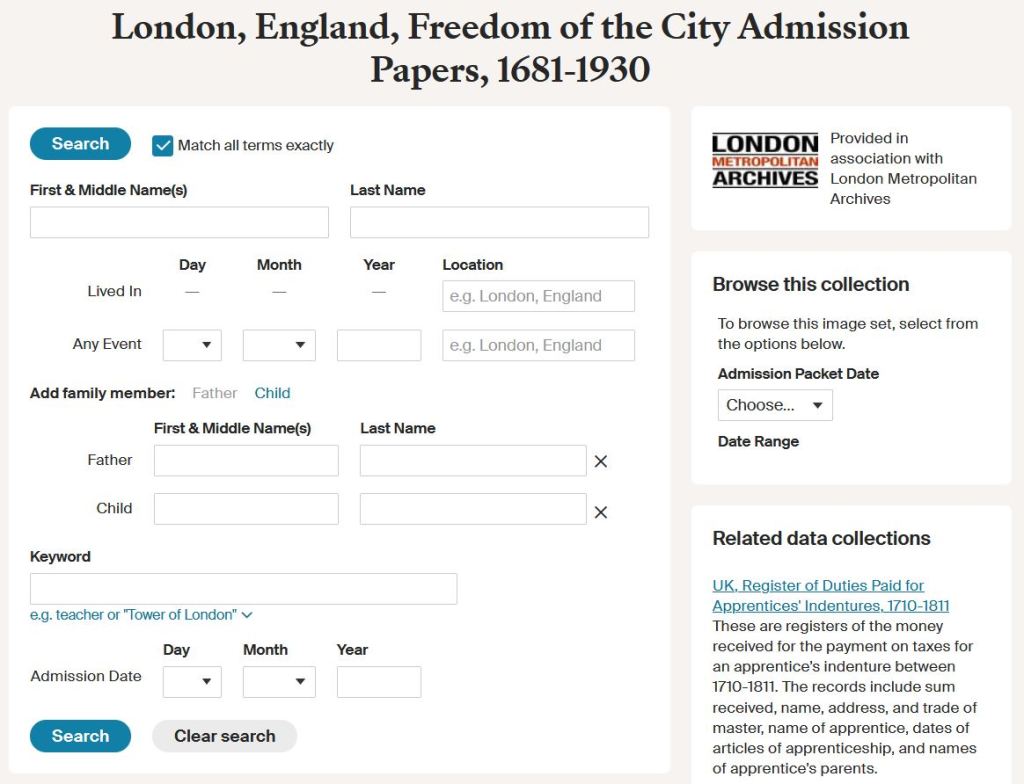
Ancestry’s search screen for the London, England, Freedom of the City Admission Papers, 1681-1930 database

The search screen includes many of the standard Ancestry fields but when it comes to dates, the only two fields available are the ubiquitous ‘Any Event’ and the ‘custom’ Admission Date. The Father and Child fields are also available to us, as well as the always-useful ‘Keyword’ option.

The search results include the following pieces of data:

  • Name
  • Birth Date
  • Admission Date
  • Master
  • Father

Let’s see what happens when we run a typical search.

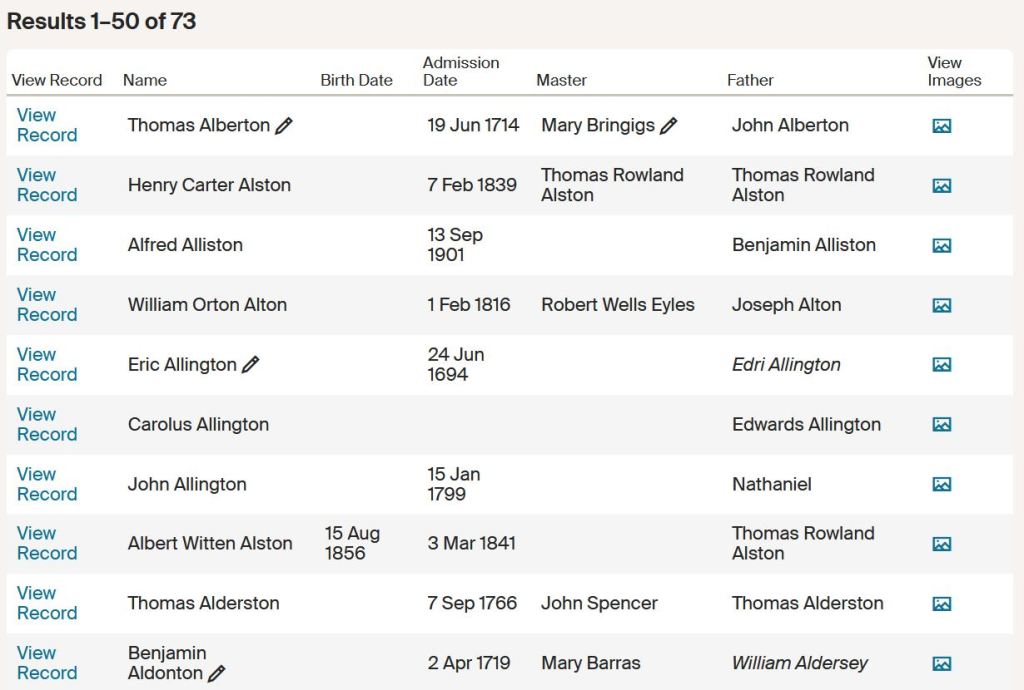
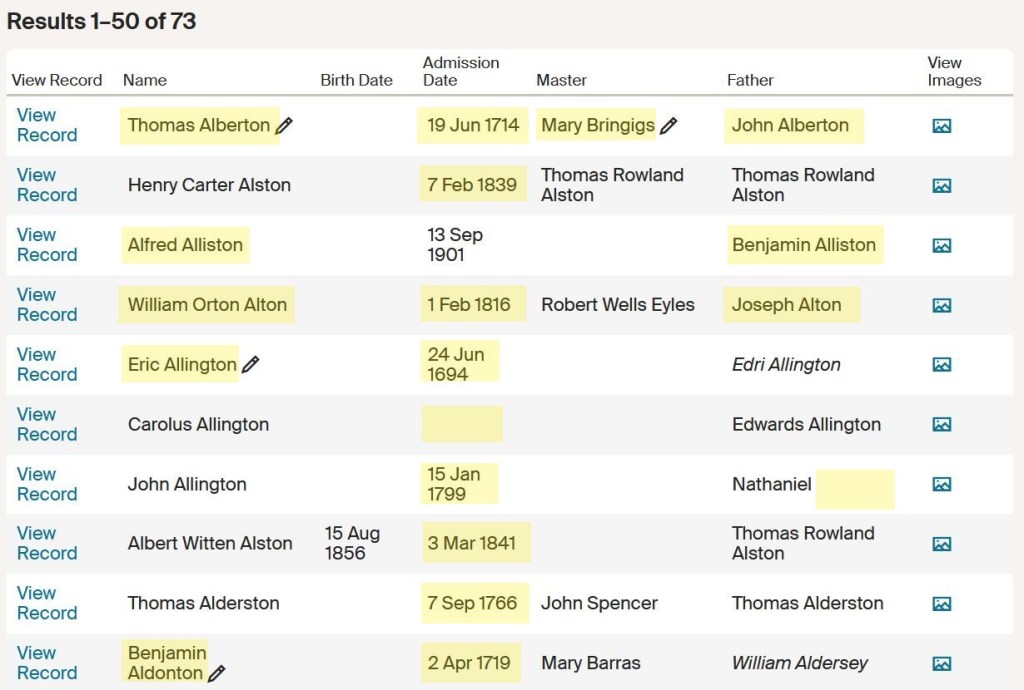
Search results from London, England, Freedom of the City Admission Papers, 1681-1930 database
Search was for the surname Al*ton

A quick glance at the results page doesn’t exactly fill you with confidence! The significant number of ‘corrected entries and the disjointed nature of some of the data are sure signs that all is not well. And a deeper look reveals the true horror of it all…

After looking at each of the ten records and abstracting the relevant data, I was able to come up with an ‘improved’ results page, sticking to Ancestry’s choice of fields:

An example of what Ancestry’s search results might look like with a more accurate version of the index.

So, let’s have another look at the original Ancestry results. I’ve highlighted the fields which contain errors but perhaps it would have been easier to highlight those that don’t contain any. It is absolutely riddled with them!

Search results from London, England, Freedom of the City Admission Papers, 1681-1930 database
Data errors highlighted in yellow

As I mentioned earlier, I’m not that bothered about the odd transcription error here and there, and a few of the ones in this little sample are, admittedly, quite minor. Transcribing names where the original is in Latin is always going to be a challenge but (sorry to repeat myself but it needs to be said!) as the main purpose of an index like this should be to create a finding aid, it would seem like a sensible policy to ‘translate’ the names into English. So ‘Edri’ should really be Edward and Carolus should be Charles. At least it seems that Ancestry have treated these names as ‘variants’ of the English name so a search for ‘Charles Allington’ will find the entry for ‘Carolus’. Some of the data has already been corrected by other users so if we’re just looking at the names, it shouldn’t, in theory, be too difficult to find most of these entries.

But there’s something working against us here: and it’s the data in the field headed ‘Date of admission’. As you will see, eight of the ten dates in our sample are wrong (one of them suggests that the freeman in question was admitted 15 years before he was born!) and one of them has no data recorded at all. Nine of them are therefore ‘wrong’ – and the bad news is that this sample is representative of the whole database…

It’s clear to me that Ancestry have failed to understand the records here. Because in most cases, the date of admission isn’t actually recorded on the document itself: instead, it can be discerned from the handwritten reference (usually on the back of the document) and from the description of the bundle of documents (either a range of dates or a particular month). But this data hasn’t been captured by Ancestry.

The date that Ancestry have recorded as the date of admission, is actually, in most cases, the date of the apprenticeship, which is usually about ten years earlier than the date of admission – and the admission date can be significantly later. On average, the dates given here as the date of admission are 12.3 years out from the actual date.

Dates of birth are only rarely recorded so it seems strange to show this data in the results field. What would perhaps be more useful would be to record the date of apprenticeship. Well over half of those admitted had served apprenticeships and as most boys were apprenticed when they were 14 we can estimate their likely dates of birth from this information.

It would also be good to know where the apprentices were from, so the father’s residence would be a useful addition and it would be nice to include the name of the livery company (and to be able to search on this data!). So, if things were being done properly, we could have an index that looks something like this:

What a truly useful version of the index might look like

You might argue that a bad index is better than no index at all and I agree … to a point. But the problem is that by creating these indexes the websites involved have made it extremely unlikely that the records will ever be properly indexed by people who really understand the documents in question. And that’s a real shame…

© David Annal, Lifelines Research, 27 January 2022

Posted in digitisation, Document Sources, research, Soapbox | Tagged , , , , , , | 1 Comment

When Digitisation Goes Bad Part I: The Night Of The Living Death Duties

This is the first part of the latest in a series of blog posts looking at the some of the problems behind the way that we access family history sources via the major commercial websites.

In previous posts I’ve looked at the dangers inherent in blindly following hints; I’ve considered the question of how complete the various countywide parish register collections are; I’ve asked why the commercial websites seem to be incapable of correctly describing the documents in their databases; and I’ve examined Ancestry’s apparent unwillingness to distinguish between user submitted content and original source material.

Now I want to consider another area of concern by taking a close look at a couple of databases (one on Findmypast (FMP) and one on Ancestry – I always like to be fair in these matters!) where the commercial websites involved in the digitisation of a particular set of records have done a particularly bad job of it all. Also, in both cases the databases include some significant data which is just wrong…

We’ll start with Findmypast’s Index To Death Duty Registers 1796-1903.

The Death Duty registers and related documents are an exceptionally useful set of records (they would have been even more useful but for the actions of Lord Denning!). They record the payments of a series of taxes (Legacy Duty, Succession Duty and Estate Duty) payable on the estates of people who died while domiciled in England and Wales between 1796 and 1903. The registers were created and maintained by clerks at the Stamp Office (later the Inland Revenue) using details submitted to them by clerks at the various probate courts. Before 1812 the probate courts sent an abstract of the details on a pre-printed form: after that, copies of the original wills or grants of letters of administration were sent to the Stamp Office.

They are undoubtedly a complex set of records and prior to the Findmypast digitisation, access to them was severely restricted: essentially, you had to be able to make a visit to the National Archives (TNA) at Kew, where you could view the registers, along with their associated finding aids, either on microfilm (pre-1858) or as original documents.

The agreement between TNA and FMP was to digitise the contemporaneous indexes (properly known as ‘alphabets’) rather than the registers themselves: a disappointing, although understandable decision, as the alphabets had already been microfilmed while nearly half of the registers remain unfilmed.

The format of the alphabets changed over the 108 years during which the register system was in place. The following details were recorded:

Details recorded in Death Duty ‘alphabets’ over time

This is, by necessity, somewhat over-simplified – the headings, for example, changed over the years and the terms ‘testator’ and ‘executor’ were substituted by ‘intestate’ and ‘administrator’ in the case of letters of administration.

Findmypast’s Index To Death Duty Registers 1796-1903 offers the following searchable fields:

  • First name(s)
  • Surname
  • Year
  • County
  • Court

The always-useful ‘Optional keywords’ field is also available.

Findmypast’s search screen for the Index To Death Duty Registers 1796-1903 database

Search results are returned under the five headings/fields listed above with the addition of the ‘Residence’. The transcription also includes the TNA reference to the document. In essence, this seems like a fairly reasonable approach. However…

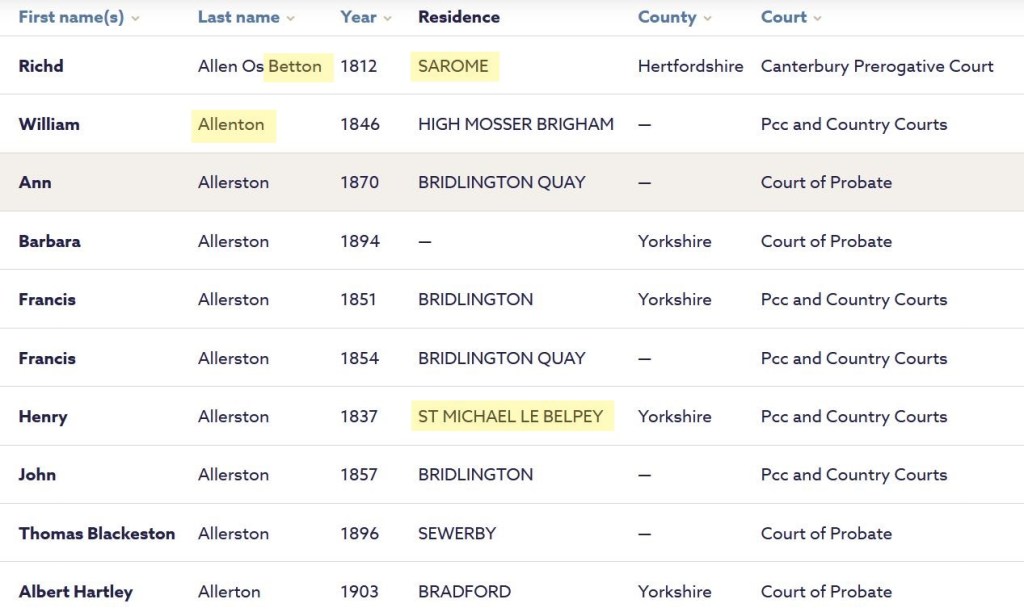
Search results from Findmypast’s Index to Death Duty Registers, 1796-1903
Search was for the surname Al*ton

… as a brief glance at just about any page of results will tell you, the quality of the data in the index leaves a lot to be desired. Let’s take a closer look at the entries on the list here. In addition to the mis-transcriptions (there are four of them in the ten records on the list, highlighted above), the entries in the alphabets also provide useful information which doesn’t appear in the FMP index.

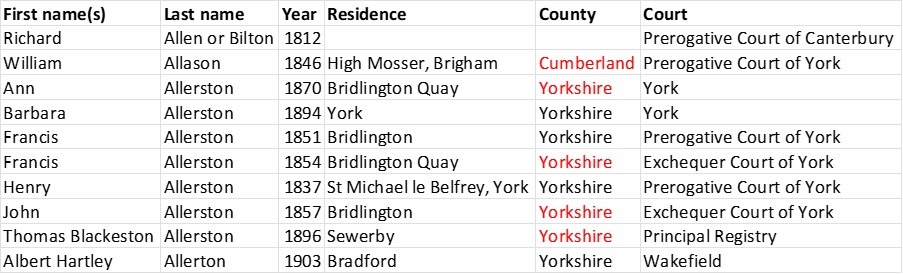
We can quickly update the Findmypast index to look something like this:

An example of what Findmypast’s search results might look like with a more accurate version of the index.

I’ve added the counties for the five entries (in red) where no county was given by Findmypast. In fact, the format of the ‘Residence’ data recorded in the alphabets is unstructured and Findmypast have merely attempted to make the information fit with their standard placename ‘fields’ set up – i.e. ‘place’ (usually the name of a parish) and ‘county’. Here, if no county was explicitly recorded, Findmypast have left that field blank.

Again, this would seem like a sensible approach to take, except for one very important point. As ‘county’ is the only ‘place’ field explicitly available for us to search on (you can use the ‘Optional keywords’ field but this is not something that would be obvious to inexperienced researchers) the only way for us to narrow down a search is to use the county option.

And the problem with this is that if you do select a county you are effectively eliminating not only those entries which record counties other than the one you’ve selected, but also all the entries which don’t record a county at all. The result of this is that if you search for the surname ALLERSTON with the county Yorkshire selected, you will get the following results:

Search results from Findmypast’s Index to Death Duty Registers, 1796-1903
Search was for the surname Allerston with the county set to Yorkshire

A bit of research will quickly tell us (based on the information in the ‘Residence’ field on the original search) that the other four ALLERSTONs on our original list were also from Yorkshire (this is NOT specified in the original data), but by entering the county that we’re looking for we’re actually eliminating these entries from the results!

We also need to be aware that the information recorded under the Court heading is taken, not from the individual entries (as you might think would be logical) but from the archival description of the individual document – thus, we get the quite meaningless ‘Court of Probate’ – so in most cases, this information isn’t as specific as it could be. This is particularly true of the details shown in the index for the pre-1858 ecclesiastical courts,

But the biggest problem with the whole of this digitisation project is that a significant amount of the data is actually completely wrong.

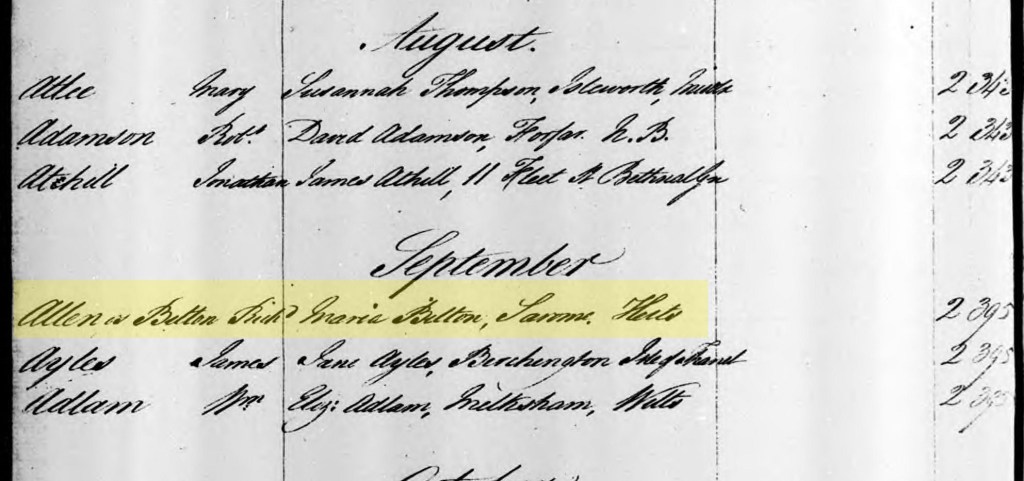
You might have noticed that in the 1812 entry for Richard ALLEN or BILTON (mistranscribed as BETTON in the Findmypast index) his ‘Residence’ was recorded as Sarome, Hertfordshire. (It’s actually Sacome but let’s not worry too much about that.) However, if you look at the entry in the alphabet, you’ll see that, the only residence recorded is that of Maria BILTON, the administrator: Richard’s residence is not recorded.

Board of Inland Revenue and predecessors: Estate Duty Office and predecessors: Indexes to Registers of Legacy Duty, Succession Duty and Estate Duty. Prerogative Court of Canterbury: administrations, 1812
The National Archives reference: IR 27/21. Accessed via Findmypast

This was, in fact, the case with all of the records between 1812 and 1834. During this period the alphabets record the residence of the executor/administrator, NOT that of the testator/intestate. Additionally, none of the registers relating to letters of administration between 1835 and 1863 record the residence of the intestate (those for the years between 1864 and 1881 are missing).

Let’s try to quantify the extent of this problem…

In the 23-year period between 1812 and 1834, there are nearly 500,000 entries in the database. It’s difficult to come up with an accurate figure for the administrations but there were probably somewhere around 100,000 between 1835 and 1863. So, for approximately 600,000 entries (roughly 18% of the total), no residence is given for the testator/intestate. And yet, a residence for teh testator/intestate is shown in the index against these entries.

Of course, in many cases, the testator/intestate and the executor/administrator are from the same place but clearly this isn’t always going to be true. Indeed, a quick check of a few pages from the 1835 alphabets suggests that we’re looking at somewhere between a third and a half of the testators and executors NOT coming from the same place. In other words, it could be that as much as 10% of the data in the ‘Residence’ field across the whole database is inaccurate! Even a conservative estimate would place the figure at over 5%. And this is NOT because the data has been mis-transcribed but because those responsible for the digitisation project have failed to understand the records that they’re digitising.

To my mind, this is simply not good enough.

In the second part of this blog post, I’ll consider Ancestry’s London, England, Freedom of the City Admission Papers, 1681-1930 database and its many shortcomings.

© David Annal, Lifelines Research, 23 January 2022
Posted in digitisation, Document Sources, research, Soapbox | Tagged , , , , , , | 4 Comments

Please Release Me…

…being a very brief history of the releases of the English & Welsh census returns.

We need to understand right from the start that the primary purpose of the census has never been to produce a resource for the benefit of family historians. It may sometimes seem that way, but the aim has always been to gather statistical data about the state of the nation. The fact that, since 1841, the legislation behind the censuses has included instructions to record the names and other details of the individual inhabitants of the country – and that those returns have (largely) survived – is merely our good fortune.

It took a long time for public interest in the census returns to grow. One of the driving forces behind the eventual release of the 1841 and 1851 returns was the introduction of Old Age Pensions in 1908. Realising that those who were born before 1837 might have no legal record of their birth, the Registrar General had allowed limited access to claimants who needed proof of age. But it wasn’t until the recently-formed Society of Genealogists started to exert pressure on the government, that the enumeration books were made openly available in 1912, for a fee (and only to those in possession of a ‘Student’s Ticket’, issued on the recommendation of a ‘person of recognised position’), at the Public Record Office (PRO) in Chancery Lane.

View of the Public Record Office, Chancery Lane.
Henry William Brewer (1895)

The fees were eventually abolished in 1952 and a project to microfilm the returns (in association with the Church of Latter Day Saints) began in 1956 but the next major event in the story was the release of the 1861 census returns – which didn’t happen until November 1962.

In 1968 a new census reading room was opened in the Land Registry building in Portugal Street, just around the corner from the main PRO building in Chancery Lane and this is where we accessed the census returns (now exclusively on microfilm) until 1991.

The 1871 and 1881 censuses were released to the public in 1972 and 1982 respectively and the microfilms were by now accompanied by street indexes covering the larger towns.

Also from 1972, the Registrar General began to offer limited searches in the 1881, 1891 and 1901 census, through which the ages and places of birth of named individuals at specified addresses would be provided – again, for a fee.

A lot of indexing work, particularly with the 1851 census, had been carried out by local and family history societies over the years but in 1985 a far more ambitious project was launched. With the Church of Latter Day Saints and the Federation of Family History Societies (now the Family History Federation) at the helm, the aim of the project was to produce a comprehensive index to the recently-released 1881 census returns. The project was completed in 1996 and, in many ways, changed the landscape of family history research in this country.

Meanwhile, the 1891 census returns had been released in January 1992, with the PRO moving its census reading rooms back into the main building in Chancery Lane. The returns were released for the first time on microfiche but the primary means of access was still a set of paper finding aids, including the now traditional street indexes for the larger towns and cities.

This was all to change with the release of the 1901 census. The PRO took the ground-breaking decision to release the returns digitally, online and, lacking the financial resources to do the work ‘in house’, entered into a partnership with a commercial company. This, remember, was before the days of Ancestry, Findmypast and the other major commercial genealogical websites and we were very much entering into the unknown as far as projects of this kind were concerned.

I say ‘we’ because, by now, I was working for the PRO at the then recently-opened Family Records Centre (FRC) in Myddleton Street, Clerkenwell. The decision had been made to provide free onsite access to the returns (along with the relevant paper finding aids) at the Public Record Office’s building in Kew (Chancery Lane had closed in 1996) with access to the online system provided (on a pay-per-view basis) on computers at the FRC, as well as (in theory at least!) at home on your own PC, 24 hours a day.

The site of the former Family Records Centre

I won’t say too much about the reality of the big launch on 2 January 2002 – let’s just say that it was – eventually! – a success, but that it took about ten months for it all to get up and running smoothly.

The pattern of releasing the decennial censuses in the January after the 100th anniversary of the returns had been well established (since the release of the 1871 census anyway) but now, as the result of a Freedom of Information request in 2006, the government ordered that the 1911 census returns should be released as soon as feasible, ‘with the exception of that considered to be sensitive personal information’.

Accordingly, the partially-redacted returns were made available online from January 2009 on a pay-per-view basis. The project was completed the following year. Access to the 1911 census was free onsite at Kew as well as at seven other institutions around the country: for the first time, there was no physical/microform access to the returns.

Much the same approach was taken with the 1921 census release yesterday. This was the first census return to be taken under the terms of the 1920 Census Act which specified that the records should be closed for 100 years and therefore protected them from any potential challenge under the Freedom of Information Act.

In every case since the release of the 1861 census in 1962, the PRO (now the National Archives) has made the returns available free of charge onsite. This is what they’ve done this time by providing free online access at Kew. And since the release of the 1901 census, we’ve had the additional opportunity to access the returns online from the comfort of our own homes – for a fee.

It would be great if we lived in a world where a benevolent government saw fit to make the returns available online free of charge as a public service – but I suspect that there might be an outcry from people who have no interest in family history (yes, such people exist!) and questions might be asked about where the funding was coming from. So, back in the real world, we have to accept that the National Archives, as custodians of the records, have to get into bed with a commercial partner to allow them to deliver this added value service. And we have to accept that that commercial partner will want to cover and recoup the not-inconsiderable costs involved in making the records – fully indexed and digitised – available to us all.

In the fulness of time, as was the case with the 1901 and 1911 censuses, and with the 1939 National Register (“like a census but not a census” © Audrey Collins), the 1921 census returns will, no doubt, become part of the standard subscription packages on Findmypast and (I haven’t read the contract so I don’t know when this will happen) will almost certainly be made available via Ancestry and other providers.

In the meantime, I don’t personally think that £3.50 is a particularly excessive fee. Most of us probably don’t have more than about ten families to look for and we’d probably be happy to spend £35 on a night out (remember those?). Or, we have the choice of visiting the National Archives at Kew, the Manchester Central Library or the National Library of Wales where we can access the returns for free and download images to our heart’s content! Or we can just wait…

The 1921 census for England and Wales is available online at: https://www.findmypast.co.uk/1921-census

Further reading: Diary of a Genalogist by Anthony J Camp https://anthonyjcamp.com/

© David Annal, Lifelines Research, 7 January 2022

Posted in Local History, research, Soapbox | Tagged , , , , , , , , , | 6 Comments

The Respectable Printer Of The Times

This is the second part of the story of John Joseph Lawson, printer of The Times. In the first part, A Gross And Scandalous Libel, I covered his ‘trial’ in the House of Lords in 1831. In Part 2, I’m looking at a later trial in which John Joseph was once more thrust unwillingly into the limelight.

Throughout the 1830s a number of civil cases were brought against John Joseph Lawson, the printer of The Times, with Lawson sometimes being found guilty and fined, and sometimes being acquitted. Then towards the end of 1838 John Joseph found himself in court again for publishing libellous material. And this time it was a criminal trial – apparently the first time for 40 years that a criminal trial against The Times for libel had been brought before a jury.

The offending article had been published on 9 March 1838 but it wasn’t until 19 December that the case came to trial at the Court of Queen’s Bench. The article in question related to some recent financial dealings of “a certain newly-created Baronet”, and while naming no names, it left little room for doubt that ‘the Baronet’ was Sir John Conroy. Conroy felt that the article “conveyed a most serious imputation” on his “honour and integrity” and accused The Times (or rather, its printer, John Joseph Lawson) of publishing a “false, scandalous, and malicious libel”.

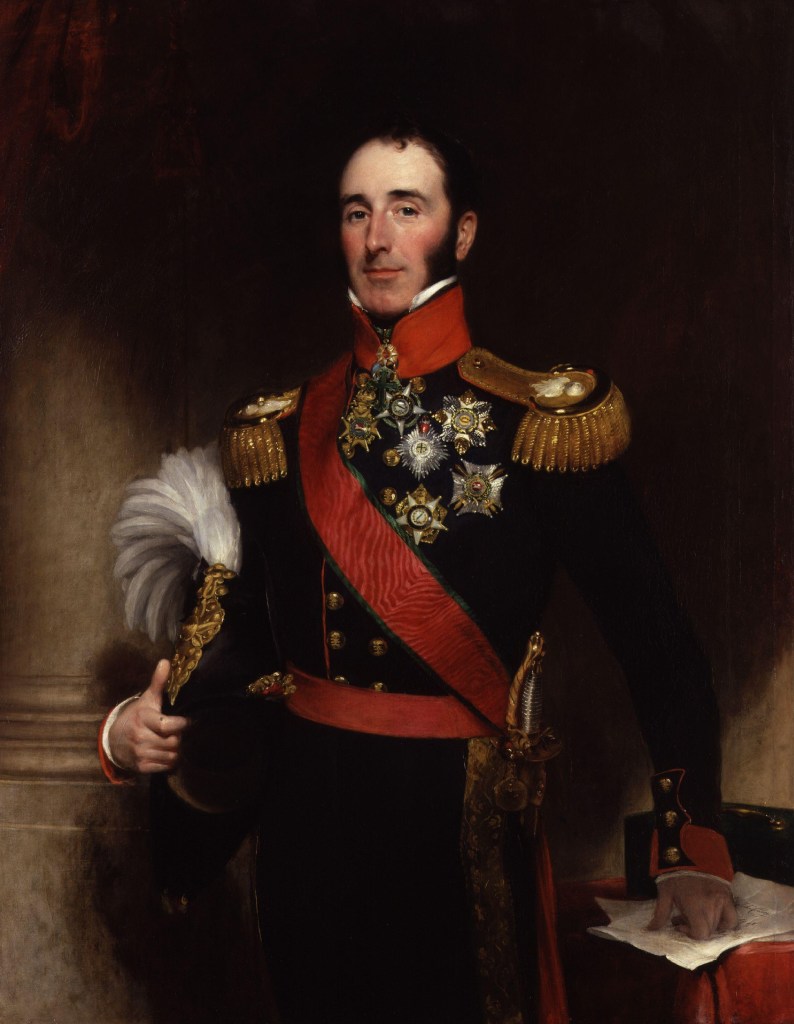
Sir John Conroy, 1st Bt by Henry William Pickersgill, 1837. National Portrait Gallery, London. Public domain.

Frederic Thesiger, acting for the prosecution, began by addressing the jury and the crowded courtroom, informing them that Conroy had served as a military officer “for many years with fidelity and integrity” before being appointed to a trusted role within the Royal Household and that it was “quite in the nature of things that from the position that [he] was placed in … he should excite a great number of enemies”. Foremost among those enemies was what Thesiger described as “one of the most formidable engines of annoyance” – i.e., the Press. Thesiger claimed that Conroy had “for many years … found himself the object of severe censure and malicious inuendos” which were “of so vague and general a character, as to be perfectly harmless”. The piece published in The Times in March 1838, however, was of a different nature, and Conroy, it was argued, was now “compelled either to come into a Court of Justice or submit to the serious imputation cast upon him.”

The Attorney General (Lord Campbell), defending Lawson, began by asking why, if Sir John Conroy was so keen to clear his name, had he failed to turn up at court in person: he was apparently somewhere “in the neighbourhood of the Court”. Lord Campbell then attempted to demonstrate that the article didn’t actually constitute libel, claiming that it was “not at all charged or insinuated that Sir John Conroy abstracted the money, or that he made any improper use of it, or that he was guilty of any fraud or dishonesty”. He then finished by advising the jury to:

… hesitate long … before you will come to a verdict of guilty. What will be the consequence of such a verdict to my client, Mr Lawson, the respectable publisher of [The Times]? He would be subjected to a fine; but, much worse than that, he would be liable to be imprisoned by the sentence of the Court of Queen’s Bench, and sent to Newgate amongst common malefactors…

The Sun (London), 19 December 1838, page 3, column b

The judge (Lord Denman), told the jury that “the only question is as to the construction to be put upon this article – whether you think it carries against Sir John Conroy that imputation which he himself attributes to it, and which is now the foundation of the complaint he brings before you.”

John Joseph Lawson had pleaded “not guilty” to the charge. There’s no evidence in the various reports published at the time that he personally took the stand but my distant cousin would clearly have been present in court throughout the trial. He must have sat with an increasing feeling of impending doom as the judge completed his summing up.

… the only observation with which I have to conclude … is, that juries in these cases are the sole judges on whose judgment alone must depend in every instance the question, aye or no, is the party guilty of the libel which the prosecution charges against him? If that be so in this case, you will return a verdict of guilty; if you think it otherwise, you will acquit the defendant.

His worst fears were quickly realised as the jury returned a guilty verdict “without quitting the box…”

John Joseph Lawson then had a lengthy wait before sentencing. It wasn’t until 30 January 1839 that he was back at the Court of Queen’s Bench, before Lord Denman.

The Attorney General, acting again as chief counsel for the defence, said that Lawson “felt to a certain degree what he considered the hardship of the law as regarded himself”. Mr Platt, also speaking for the defence, commented that Lawson was “as innocent of the composition of this matter as the persons who had laid the types for printing the paragraph.”

The prosecution however, demanded a “severe punishment”. Mr Thesiger said that he had “listened in vain for even one slight expression of regret” on the part of the defendant.

The Judges then consulted, and Mr Justice Littledale made the final statement, pointing out that as the printer of the paper, Lawson had:

… had the opportunity of seeing all that it was proposed to put into it. It was his duty, if he saw anything improper, to go to the editor, and if he persisted in inserting it, it was the defendant’s duty to resign.

The Sun (London), 30 January 1839, page 3, column 3

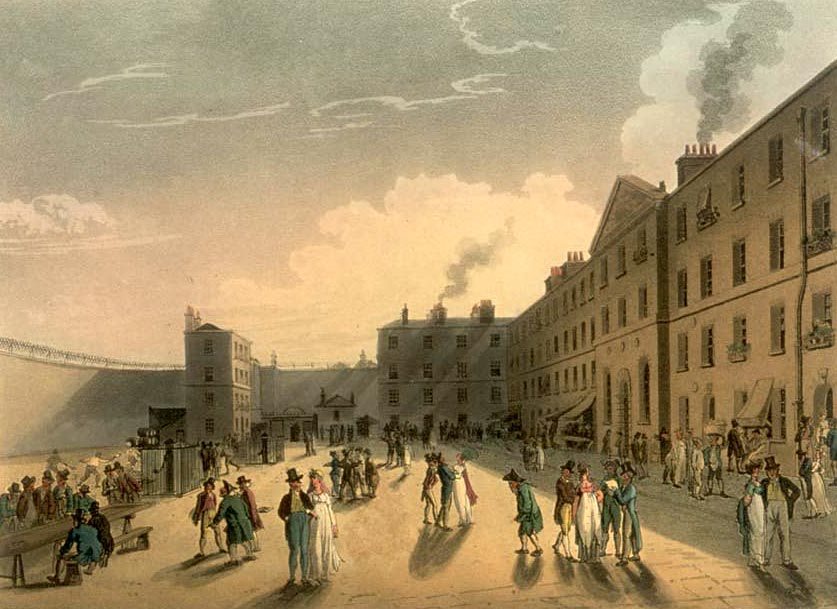
John Joseph Lawson wasn’t about to receive any sympathy from the judicial system. As far as the law was concerned, the buck stopped firmly at his door and sentence was duly passed: a fine of £200 and one month’s confinement in the Prison of the Queen’s Bench.

King’s Bench Prison (from 1837, Queen’s Bench Prison). King’s Bench Prison in London: originally published as Plate 9 of Microcosm of London (1809). Public domain.

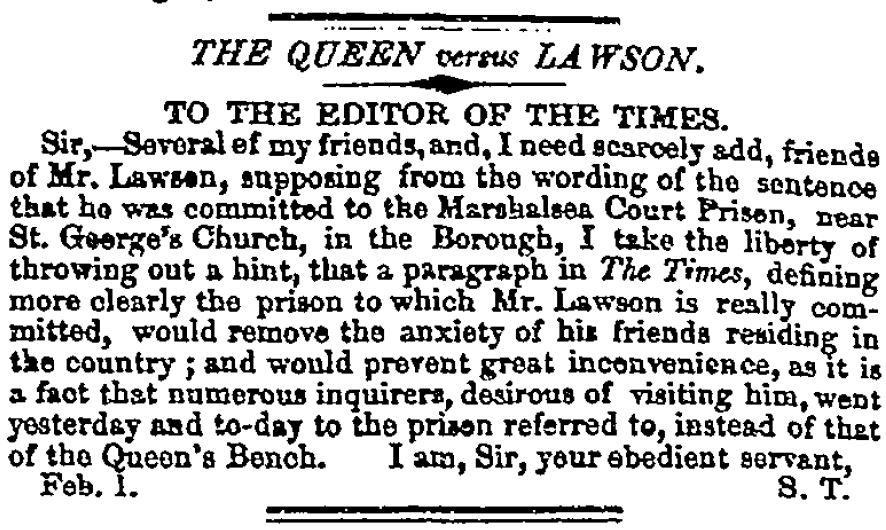
The fear that Lawson might end up in Newgate amongst the ‘common malefactors’ wasn’t realised, yet, initially, there was some confusion about where he had been imprisoned. Several newspapers reported, incorrectly, that he was in the custody of the Marshall of the Marshalsea Prison. An intriguing letter was published in The Times on Saturday 2 February (3 days after the date of John Joseph’s imprisonment):

Sir, – Several of my friends, and, I need scarcely add, friends
of Mr. Lawson, supposing from the wording of the sentence
that he was committed to the Marshalsea Court Prison, near
St. George’s Church, in the Borough, I take the liberty of
throwing out a hint, that a paragraph in The Times, defining
more clearly the prison to which Mr. Lawson is really com-
mitted, would remove the anxiety of his friends residing in
the country; and would prevent great inconvenience, as it is
a fact that numerous inquirers, desirous of visiting him, went
yesterday and to-day to the prison referred to, instead of that
of the Queen’s Bench. I am, Sir, your obedient servant,
   Feb. 1.                                                                               S. T.

The Times, Saturday, 2 February 1839, page 4, column e.
The Times Digital Archives

Apart from shedding some fascinating light on the story, my particular interest in this letter is in the identity of the semi-anonymous author. I feel quite sure that it was a man called Samuel Truman. Samuel was the first cousin of my great, great, great grandmother, Mary Ann Port and, more significantly, John Joseph Lawson’s maternal uncle. Following the death of John Joseph’s father in 1817, Samuel Truman appears to have taken on a parental role in the lives of his sisters’ children. He was a witness at John Joseph’s wedding in 1829 and as a senior official in the Stamp Office, he would have been well placed to offer the young family the appropriate support and advice. I certainly can’t think of anyone more likely to have written the letter.

On the Sunday before Lawson’s release, a large crowd gathered at the Queen’s Bench chapel. A short piece in The Times described the chapel as “literally thronged with his friends, anxious to pay him a mark of respect … it must have been truly gratifying to him to receive so handsome, so free, and so spontaneous a compliment from so many excellent friends.”

John Joseph Lawson was released from prison on Thursday 28 February. The libel cases continued to come thick and fast – another charge was brought while he was still in the custody of the Queen’s Bench! – but there were no more criminal trials, and, as far as I know my second cousin, four times removed, was never incarcerated again.

The reports of the trials give us fleeting glimpses of the man behind the name – John Joseph was, in some respects, a bit-part player in his own story – but we can begin to get the sense of a man of principle; a man who was prepared to do what had to be done to protect his colleagues and to defend the freedom and integrity of the Press.

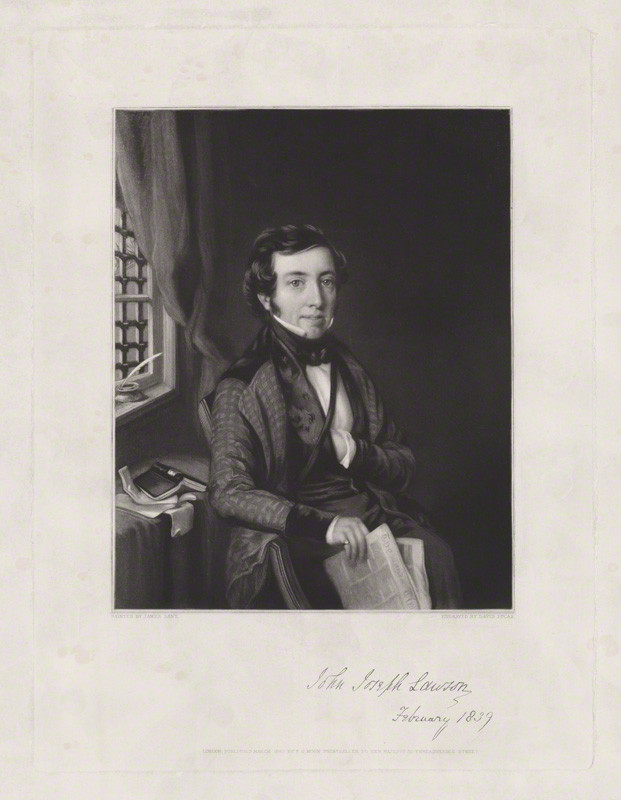
One thing I can say for certain about John Joseph Lawson is that he’s the only relative (that I’m aware of!) to have a portrait in the National Portrait Gallery.

What survives is a mezzotint print, published in 1840 by Sir Francis Graham Moon, printseller of 20 Threadneedle Street, London. It was engraved by David Lucas from an original 1839 painting by James Sant.

John Joseph Lawson by David Lucas, published by Sir Francis Graham Moon, 1st Bt, after James Sant, mezzotint, published March 1840. National Portrait Gallery, NPG D37224

I was delighted to find a contemporary ‘review’ of the print in the Literary Gazette:

A grated window and the interior of a prison, for the background of a picture, convey no very pleasant idea either of comfort or of tranquillity. Yet the features of the individual so situated suggest nothing like prison thoughts. On the contrary, the expression appears that of self-possession, perhaps that of self-gratulation; but our views of the print as a work of art are favourable, as a brilliant example of mezzotinto engraving, and a fair specimen of portraiture.

The Literary Gazette and Journal of the Belle Lettres, Saturday, 31 October 1840, p.709, column a

A facsimile of John Joseph Lawson’s signature together with the date February 1839 complete the print. The barred window, the prison interior and the date leave little room for doubt that the sitting for the original painting took place while James was incarcerated at the Queen’s Bench Prison.

And if I’m not greatly mistaken, the look on my cousin’s face is one of defiance. If it was a meme John Joseph might be saying, ‘Go on. What else have you got…?’

© David Annal, Lifelines Research, 30 December 2021

Posted in Document Sources, research, Stories | Tagged , , , , , , , , , , | 1 Comment

A Gross And Scandalous Libel

I was watching some old episodes of Who Do You Think You Are the other day and I was particularly taken by the one featuring Ian McKellen; as engaging, enthusiastic and warm a subject as you could possibly hope to have for the programme.

I found myself feeling quite moved by Sir Ian’s reaction to learning that an ancestor of his (Robert Lowes) had been instrumental in establishing the UK’s first regular workers’ half-holiday – although the claim that he had thereby invented the British weekend may have been a bit far-fetched!

This, I would argue, is the sort of ancestor that all serious family historians yearn to possess. Someone who left a mark, even if that mark is quite small; someone whose story tells us something about the person behind the name.

I have such a relative in my tree: a distant one, admittedly – a second cousin, four times removed – who was thrust into the limelight on a number of occasions in the 1830s and ‘40s and whose voice can be heard nearly 200 years later, thanks to some detailed contemporary accounts.

John Joseph Lawson was the second son, and third child of James Lawson and his wife Mary Ann Truman, born on 26 March 1802 at the family home in Fleet Street, London.

Fleet Street is, of course, well known as the home of the English printing industry so it’s perhaps not too surprising to hear that John Joseph’s father was involved in the trade. In fact, he was involved in a particularly significant role: that of printer of The Times.

I need to find out more about James Lawson’s time as printer of The Times. Most importantly, I need to find out when he first took on the role and I need to solve a particular mystery. A number of sources suggest that John Joseph took over as the newspaper’s printer following his father’s death in 1817. This clearly can’t be the case as John Joseph would only have been 15 at the time!

In fact, the earliest reference I’ve found to John Joseph working for The Times comes from a short piece in the Evening Mail, dated 24 April 1826. It’s also the first of many references to John Joseph being sued for libel. As the printer of the newspaper, it was he, and not the owner or the editor, who was legally liable for the content.

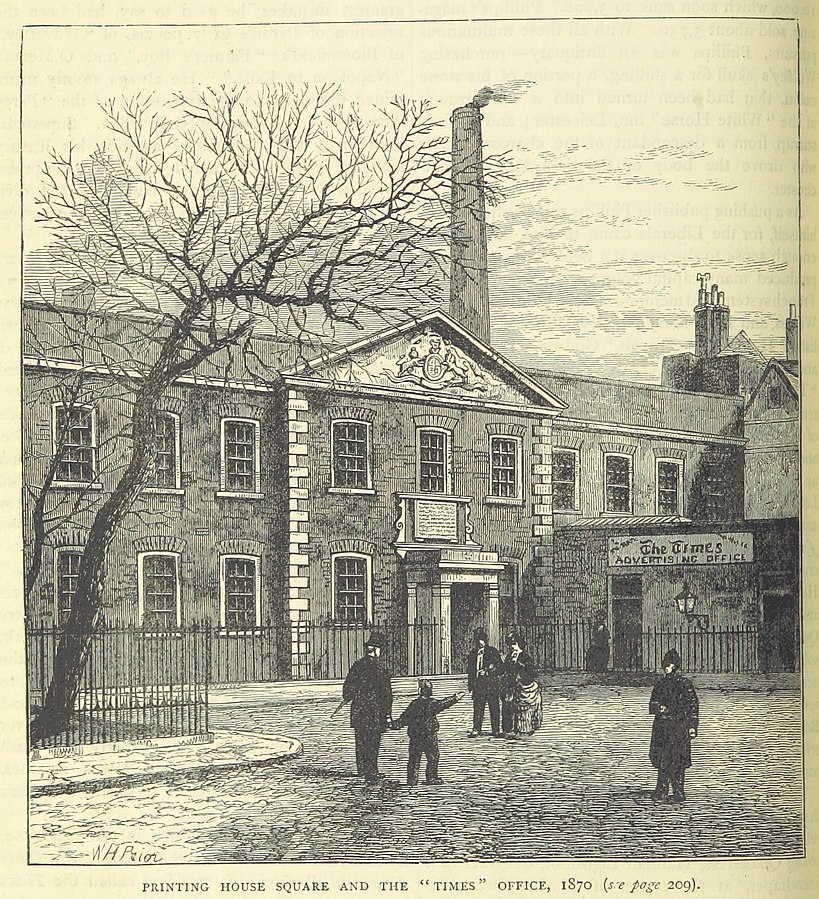
Printing House Square and The “Times” Office, 1870
British Library HMNTS 010349.l.1.
Image extracted from page 228 of volume 1 of Old and New London, Illustrated, by Walter Thornbury.
Original held and digitised by the British Library. Via Wikimedia Commons.

I’m planning to look at each of the cases in detail but there are two which are of particular interest.

The first of these stems from a debate in the House of Lords on 15 April 1831, concerning a petition which had been presented by the Earl of Roseberry, proposing the introduction of “a compulsory rate or tax upon land in Ireland, for the relief of the poor of that country”.

The Earl of Limerick, one of Ireland’s most prominent ‘absentee landlords’, was quick to offer his opposition to the “ludicrous petition” stating that he “would not be deterred … by the popular odium that might be cast upon him” as a result.

The ‘odium’ didn’t take long to appear. The following day The Times published a piece which we might call a ‘leader comment’ today, which began by suggesting that there were encouraging signs that “the resident gentry in some parts of Ireland” seemed to be moving in the right direction towards “bettering … the condition of the now unsettled poor.”

However, it was clear that the resistance to the idea of introducing a “rate or tax” was strong, particularly amongst Ireland’s absentee landlords. The piece went on to suggest that “the Irish gentleman shall not contribute a shilling to save the lives of those miserable beings whom his systematically selfish and rapacious policy has reduced to the lowest stage of destitution.”

Although the tone of the article was getting quite heated, there was nothing too controversial so far. But a particular phrase in the next paragraph appears to have lit the touch paper.

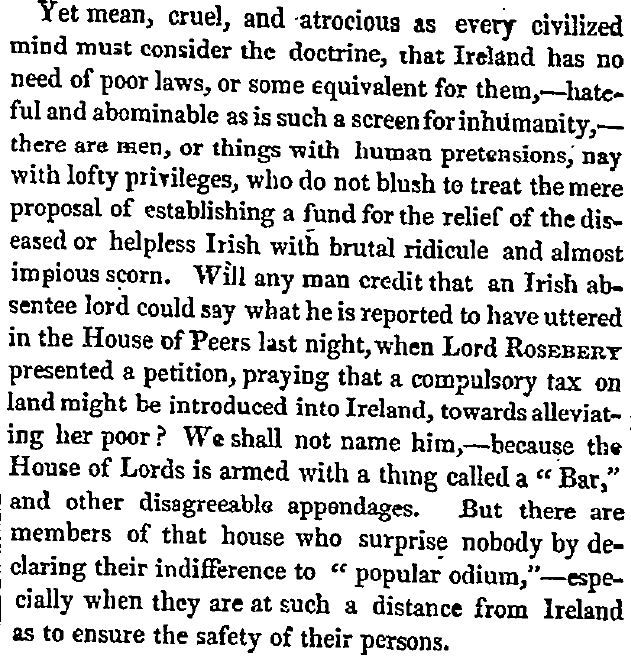
Yet mean, cruel and atrocious as every civilized mind must consider the doctrine, that Ireland has no need of poor laws, or some equivalent for them, – hateful and abominable as is such a screen for inhumanity, – there are men, or things with human pretensions, nay with lofty privileges, who do not blush to treat the mere proposal of establishing a fund for the relief of the diseased or helpless Irish with brutal ridicule and almost imperial scorn.

The Times, Saturday 16 April 1831, page 5, column c
The Times Digital Archive

The phrase, ‘men, or things with human pretensions’, was evidently too much for Lord Limerick, for, although the piece in The Times didn’t specifically name him, Limerick himself said that it “described him so that it was impossible for any person to doubt to whom the writer intended to apply his attack.”

After a short debate on 18 April, the House agreed “That the Printer of The Times be ordered to attend at the Bar of this House to-morrow”.

On Tuesday 19 April 1831, John Joseph Lawson, printer of The Times – and my distant cousin – was brought before the Bar of the House of Lords. He was asked to give his name and to confirm that he was the printer of The Times newspaper, and was then asked to withdraw from the Bar while the clerk read the offending paragraph to the House. Their Lordships then quickly “determined that the paragraph was a false and scandalous libel” after which Lawson was ordered to return to the Bar in order to face the charge. He was given the opportunity to speak in his own in defence and, while we don’t have a verbatim report of what he said, the following is a transcript of the report recorded in Hansard:

Mr. Lawson expressed his regret, that there should have appeared in The Times newspaper, of which he was the printer, any paragraph calculated to give offence either to their Lordships in general, or to any noble Earl in particular. Their Lordships must be aware, that owing to the rapidity with which a journal like The Times must be printed, and the multiplicity of articles which necessarily found their way into it, it was almost impossible for him, using every diligence in his power, to peruse every separate paragraph which appeared in the paper. The paragraph of which their Lordships complained, had found its way inadvertently into the paper, and he had only to repeat his deep regret that it had done so.

Hansard: House of Lords Sitting of 19 April 1831, Series 3 Vol. 3, cc1584-8

Lawson was asked if he had “supreme control of the paper of which he was the printer” to which he replied that he had not. He was then asked if he could name the person who was in “supreme control” but said that to do so would be a breach of trust to his employers. The Lord Chancellor told Lawson that he wasn’t obliged to answer any questions but that if he declined to do so, their Lordships would “form their own opinions as to his reasons for not answering such questions as might be put to him”. Lawson confirmed that he understood this at which point a “noble Lord” asked whether a gentleman “whose name he mentioned” was not the editor of The Times.

In Lawson’s reply to this we get a brief glimpse of his character:

Mr. Lawson replied, that this was only another mode of putting to him the last question; and therefore, with all respect to their Lordships, he must decline giving any answer to it.

He was not about to name names and, after refusing to answer further questions about the proprietors of the paper, he was once more ordered to withdraw. It was then moved that Lawson “having admitted himself to be the printer of a false and scandalous libel, which had appeared in The Times newspaper of the 16th instant, be fined £100 and committed to Newgate till the fine be paid.”

But before the motion could be voted on – the Lord Chancellor (Lord Brougham), the Duke of Wellington, the Marquis of Lansdown, and Earl Grey (the then-Prime Minister) had spoken out against it – an amendment was proposed and carried “that Mr. Lawson should be committed to the custody of the Usher of the Black Rod, and that he do attend their Lordships to-morrow morning at ten of the clock.”

John Joseph appears to have spent his night of incarceration in the House of Lords in composing a petition. This was presented to Lord King and read to the House the following day:

To the Right Honourable the Lords Spiritual and Temporal.
That your petitioner feels the sincerest regret at having given offence to your right honourable House, and to the Earl of Limerick in particular, and craves pardon for the same; and humbly begs, in consequence of this acknowledgment of his error and regret, he may be set at liberty by your right honourable House.
And your Petitioner will ever pray…
John Joseph Lawson.

Hansard: House of Lords Sitting of 20 April 1831, Series 3 Vol. 3, cc1701-19

There followed a lengthy, and somewhat heated, debate, largely relating to the question of whether the House of Lords did in fact have the powers to fine and/or imprison “offenders” and it was agreed that “the matter contained in this petition be taken into further consideration to-morrow.”

After spending another night in the cells, Lawson was once again brought before the Bar and was addressed directly by the Lord Chancellor.

John Joseph Lawson—the paragraph of which you have acknowledged yourself to be the printer and publisher, has been pronounced by the unanimous voice of this House to be a gross and scandalous libel upon Edmund Henry, Earl of Limerick, a Member of this House, and it has also been pronounced to be a high breach of the privileges of this House.

You have freely and at once acknowledged, that you are guilty of the offence: you have acknowledged that you are guilty in fact, by admitting that you are the publisher of the libel; and you have acknowledged that you are guilty in law and in substance, because you have expressed your contrition for that publication. You have also most amply, by petition, and in your own person at that bar, made submission to the House, and to the noble Earl who was the object of the slander. Moreover, you have suffered, not a long, but a close confinement, by the authority of this House, and in the custody of the officers of this House. For these reasons, and because the House is anxious to temper justice with mercy, their Lordships have thought proper to impose on me the painful duty—which I have now performed—of reprimanding you; and having thus reprimanded you, I have to tell you, that you will be forthwith discharged out of custody, upon payment of your fees.”

Hansard: House of Lords Sitting of 21 April 1831, Series 3 Vol. 3, cc1748-54

John Joseph’s short “close confinement” had lasted less than 48 hours but it must nevertheless have been an uncomfortable few nights for him.

Seven years later, Lawson was to become embroiled in another, more contentious libel case: a case which resulted in his spending a month in prison and one which I’ll look at in detail in my next blog post…

© David Annal, Lifelines Research, 28 December 2021

Posted in Document Sources, research, Stories | Tagged , , , , , , , | 1 Comment

You Don’t Know What You’ve Got…

I realise that I’m running the risk of sounding like a broken record here but it seems like there’s always something else to say when it comes to assessing the work of the major commercial genealogical websites.

Because it’s undeniable that, alongside the many clear and obvious benefits of digitisation there are a number of pitfalls. And one of the most striking of these is the way that the whole process of digitisation robs us of an important sense of context.

Context is vital in any type of historical research and when we’re handling original documents in an archive, we have a tangible and visual relationship with that document. We know what it is, partly thanks to the description in the archival catalogue but also because, in the majority of cases, the document does (or at least, is) exactly what it says on the tin. Somewhere, either on the cover, the spine or perhaps on an internal title page, the document will usually tell us what it is.

Ledger, Northampton General Lunatic Asylum – Northamptonshire Archives & Heritage

Even with microfilm and microfiche, there’s usually some sort of description of what it is we’re looking at written on a label on the outside of the microfilm box or on the little paper sleeve holding the fiche. And in both of these cases (although perhaps less so with microfiche), we get a sense of the physical structure of the document in question as we wind/scan through it.

With digitisation, however, we’re instantly dropped down on a particular page, somewhere in the middle of the document: the physical connection with the document has been almost entirely lost.

If we want to understand what the document is telling us about our ancestor (hint: we really do…) we are now largely reliant on the accuracy of the information captured as part of the digitisation process. Ideally, we would expect a good archival description of the document; some information about the larger collection of which it forms a part (i.e. the archival hierarchy to which it belongs); the archival reference to the specific document that we’re looking at, and a reference to the particular page (if it’s in a book or register) or individual item (if it’s part of a collection of loose papers).

Of course, we can usually browse through the digital images, or, in some cases, select a particular image number so that we can jump to a different part of the document and thereby, to some extent, recreate the process experienced by the previous generation of genealogists when using microform ‘surrogates’.

But I would argue that, while experienced researchers might instinctively pursue this as an option, when it comes to newcomers, this is not a concept that would instantly occur to them as something that’s going to add value to their research. The commercial websites are in the business of making it all sound as straightforward as possible. so they’re hardly about to encourage inexperienced researchers to embark on something as seemingly complex as this is.

So, you’d like to think that the descriptions of the documents and the archival details attached to each individual image would do the necessary job and do it well. But as I explained in my previous blog on the subject, this is, sadly, not always the case. What I want to do now is to illustrate the sorts of challenges that we’re up against, by taking a detailed look at the registers of one particular London parish and comparing the actual documents with their descriptions on the Ancestry website.

St Pancras is a vast ancient parish formerly on the outskirts of London but now very much part of the capital’s urban sprawl. The history of its churches is admittedly confusing as two different buildings, situated in different places, have served as the parish church. And both of them are still in existence today.

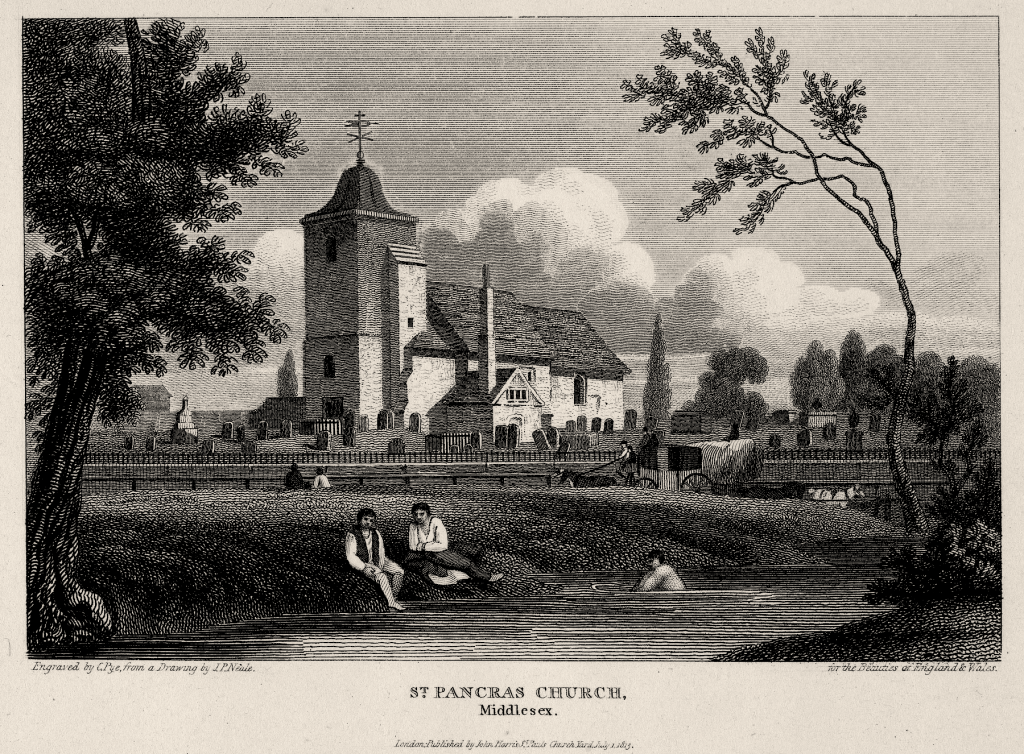
The original building, with its claims to late-Saxon (or even Roman!) origins, stands to the north of the present St Pancras railway station. It served as the parish church for the whole of the parish of St Pancras until the building of the new neo-classical church on the New Road (now Euston Road) which was consecrated on 8 May 1822. The original parish church then became a chapel of ease to the new church but quickly fell into disrepair and by 1847 it was derelict.

St Pancras Church. Engraved by Charles Pye from a drawing by John Preston Neale. – Brewer, J. Norris (1816). The Beauties of England and Wales, Vol. 10: London and Middlesex (Part 4). London: J. Harris, et al.
Public Domain

This was a period of rapid growth in London and the existing parish churches were simply unable to cope with the thousands of people flooding into the capital, in need of spiritual care. The solution was to build new churches in the rapidly expanding suburbs and in the case of St Pancras, the ideal site for one of those new churches already existed in the shape of the old parish church. The building itself required extensive renovation but nevertheless, baptisms began to be performed again at the church from 1848 and marriages from 1859, and by 1863 the restoration work was complete and the somewhat misleadingly-named new ecclesiastical parish of Old St Pancras was formed.

I did say it was confusing but the key to understanding it all lies in the descriptions and archival references provided by the record holders, the London Metropolitan Archives (LMA) – descriptions which Ancestry appear to have widely ignored when digitising the records.

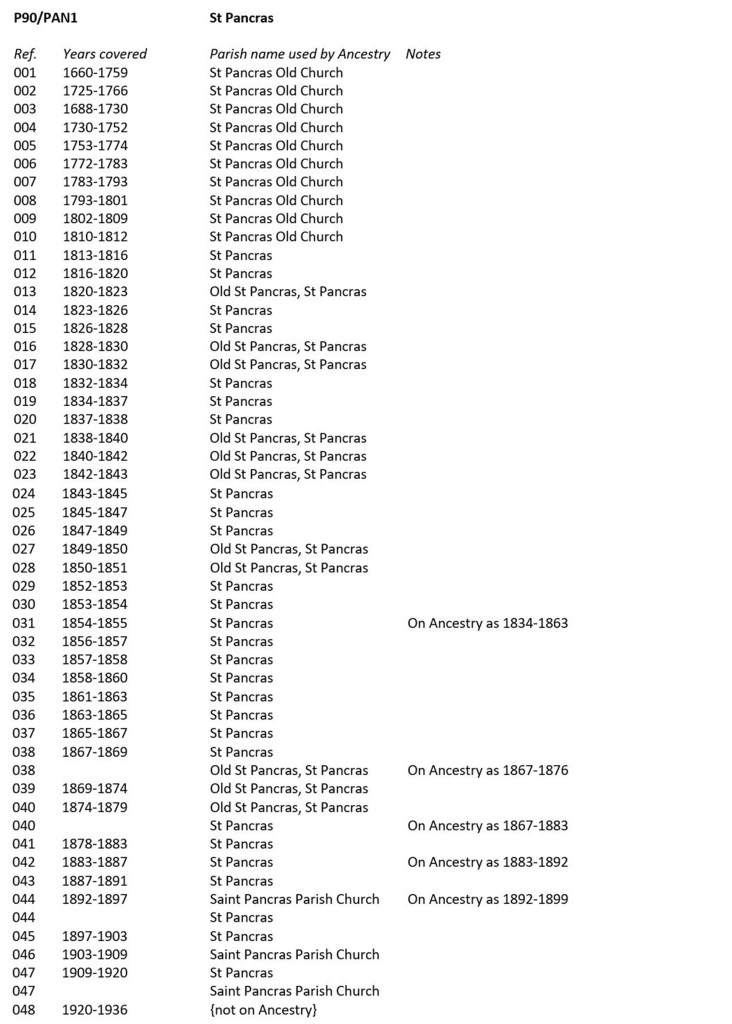
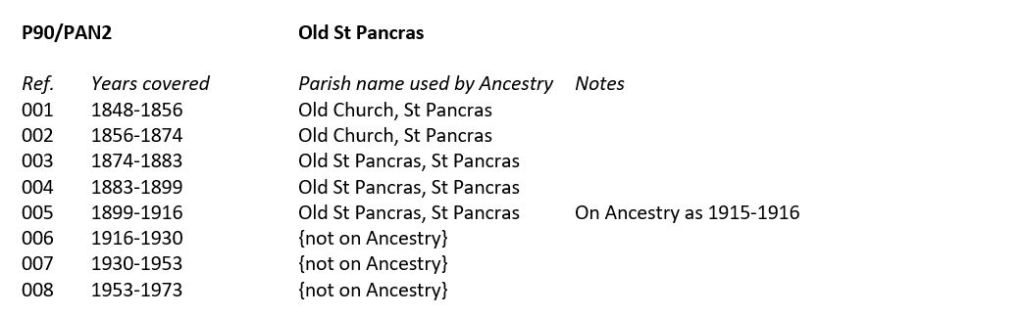
I’ve spent some time today comparing the records on Ancestry with the entries in the LMA catalogue and it’s obvious that there are some serious issues here surrounding nomenclature. The following table lists the baptismal registers for St Pancras parish (i.e. the parish church, whether at its original site up until May 1822 or in its later position since then) and those for Old St Pancras, from 1848 onwards. For each register I have shown the archival reference and the years covered (the LMA catalogue also gives the months in each case but I’ve removed these to make the data clearer). Next to these I’ve added the name of the parish as used by Ancestry.

Table 1. List of baptismal registers for Saint Pancras parish. LMA reference: P90/PAN1
Table 2. List of baptismal registers for Old Saint Pancras parish. LMA reference: P90/PAN2

As you’ll see, no fewer than four different names have been used by Ancestry for Saint Pancras parish, while the ‘new’ Old St Pancras parish has two different names assigned to it, one of which has also been used for the parish church! What the table doesn’t show (due to shortage of space) is that in many cases the references assigned to the registers by Ancestry are also wrong.

You’ll also see that several of the date ranges used by Ancestry are wrong and that a number of the registers are duplicated, which isn’t, in itself a bad thing. But it’s all suggestive of a ‘gung-ho’ approach to the process and this is illustrated by just one example of the extent to which the registers have somehow been mixed up in the course of the digitisation process.

Table 3 relates to a section of digital microfilm described by Ancestry as relating to the parish of ‘Old St Pancras, St Pancras’, and allegedly covering the years 1875-1903. As is so often case with Ancestry, the devil is in the detail. Here I’ve shown the image numbers, the page numbers and the dates covered by the actual registers; the references shown by Ancestry and the actual references according to the LMA catalogue.

Table 3. Showing various discrepancies between Ancestry’s descriptions and the actual archival references

So, it does cover the years 1875 to 1903 but there is clearly a gap of 16 years here: a gap which, you’ll be relieved to hear, is covered elsewhere. You’ll also be relieved to know that the first two pages of P90/PAN1/045 are to be found elsewhere.

The worrying thing about all of this is that the deeper you dig, the more problems you find. At least in this case there don’t appear to be any registers actually missing from the collection. There may be some individual pages or small sections missing but we can rest assured that every baptismal register from the parishes of St Pancras and Old St Pancras is included in one or other of Ancestry’s London Parish Register databases.

I spent about four hours investigating this today and I haven’t even started on the marriages and burials. Who knows what horrors are to be found there…? Surely it isn’t too hard to get this right: all they need to do is to use the descriptions that are readily available via the LMA catalogue. And it’s really not even that complicated. We’re dealing with two separate parishes: St Pancras and Old St Pancras. So all of the registers with the reference P90/PAN1 should be described as St Pancras, and all of those with the reference P90/PAN2 should be described as Old St Pancras.

I mean, yes, Old St Pancras is the actually the newer parish but I think that I’ve cleared that up. At least I hope I have…

© David Annal, Lifelines Research, 26 November 2021

Posted in Document Sources, research, Soapbox | Tagged , , , , , , | 9 Comments

The Last of the Moultings

On 2 February 1974, a 72-year old woman called Gladys Elizabeth Moulting died in Canvey Island, Essex. I know very little about Gladys, except that she was the youngest of two children of George Henry and Harriet Amelia Moulting, that she had been born on 25 July 1901 in the Hertfordshire parish of Tring and that when she was a young girl, her parents had moved to Watford, before settling in Essex in 1924.

Oh, and I also know that Gladys was the last person to bear the surname Moulting…

My interest in the Moulting family began when I discovered the name of William George Moulting of Thorn Cottages, Cornwall Place, Holloway in an 1846 Legacy Duty register entry, relating to my 3x Great Grandmother, Mary Ann Port. Mary Ann had died intestate, and a man called Samuel Truman (who worked at the Stamp Office, the forerunner of the Inland Revenue and the department responsible for the administration of Legacy Duty) had been granted letters of administration at the Prerogative Court of Canterbury.

I knew who Samuel was – he was Mary Ann’s first cousin, and one of the beneficiaries of her father’s will over 40 years earlier – but I wanted to know who William George Moulting was, and my searches led me to uncover the story of a remarkable family.

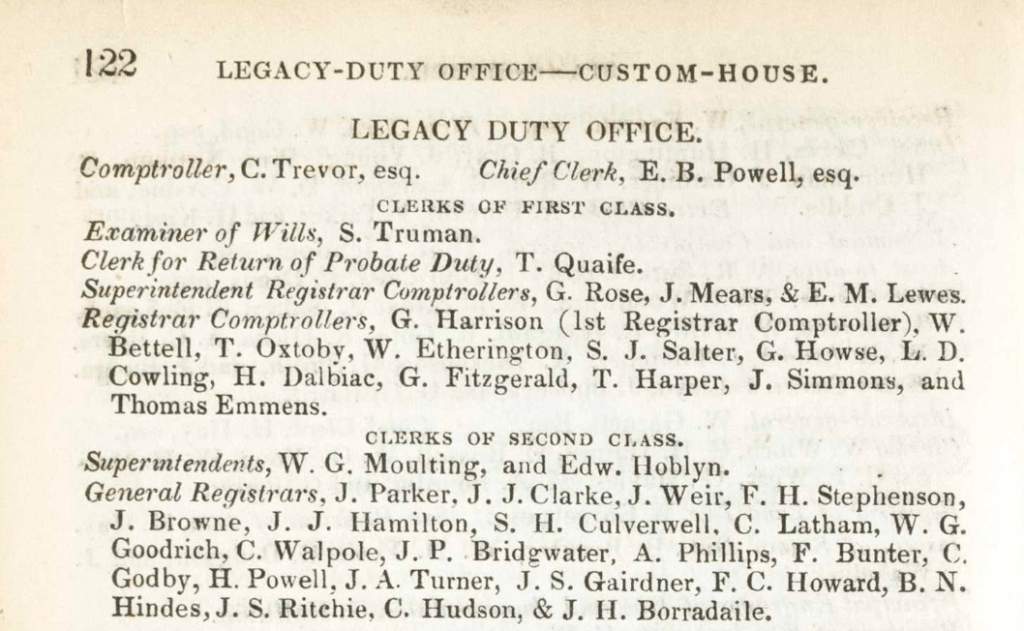
British Imperial Calendar, 1847, page 122. Findmypast

William George Moulting was born in Evesham, Worcestershire sometime around 1784. He was the son of William and Ann Moulting, who ran the Blue Bell in the High Street. His mother had died in 1813, aged 69 and three years later, his father, then aged 70, married a 17-year-old called Maria Headley – possibly a barmaid from the Blue Bell?

By 1821, William George Moulting was in London and it appears that he was a colleague of Samuel Truman’s: his name appears in the British Imperial Calender as an ‘Alphabet and Indexing Clerk’ in the ‘New establishment for better collecting legacy duty’. That same year, on 22 December 1821, William George Moulting married Mary Bellamy in the recently-opened, ‘new’ St Pancras church on Euston Square.

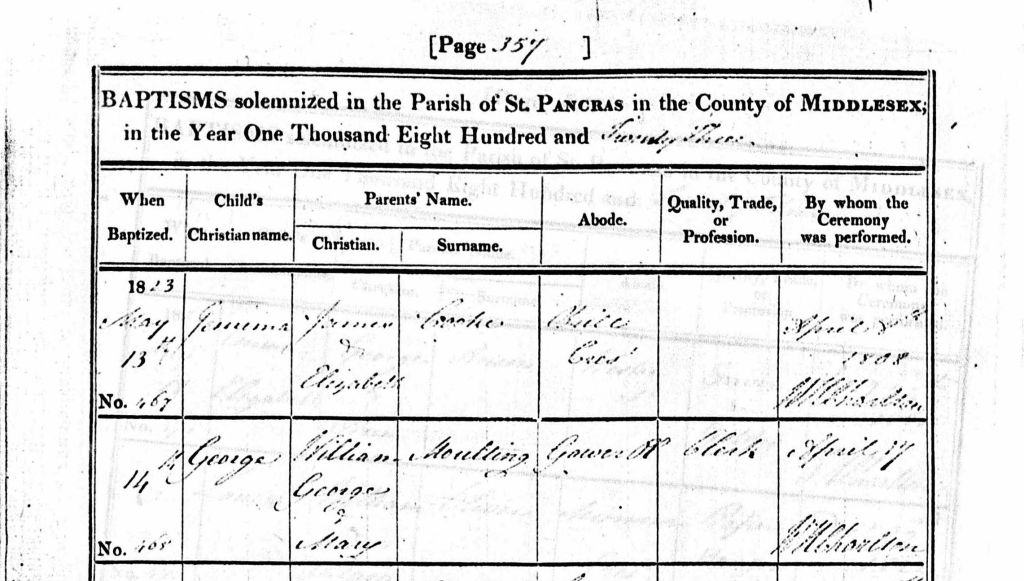
Surprisingly, William George and Mary had just the one child, a son called George, who was baptised at St Pancras on 14 May 1823.

Baptism of George Moulting, St Pancras, London, 14 May 1823.
London Metropolitan Archives reference: P90/PAN1/013 p.357

Sometime around 1847, William George Moulting retired from the Legacy Duty Office and, at the time of the 1851 census, we find him at his home in Holloway, with his wife, Mary, and their son, George. William died later the same year and Mary continued to live at Thorn Cottages until her death in 1864. They were both buried at Highgate Cemetery.

Their son, George, meanwhile, having served an apprenticeship to an engraver, was now working as an artist, and he appears, initially at least, to have had a degree of success. He twice exhibited paintings at the Royal Academy (in 1849 and 1854) and he was a member of the Royal Society of British Artists, where he exhibited no fewer than 15 watercolours between 1847 and 1857.

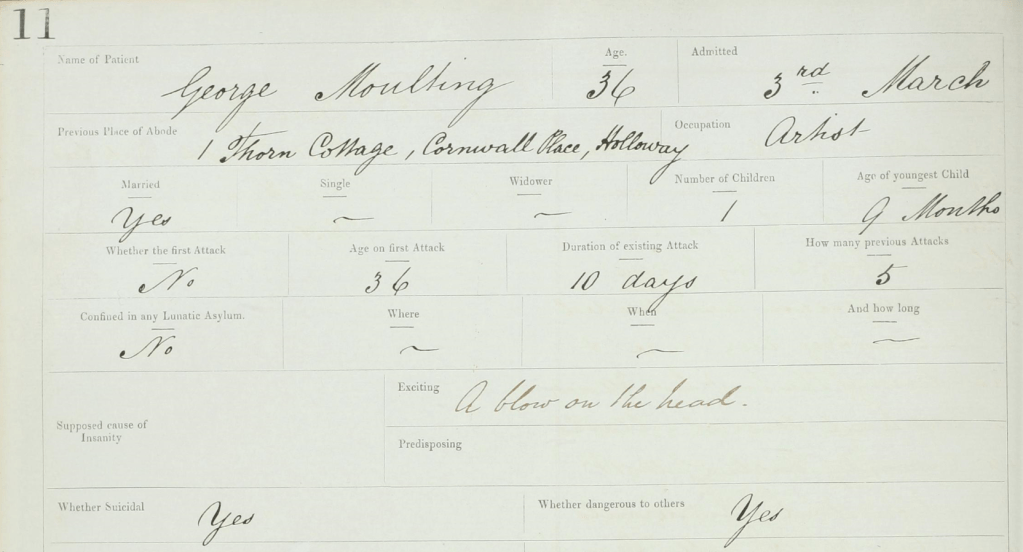
George had married Elizabeth Deacon at St Andrew’s church in Barnsbury in 1854 and they would go on to have four children, but their first child, Emily Mary, died aged just a few weeks in 1856. Then on 3 March 1860, just over a year after their oldest son, George Henry, was born, George was admitted to Bethlem Hospital, suffering from ‘acute mania with violent paroxysms of hysteria’ all of which was ascribed to his having suffered a blow to the head, the result of a fall about two years earlier. This, it seems, had forced to him to give up painting and move to the country.

Patient Casebook, Bethlem Hospital reference CB-076 p.11

His case file makes quite harrowing reading but George gradually recovered and on 14 September he was formally discharged.

George returned to the family home near Hemel Hempstead in Hertfordshire, where a daughter, Rosa Elizabeth, was born in September 1861. Four years later, their fourth and youngest child, William Joseph Moulting, was born. Sadly William Joseph died just 11 months later.

Unfortunately, our sightings of the family over the next few decades are few and far between. George continued to work locally as an artist but there’s no indication that he was actively involved in the London art scene. He lived out the rest of his life in Hemel Hempstead and died at his home in 1894, his daughter Rosa dying (unmarried) three years later. They were both buried in Hemel Hempstead’s Heath Lane Cemetery. George’s widow, Elizabeth, moved the short distance to Watford where their son, George Henry had settled, before she also died, in 1908.

Sometime in the late 1870s, George Henry had moved to Tring, where he found work as an auctioneer’s clerk but at the time of the 1891 census he was living in Watford, with the Lewin family. Later that year, George Henry Moulting married the second Lewin daughter, Harriet Amelia, at the parish church in Watford and, although they initially set up home in Tring, by about 1906 they had moved to Watford with their two daughters, Daisy Florence and Gladys Elizabeth. George Henry was now working as a secretary to a building society, but he seems to have retired in 1923 and the whole family were soon on the move again, this time to Essex.

Marriage announcement. Hemel Hempstead Gazette, 12 September 1891 p.4 col.e
British Library Newspapers

Daisy and Gladys were still living with their parents on the outbreak of the Second World War, when the National Register was compiled. George’s occupation was given in the register as ‘Corporate Accountant Retired’ and Harriet was described as an invalid. Daisy was a ‘Preparatory School Teacher’ while Gladys was working as the family’s housekeeper.

Just a few months later, on 6 December 1939, George Henry Moulting died. Harriet Amelia survived him by just four years and then Daisy died in 1960. Which just left Gladys…

A search on the FreeBMD website for the surname Moulting – with no other restrictions – brings up just 20 results: 6 births, 2 marriages and 12 deaths. And all 20 of these vital events relate to the family of William George Moulting. The surname seems to be a variant of the more common ‘Moulton’ which can be found in earlier Evesham records but the Moulting spelling appears to have been settled upon uniquely by this particular branch and used quite consistently for nearly 200 years. There’s no evidence that the name ever crossed the Atlantic or wound its way to the Antipodes, so when Gladys Elizabeth Moulting died on 2 February 1974, the Moulting surname died with her.

© David Annal, Lifelines Research, 21 November 2021

Posted in Local History, research, Stories, Surnames | Tagged , , , , , , , , , , | 3 Comments

Incorrigible & Worthless

Researching the lives of our military ancestors can be difficult at the best of times but when it comes to retelling the stories of the seven million men and women who served in the British Army during the First World War, there are significant obstacles in our way.

In September 1940 a German bomb hit the military repository in Arnside Street, London, instantly destroying well over half of the main series of First World War army service records stored there. Roughly a third of the records were saved from the fire that followed and another set of records recording the service of around 750,000 men who had been discharged as a result of wounds or illness has also survived but your chances of finding a surviving service record are still no greater than 40%.[1]

A few months ago I was searching for a man who, it was believed, had seen active service in the First World War. His army service record, it seems, was amongst those that were lost in 1940, but I was able to uncover a remarkable story and, although this man clearly survived the war, I thought it might be appropriate to mark Remembrance Sunday by writing about his life.

Edward Frederick Goodwin was born in Bristol on 14 March 1881, the oldest child of Edward Goodwin and his wife Rosina Caroline (née Rodda). Later records give his date of birth as 15 March but this was undoubtedly the man I was looking for.

Just two weeks old, he appears in the 1881 census (as Frederick Goodwin), living with his parents at 5 Lower Church Lane in the parish of St Michael, Bristol, in the west of the city. His father, Edward, a Londoner by birth, was a French Polisher and seems to have returned to London soon after Edward Frederick was born; their second child, Rosalia Clara, was born in Islington in 1884.

1891 census, 21 Barritt Street, Middlesbrough.
The National Archives reference: RG 12/4011 f.13 p.20

The family were soon on the move again, and by the time of the 1891 census the Goodwins were in Middlesbrough, some 215 miles to the north. A third child, Oswald, was born the following year with the family now firmly settled in the North East. The 1901 census finds them living in Billingham, County Durham.

Rosina had died in 1897 and it may have been this event that caused Edward Frederick – or Frederick Edward as he routinely called himself from this time onward – to leave home and seek a new life for himself. He had served an apprenticeship with Craig, Taylor & Co., shipbuilders based in Thornaby-on-Tees[2] but it seems that this was not where his future lay and by the summer of 1900 he had moved south again and was living in Southwark – at 7 Poplar Road, to be precise, the home, in 1901, of a Bristol-born man called Henry Bachelor, perhaps a friend of the family?

Whether or not this had been Frederick Edward Goodwin’s plan when he set off for London, on 17 July 1900, aged 19 years and 3 months (a remarkably accurate age for army service papers!) he signed up with The Queen’s Royal West Surrey Regiment of Militia. The military life must have appealed to young Frederick, as within a month, he had joined the regular army.

Army Service papers of Frederick Edward Goodwin, 14 August 1900.
The National Archives reference: WO 97/4955 #109

On 14 August 1900, Frederick Edward Goodwin, now aged 19 years and 4 months, enlisted in the Liverpool Regiment, giving his next-of-kin as his father, Edward Goodwin of 27 Middle Bank Street, Stockton-on-Tees. Three months later, on 21 November, after completing his basic training, Frederick was posted from the regimental Depot to join the 2nd Battalion which, at the time the 1901 census was taken (on 1 April), was stationed at the Curragh Camp, 25 miles to the west of Dublin.

Private F Goodwin, aged 20, is listed amongst the men of the 2nd Battalion “The Kings” Liverpool Regiment. Everything seemed to be going swimmingly, but on 29 May he was marked as absent from the regiment, and three weeks later, on 20 June 1901, he was declared a deserter.

We don’t know why Goodwin decided to desert from the Liverpool Regiment but it clearly wasn’t anything to do with a dislike for army life. Because, just six days after deserting, Frederick enlisted, at Dublin, in the 99th Battery, Royal Field Artillery, under the assumed name of Frederick Edward Palmer. This time he gave his next of kin as his father, Edward Palmer, of New-bank Street, Glasgow!

Despite his attempted subterfuge, Frederick’s previous life didn’t take long to catch up with him. After serving 7 weeks in military prison between 1 November and 27 December 1901 for an unspecified offence, his ‘fraudulent enlistment’ in the Royal Artillery was discovered. By 21 March 1902 he was awaiting trial and he was convicted of the offence on 15 April, his period of imprisonment lasting until 15 August 1902.

On 4 June 1902, presumably while he was still in prison, Frederick was officially discharged from the Royal Artillery, described by the authorities as ‘Incorrigible & Worthless’.

Army Service papers of Frederick Edward Palmer, 4 June 1901 to 4 June 1902.
The National Archives reference: WO 97/5641 #125

Had Frederick learned his lesson? Had he decided that army life wasn’t for him after all? Well, no…

Back in London, just 11 days after being discharged, Frederick enlisted for the third time. His unit of choice this time was the 53rd Battery, Royal Field Artillery. He reverted to his real name and gave his age as 21 years and 5 months old (which was true!) but claimed to have been born in Islington. He was posted from the Depot to the 53rd Battery on 5 November 1902 (was anyone suspicious of how easily he must have completed his ‘basic’ training?).

This time his deception lasted three months before being discovered. On 8 February 1903 he was awaiting trial, having been found to have been discharged (as Frederick Edward Palmer) from the 99th Battery, Royal Field Artillery the previous June. He was sentenced on 23 February and was finally discharged ‘with Ignominy’ on 4 March 1903. Frederick was released from prison on 22 February 1904, with all previous service towards pension forfeited.

Surely this would be the end of the road for Frederick as far as military service was concerned? Well, yet again, the answer is no…

Less than a year after getting out of prison, our serial enlister was at it again. On 3 January 1905, Frederick Edward Goodwin enlisted in the 2nd Battalion, the Yorkshire Regiment. Unfortunately, the record covering this fourth spell in the army hasn’t survived – the date of his enlistment is taken from a later document – but this time, his service was an undoubted success.

Without a full record it’s difficult to say too much about the details of Frederick’s time with the ‘Green Howards’ but we know that he saw service overseas (we find him in the British Barracks at Khartoum in the 1911 census) and that he was part of the British Expeditionary Force, travelling to France in October 1914. He was also promoted to the rank of Acting Corporal before being discharged on 5 October 1917, having been wounded at the Somme in 1916.

Medal card of Frederick Goodwin, Yorkshire Regiment
The National Archives reference: WO 372/8/64085

And that, surely, is the end of the story. Well, not so fast…

On 31 January 1918, Frederick Edward Goodwin joined the Royal Navy Air Service as an Aircraftman, 1st Class (AC1) and was still in active service two months later, when, on 1 April 1918, the Royal Air Force was formed.

Frederick Edward’s Royal Naval service paper records his conduct as ‘Very Good’ and he clearly continued to impress after joining the RAF. On 31 July 1918 he was promoted to the rank of Corporal. His RAF service saw him in Lerwick, Shetland and in Ripon, North Yorkshire and it was there on 1 March 1919 that Frederick was transferred to the RAF reserve before being finally discharged on 30 April 1920.

As always, there’s more to be discovered. Frederick’s pension record card includes a reference to service in the Shropshire (or Somerset) Light Infantry but it’s difficult to see how he would have had time for service in another regiment. Unless, of course, this was after 1920 – he wasn’t yet 40 when he was discharged from the RAF so perhaps he fancied one last blast!

And the story doesn’t end there. We find Frederick in London in 1939, on the outbreak of the Second World War, working for the City of London Corporation, ARP Demolition and Rescue service. What happened to him after that is, sadly, currently unknown.

What we do know is that he ended his life a decorated ex-soldier, having been awarded the 14 Star, along with the British and Victory Medals and the Silver War Badge. He had attained the rank of Acting Corporal in the Army and was later promoted to the rank of Corporal in the RAF. Not bad for a man who had been written off by the authorities as ‘Incorrigible & Worthless’…

Thanks to John Sly for giving me the opportunity to tell this fascinating story.

Further reading: Army Records: A Guide for Family Historians by William Spencer (2008)

© David Annal, Lifelines Research, 14 November 2021


[1] http://www.greatwar.co.uk/research/military-records/british-soldiers-ww1-service-records.htm

[2] https://www.gracesguide.co.uk/Craig,_Taylor_and_Co

Posted in Document Sources, research, Stories, Uncategorized | Tagged , , , , , , , | 3 Comments