Welcome to the family

Margaret Howland was born on 9 August 1906 at 46 Brunswick Street, Edinburgh, just off Leith Walk but south of the border with the ancient Burgh of Leith.

Margaret was my grandma and one of the nicest and kindest people you could hope to meet but she didn’t have the easiest of starts to life. Her birth certificate leaves no room for doubt on one particular matter: she was born to unmarried parents, or, to use the language of the time, she was illegitimate. There’s a blank space on the certificate where her father’s name should be.

Birth certificate of Margaret Howland, Edinburgh, 1906. National Records of Scotland Birth 1906 Canongate 685/3 #917

Piecing together the story of her life, both from documentary sources and from family stories and photographs, I was certain of one thing: my grandma was an only child. And I was certain about that until a few days ago when I discovered that it wasn’t true…

I knew my grandma well. Growing up, we would visit her at least once a year, every year, in her house in Carrick Knowe, a suburb to the west of Edinburgh. When she was in her late 70s or early 80s, she shared a fascinating piece of information with me – she told me that she had known her father and that he was a man called Frederick Porter. This turned out to be slightly wrong – he was actually called Frederick Port – but nevertheless, the revelation opened up research into a whole new area of the family and over the years I have discovered a wealth of information about the Ports – my only English ancestors.

I’ve also spent many happy hours exploring the Howland and their origins on the Isle of Man and I’ve become increasingly interested in finding out more about my grandma’s mother, Margaret Howland senior.

Ballygrant, Kilmeny, Islay. Postcard, ca.1900

My great grandmother was born in Ballygrant on the isle of Islay, the southernmost of Scotland’s Inner Hebrides. She arrived, along with her twin brother John, on 1 December 1872. Their parents, Charles and Catherine Howland, had recently moved from their native Isle of Man and Charles was working as a blacksmith for the Islay Lead Mining Company. The family were only on Islay for a few years before moving to Wanlockhead, a remote lead mining village in the south-west of Scotland which has the distinction of being Scotland’s highest village.

Margaret and John were to grow up in Wanlockhead alongside their three older siblings and two younger ones but in 1880, their mother died. Catherine Howland (née Crinnell) was just 36 years old. Charles was to marry again two years later and he went on to have a further six children with his second wife, Ann Kirk: remarkably, all 13 of Charles’s children survived infancy. [Update: after writing this, I discovered that Charles and Ann had in fact had two children who died in infancy – so there were actually 15 in total!]

Using a variety of records, including birth, marriage and death records, census returns, directories, electoral registers and tax records, I have recently been attempting to work out where each of my more recent ancestors lived on a year-by-year basis. Not only does this help to understand the stories of their lives, it also serves to highlight any gaps in the story. Dr. Sophie Kay has published a fascinating blog post about using timelines to discover ‘negative space’ in your research and how you can use this approach to identify further areas to explore. In the case of my great grandmother, I discovered that I had a gap of 25 years to fill!

Lead Miners, Wanlockhead

The 1881 census finds the Howlands living at Lochnell Cottages in Wanlockhead, the recently widowed Charles working as a blacksmith, the two oldest sons (Charles junior, aged 15, and Thomas, 13) already working in the lead mining industry and the five younger children, including Margaret (aged 7), being looked after by a 21-year old domestic servant. Yes, you’ve guessed it: Ann Kirk, soon to be the children’s stepmother.

Until last weekend, this was the last confirmed sighting I had of Margaret before she appeared in Edinburgh in August 1906, as the mother of an ‘illegitimate’ child. Young single women not living with their families are notoriously difficult to track down: they are unlikely to appear in the obvious records – directories, electoral registers, valuation rolls etc. – as these records generally relate to ownership or rental of property but, although the census is only a snap shot, taken once every ten years, it should have been possible for me to fill in some of the gaps by tracking Margaret down in the 1891 and 1901 returns – wherever she was. But I could find no trace of her.

A few months ago, I was carrying out some extreme online searches, looking for any signs of Margaret in the last few decades of the 19th century or the first few years of the 20th when I came across an intriguing record. A single line entry in the admission and discharge register of the Toxteth Union Workhouse (Liverpool) recorded the details of a woman called Margaret Howland who had been admitted to that institution on 4 January 1903 on the order of the Master. The ‘Cause of Seeking Relief’ was recorded as ‘Pregnant’, her address was given as 35 Cullen Street and her year of birth as 1872. She was a single woman, her ‘Trade or Calling’ was given as ‘Charwoman’ and her religion as ‘C.E.’ – i.e., Church of England.
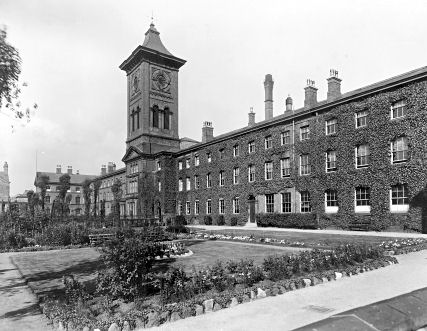
Toxteth Union Workhouse, ca.1925.
https://www.workhouses.org.uk/ToxtethPark/

Margaret Howland is not a common name. The surname Howland most frequently occurs in Kent and the south east of England and apart from my own Manx family, occurrences in the north west of England are fairly exceptional. I had no idea what my Scottish great grandmother might be doing in Liverpool in the early 1900s but this reference to a Margaret Howland of exactly the right age was certainly worth looking into. I had a look at the 1901 census returns for 35 Cullen Street, Liverpool but I couldn’t see anything of interest and after trying a few other unproductive searches I put it to one side. My ‘magpie’ mind moved on to other things…

So it was only when I was attempting to identify all the addresses that my great grandmother had lived at throughout her life that I realised how large the gap was on her timeline and I decided to revisit that curious workhouse reference.

Margaret had been discharged from the Toxteth workhouse on 16 January 1903, just twelve days after she was admitted, and there was no evidence to suggest that her pregnancy had resulted in the birth of a child in the workhouse. There was certainly no record of the ‘admission’ of a child to the institution and a search of English civil birth records for the year 1903 revealed nothing relevant in the Liverpool area. In fact, a search of the whole of England and Wales didn’t bring up any births that could possibly relate to this pregnancy. The only Howland birth I could find to unmarried parents in 1903 was that of an unnamed boy registered in West Ashford (Kent) and I was quickly able to eliminate him from my enquiries.

And that’s when I thought that, if this was my great grandmother, I should probably check Scottish birth records as well. And my search turned up something which, despite my suspicions, I really didn’t expect to find: the birth of a Thomas Howland in the St George district of Edinburgh in 1903.

The certificate quickly confirmed that this was a ‘person of interest’: Thomas was born on 22 February 1903 at Edinburgh’s Royal Maternity Hospital and he was the ‘illegitimate’ son of Margaret Howland, a domestic servant of 24 Caledonian Crescent, Edinburgh. And Margaret’s signature on the certificate was a good match with the signature on my grandma’s birth certificate.
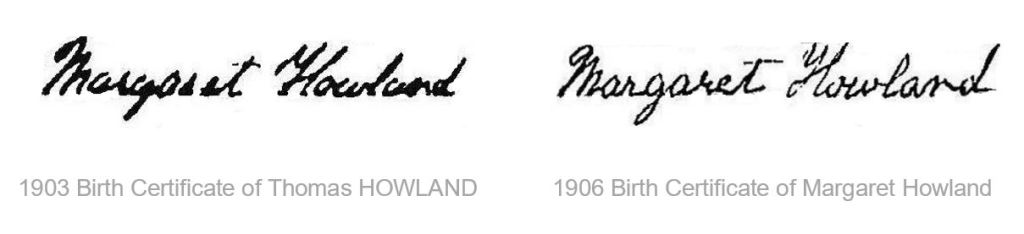
I was certain that this was the Margaret Howland who had been admitted to and discharged from the Toxteth workhouse the previous month but could I prove that it was my great grandmother? On the assumption that Thomas had died young, I searched for a record of his death. My search was initially unsuccessful but I soon found the death registration of a Thomas Holland which seemed to fit the bill.

It was the right Thomas. He had died at 24 Caledonian Crescent on 15 April 1903, aged just 7 weeks, of gastro-enteritis. But the certificate had another surprise in store: under the column headed ‘Signature & Qualification of Informant, and Residence, if out of the House in which the Death occurred’, Margaret had signed her name (as Margaret Holland!) and then written, ‘Mother. 10 Shandon Street.’

I instantly recognised this address as the residence of Frederick Thomas Port, the man who, three years later, was to become the father of my grandma.

Municipal Register of Voters, Burgh of Edinburgh, 1900-1901. Edinburgh City Archives. Accessed via Ancestry.com

Does this suggest that Frederick was also the father of young Thomas? Quite possibly, yes – his middle name was Thomas and his father (who had died a few years earlier) was called Thomas. It’s something I intend to consider in a future blog post – but there’s still one more significant episode to explore in this part of the story.

Having found Thomas – my great uncle Thomas! – I wondered whether there were more siblings to discover. As a professional genealogist with over 40 years’ experience I’m somewhat embarrassed to reveal that searching for – and finding – a third child was about as easy as any search could be. There were only three Howland births in Edinburgh between 1880 and 1930 and all three were the children of my great grandmother, Margaret. I could easily have found them at any time in the past 40 years but I never thought to look.

In a desperate attempt to seek excuses, the best I can offer is to say that Sophie Kay’s search for ‘negative space’ works best when you have the structure of a marriage to work with. You know when the couple married and you know when the woman is likely to have reached the end of her child-bearing years and you look for gaps in between those points in time. In Margaret Howland’s case, this structure was missing and I had simply never considered the possibility that there were any gaps to fill

Alice Coleridge Howland was born at the Royal Maternity Hospital (I really need to look at the records of the hospital) on 14 August 1900. Margaret was living at 17 Cheyne Street in the Stockbridge district of Edinburgh at the time and working as a domestic servant. Could Frederick have been Alice’s father as well? Again, I intend to explore this question in a future post, but I did wonder whether the middle name Coleridge might be a nod in the direction of the father’s identity. My feeling is that this probably isn’t the case: the only Coleridge I can find in Edinburgh around this time is a woman – and the fact that she was called Alice is surely not a coincidence. I suspect that Alice Coleridge (an English woman who was born in Devon in 1876 and was working in a draper’s warehouse in Edinburgh at the time of the 1901 census) was a friend of Margaret’s. I need to explore Alice’s life more. I know that she returned to England and died in Devon in 1968 and that she never married. I wonder whether she kept in touch with my great grandmother…

The discovery of young Alice Howland was the key that unlocked the 1901 census for me. Margaret (‘Maggie’) and Alice were living at Cross Keys, in the Fife parish of Beath, boarding with the family of Robert and Charlotte Johnston, an Irish mining family. And there was another boarder: Margaret’s twin brother John. I hadn’t found them previously, partly because they’re in such an unexpected place but also because they’re listed under the name Holland and their birthplaces were unknown.
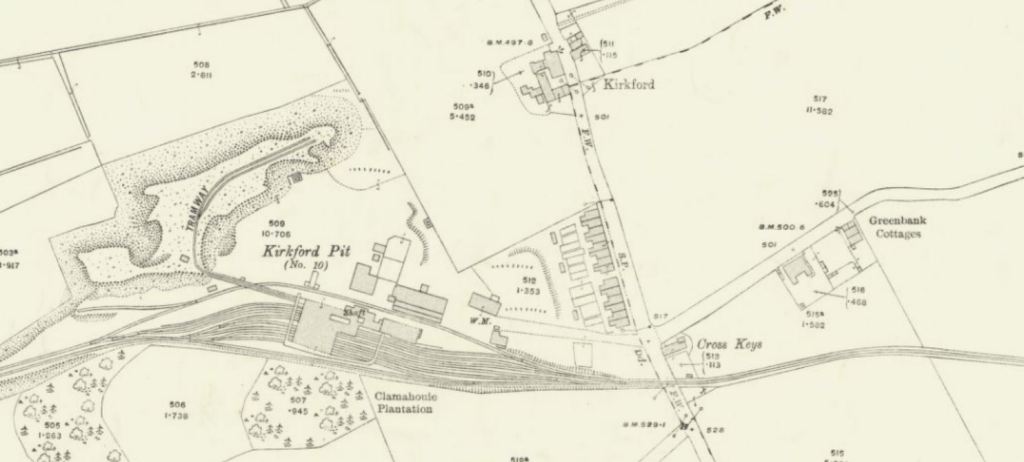
Ordnance Survey map, 25 inch to the mile, Fifeshire Sheet XXXIV.11 (detail), 1915. National Library of Scotland

John was working in Beath as a miner – presumably at the nearby Kirkford Pit. Perhaps he’d been living there for some time, boarding with the Johnston family, and he’d invited Margaret to stay with him for a while. Alice was 7 months old at the time of the 1901 census and Edinburgh was in the grip of a measles epidemic.

The Edinburgh Evening News of 5 February 1901 reported that:

The epidemic of measles … shows no abatement, the intimations of cases for the past month numbering no fewer than 777, a very considerable increase over the preceding month.

Things hadn’t improved by early March. On 5 March the Evening News reported that:

… the epidemic of measles shows no sign of abating, the cases for the month reaching 779. Last year in the same month there were only some 76 cases.

Sadly, Margaret’s efforts to protect her daughter (if indeed that’s what she was trying to do) were unsuccessful. On 6 June 1901, now back in Edinburgh, Alice died of measles and broncho-pneumonia at 38 Caledonian Crescent.

I only know my great grandmother from photographs. She always looks like a determined woman and one who doesn’t give much away. My dad, who lived with her for the first 21 years of his life doesn’t feel like he ever really knew her. She was an ‘inward’ person who kept herself to herself. She died three years before I was born and was never really spoken about. My interest in family history was perhaps partly inspired – or provoked – by this silence – particularly in my paternal family.
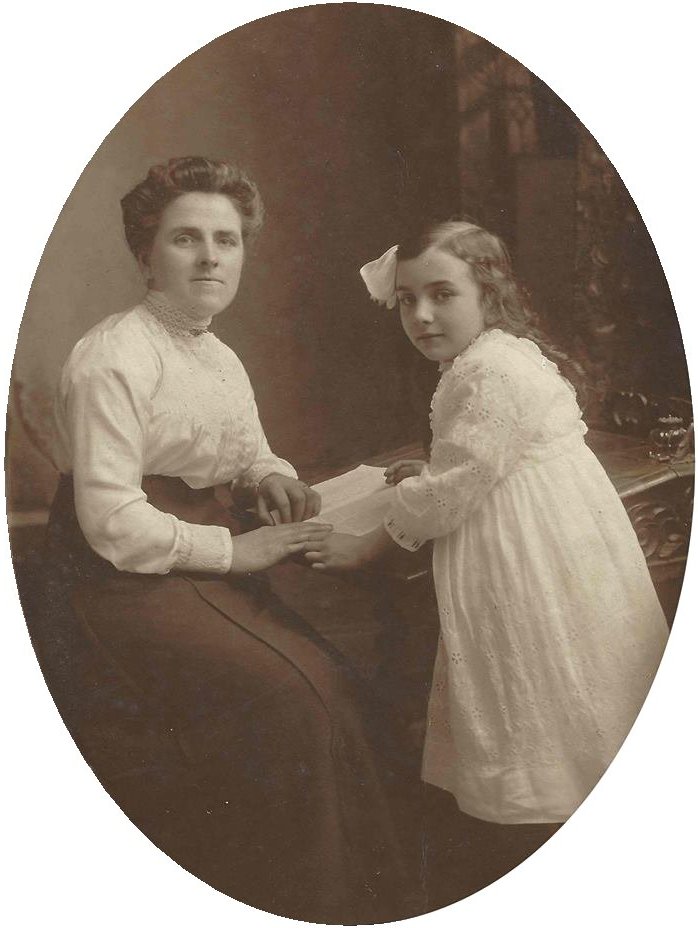
Margaret Howland senior and junior, ca.1913

As family historians it’s important that we research and record the short lives of our ancestors’ siblings. We need to recognise the impact that their deaths had on the family – and let’s not for a single minute fall into the trap of believing that the frequent occurrence of infant death made it any easier for the parents to come to terms with. Bereavement isn’t something that you get used to.

There are a lot of questions still to answer. What was Margaret doing in Liverpool in January 1903? Where was she in 1891 – I still haven’t found her! And who were the fathers of her first two children? But as a result of these new discoveries I can now welcome Alice and Thomas to the family and proudly add them to the tree. I can also promise that I’ll do my best to ensure that they won’t be forgotten again.

© David Annal, Lifelines Research, 20 August 2022

Posted in Local History, research, Stories | Tagged , , , , , , , , | 9 Comments

A Moving Tale

Those of you who follow me on Twitter will know that I spent a day in London last week, pounding the streets in search of ancestors. Over the course of a long day, I visited four ‘live’ archives: the Bank of England Archive, Guildhall Library, the London Metropolitan Archives and the National Archives. But I also took time out to visit the sites of some former libraries/archives/reading rooms, took photos of them and then set people the challenge of identifying them.

Eight former London libraries/archives/reading rooms. How many can you name?

As I was sorting out the answers to the quiz, and making sure that I’d got all the facts right, I realised that there was one detail that I wasn’t at all sure about. I knew that the 1857 Court of Probate Act had led to the establishment of the civil probate system in 1858 and I knew that the Probate Search Room had ‘always’ been at Somerset House. But did ‘always’ mean that it was there from 1858? I needed to find out and my research led me to the discovery of a fascinating article published in the Daily News on 21 October 1874, comprising a blow-by-blow account of the relocation of ‘waggon-loads of wills’ from Doctors’ Commons, the ancient establishment in Knightrider Street, close to St Paul’s Cathedral, to the new (partly) purpose-built facility at Somerset House. The article also includes a brief and colourful history of Doctors’ Commons, an institution described by Charles Dickens in his semi-autobiographical novel, David Copperfield, as a ‘pernicious absurdity’. For people like me, with an (admittedly fairly niche) interest in the ‘history of family history’, the article is a precious treasure. So here it is, in its entirety…

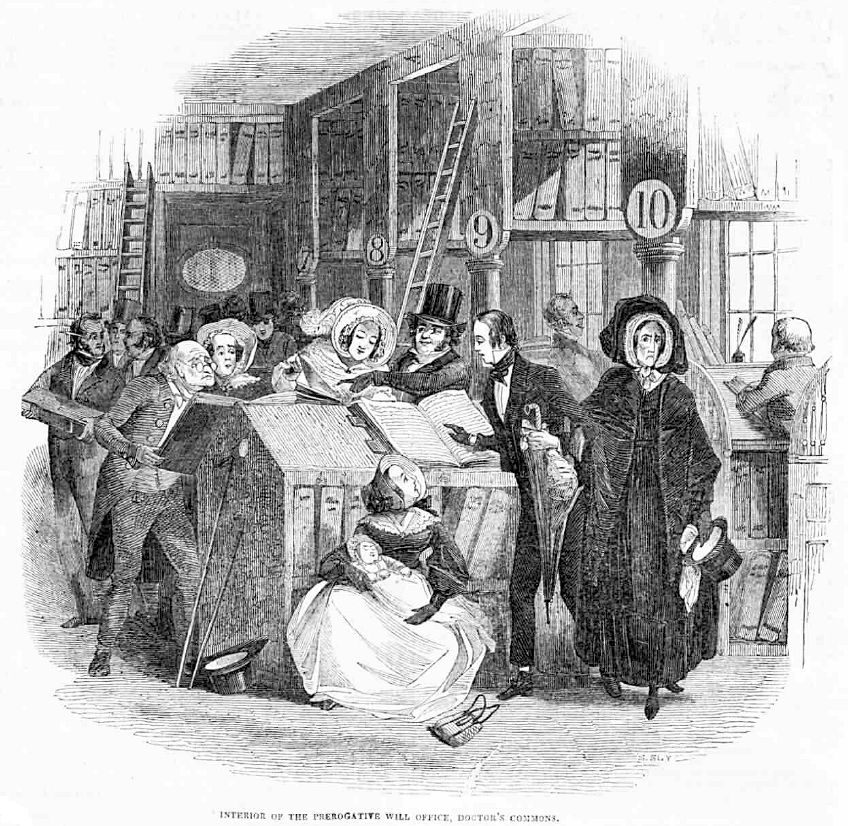
Interior of the Prerogative Will Office, Doctor’s Commons, Pictorial Post, January 1846, p.16

THE DESERTION OF DOCTORS’ COMMONS.

A very remarkable and miscellaneous list might be formed of the strange articles which from time to time are carted through the streets of London. A live tiger from Wapping to the Zoological Gardens, a consignment of Egyptian mummies on their way from the docks to the British Museum, waggon-loads of yellow gold to the Bank, slabs scored with Assyrian inscriptions – such commodities as these would form items in the catalogue; but never until yesterday have waggon-loads of wills passed along one of our thoroughfares.

Under the tilted hoods of furniture, all the last wills and testaments which have accumulated for centuries in the principal registry of the kingdom were carted yesterday, or will be carted during the next three days, from their late home in Great Knightrider-street to their new receptacle in Somerset House.

The removal is wholesale. The laconic will of Henry VIII., the famous holograph will of Shakespeare, the last testament of the acute old gentleman who founded the great moneyed family of Rothschild, the wills of Mr. Morrison, the millionaire, and of Elwes, the miser, the wills of the deceased Browns, Joneses, and Robinsons, are all included in the universal flitting.

This is the last blow to Doctors’ Commons – the last blow of many. Times have sorely changed with the dingy venerable precincts since Dickens first took pen in hand to photograph their features and abuses. The day is gone by when pimply-faced apron touts button-holed the stranger passing under the archway of the Deans’-court, and carried him off to invest in a marriage licence, totally irrespective of the question whether or not he nourished the design of being married at all.

Before that ruthless Act of 1857, which abolished all ecclesiastical jurisdiction in testamentary and cognate matters, Doctors’ Commons was a nest of tribunals, the practitioners and pleaders before which were a body distinct from all other legal practitioners.

The visitor, as he entered Carter’s-lane, where the Royal Wardrobe Palace once stood, to which was brought the “Fair Maid of Kent,” the widow of the Black Prince, on the evening of the day that Wat Tyler’s followers broke into the Tower, became at once sensible of a holy calm, and a strong smell of parchment and pounce.

Every house was the office of a proctor. The present explorer will find at the east end of Knightrider-street, close to St Benet’s-hill, a square plot of ground, partly tenanted by scaffold poles, partly occupied by a pile of new buildings, which extends down to and has a frontage in Queen Victoria-street. This plot was the site of the old College of the Doctors of Civil and Canon Law. The dim old pile had a history. The college as an institution, although not as a building, was founded before the reign of Henry VIII., and in 1586 Dr. Henry Hervey, Dean of Arches, obtained a lease of, and presented to the college, a ruinous pile on the site referred to, named Mountjoy House.

Detail from the Agas Map (ca.1561), showing the location of ‘Knyght Ryder Street’ just to the south of St Paul’s Cathedral.
https://mapoflondon.uvic.ca/map.htm

The college repaired the structure, and abode there, dining together in its Common Hall until the Great Fire destroyed their quiet home, whereupon they migrated for a time to Exeter House in the Strand, where they held their courts. In 1672 the college was rebuilt, and Charles II, having “authorised and required” the doctors to occupy it, they did so with probably their accustomed sleepy alacrity. Here they droned on comfortably until 1858, when the thunderbolt fell upon them.

Their college home was a pleasant abiding place. The chambers of the doctors occupied three sides of the principal square; on the fourth was the Common Hall, where the doctors dined together, and which formed, too, the Common Court-room for the various courts which had their home in Doctors’ Commons. The few doctors of the old regime who still continue to practice in the reformed courts under the new dispensation must remember with fond regret the snug old hall, with its dark-polished wainscot reaching half way up the walls, and above it the emblazoned coats of arms of all the doctors for a century back, the fire burning cheerfully in the open stove in the centre of the spacious room, the picturesque dresses of the doctors in their scarlet and ermine, and of the proctors in the ermine and black.

In this room all the old Ecclesiastical Courts held their sittings: the Court of Arches, the Pleas, tried before which Chaucer speaks of as cases

“Of defamation and avouterie,
Of church reves and of testaments,
Of contracts and lack of sacraments,
Of usure and simony also:”

the Prerogative Court, where contentions arising out of testamentary causes were tried; the Consistory Court, and the Court of Admiralty, whose ecclesiastical connection is somewhat obscure. Where the carcase is, there will the eagles be gathered together. The proctors “admitted exercent by virtue of a rescript,” and the doctors, the bulk of whose fees came from testamentary litigation, naturally harboured around the registry, where were received and stored the wills of the Province.

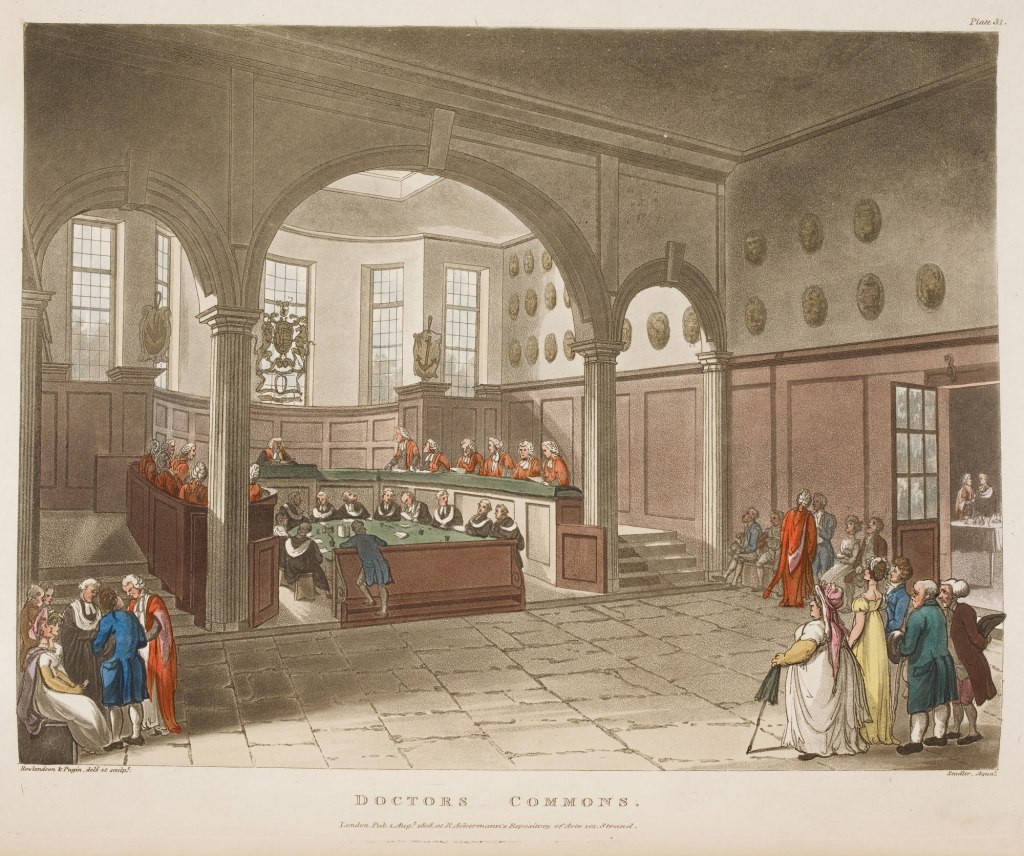
Doctors’ Commons from Microcosm of London, 1808-1810. British Library C.194.b.305-307 (Public Domain)

For centuries the receptacle of these has been in or about Doctors’ Commons. There are copies of wills dating as far back as 1383, and the original wills begin with the year 1483. In what manner the valuable documents were cared for in the early days may be judged from the fact that some seventy years ago they were stowed away into cupboards and odd corners and closets about the Registry Office in Knightrider-street. It then occurred or was suggested to the registrars of the period, who of course were the sons of an archbishop, to build a strong room for the safe storage of the documents in their charge, and this structure was accordingly erected behind the Registry, and abutting into the garden of the Doctors’ College.

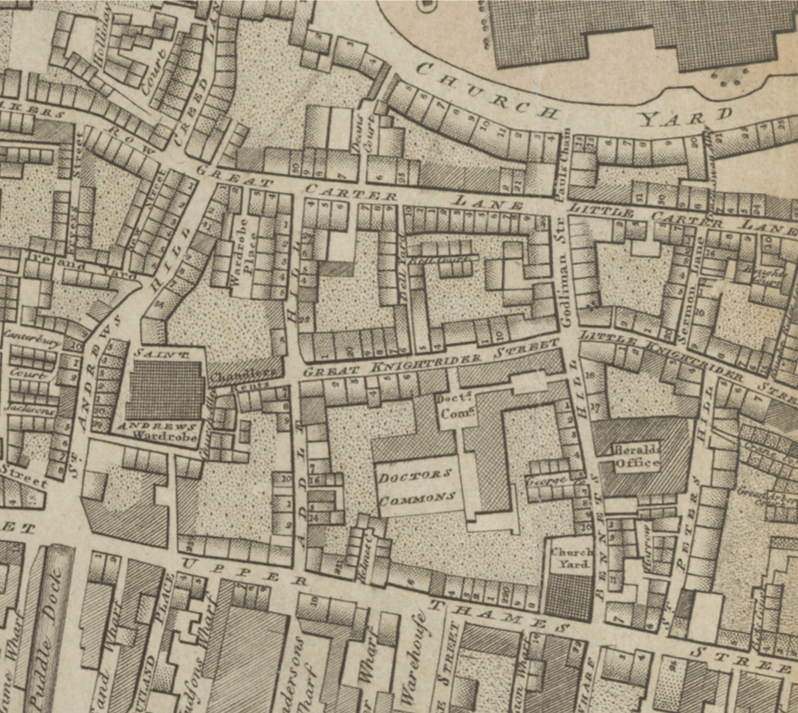
Detail from Richard Horwood’s PLAN of the Cities of LONDON and WESTMINSTER the Borough of SOUTHWARK, and PARTS adjoining, 1792-1799. Romantic London http://www.romanticlondon.org/horwoods-plan

Times are changed, and across the old garden, in the shady walks of which the learned doctors were wont, no doubt, to hold sweet converse of knotty points in sacerdotal, bottomry, and salvage law, Queen Victoria-street now runs. The New Civil Service Co-operative Store stands somewhere about its north-eastern corner.

A right pleasant rus in urbe was the old garden, with its great branching elms, among the limbs of which there was a rookery until within the last fifteen years, the rooks, ultimately deserting their haunt when one of the old trees fell. The story goes that the registry clerks used to shoot at the rooks with stones from crossbows, and that a learned doctor, once finding a bird lying dead that had thus been killed, wrote a laboured treatise to prove that it had died from epilepsy. The garden was ten feet above the level of the present street.

The bolt fell which abolished the ecclesiastical jurisdiction in virtue of which Doctors’ Commons had prospered so snugly ever since Charles II.’s time, and the doctors and proctors for the most part acted as did the rooks, and forsook the scene of their former fortunes. The courts were transferred to Westminster, and the close borough of Doctors’ Commons passed into Schedule D., solicitors being allowed to practise freely in them. Most of the doctors and proctors retired on their dignity and the compensation which the Act of Parliament awarded to them, and for some years the old place existed, forlorn and dismantled, the Admiralty Court only continuing to be held in its precincts. The court-room door of long-discoloured baize flapped listlessly on its rusty hinges, and the Common Hall became a nest for spiders.

Demolition of Doctors’ Commons: The Great Quadrangle, The Illustrated London News, 4 May 1867, p.440

The courtyard and garden fell temporarily into the hands of Captain Shaw and his merry men of the Fire Brigade, and firemen were drilled at the hose where the doctors had promenaded. Then the contractors came and demolished everything, sweeping college and garden, and even the very soil of the latter, away into the havebeens, and the new street grew slowly into shape, among the Roman remains and the mouldering brick foundations of Mountjoy House.

Foreseeing the ruin that was to come, alike to the garden and to the strong room built out upon it, the authorities about ten years ago built another series of fireproof apartments fronting Knightrider-street, into which the accumulated wills, the mass of which had quite overwhelmed the old garden storehouse, were removed, and in which they remained until this last removal was commenced yesterday morning.

But the whole place had grown too small for its parchment tenants and their suite of custodians, recorders, clerks and engrossers. The search-room of the Registry could not accommodate the numbers who thronged to it to examine wills, and the volumes into which the wills are copied had overflowed into passages and lobbies. The bulk of the records which accumulate in the Registry of the Court of Probate naturally increases in proportion to the national growth in wealth and prosperity.

The copies of the wills for the year 1383 are contained in one volume two inches thick: now the copies for a single year fill twenty huge tomes of six inches thick, each weighing half a hundredweight. About ten thousand “town” wills are registered annually, and in addition copies of about 17,000 country wills are filed every year in the metropolitan registry.

To the consideration of scanty space was added the argument of the inconvenience of the situation in relation to the Court of Probate sitting at Westminster, and for every reason the arrangement was wise and advisable that the registry and its archives should be moved westward to Somerset House in default of the once anticipated accommodation in the New Courts of Law buildings.

Somerset House and St. Mary le Strand, 1851-1855. Government Art Collection
https://artcollection.culture.gov.uk/artwork/18466/

The wills are being conveyed from Doctors’ Commons to Somerset House with the utmost care. They are packed in locked baskets, which are carried in covered vans, each accompanied by a responsible person. The baskets when discharged are at once carried into the new strong-room, and there unpacked, and the parchments are immediately refilled and stowed away in order by careful and experienced officials, on the shelves on which they are to remain permanently. The wills of most recent dates, and the books in which all the wills from the commencement are registered are removed first, with a view to meet the convenience of the public by rendering it possible to open the new search-room at an earlier date than if the older wills, which are less frequently asked for, had received the precedence which their greater age might claim.

The portion of Somerset House which the registry will occupy is that on the river-front recently vacated by the Admiralty. The wills are being stored in a long gallery which has been fitted up – indeed, reconstructed – for the purpose under the terrace which runs parallel to and overlooks the Thames Embankment. It is sufficiently removed from the river to obviate any danger of injury from damp to the valuable archives which it is to contain, and the officials regard it as a receptacle extremely well adapted in every way for its new purposes. The iron shelving which was in use in the Doctors’ Commons registry has been removed and re-adjusted here, resulting in an economy of some £15,000.

The New Registry of Wills Office, Illustrated London News, 30 January 1875, p.96

The room which is to be devoted to the public examination of wills is a large, handsome room, conveniently fitted up for its special purpose, and is an immense improvement on the old cramped and gloomy search-room. It is on the ground floor of the side of the inner quadrangle of Somerset House, opposite to the Strand entrance and the doorway leading into it will be found exactly opposite the archway opening into the courtyard from that thoroughfare. The registry will open the doors of its new abiding-place to the public on the 24th inst., and until then expectant legatees and suspicious relatives must possess their souls in patience, since the Knightrider-street office was finally closed on Monday.

So, I had my answer: the Probate Search Room at Somerset House had opened its doors on 24 October 1874, 16 and a half years after the establishment of the civil probate system. The descriptions of the ‘large handsome room’ struck a chord with me as it was the same room that I first visited as a young researcher in the early 1980s. Indeed, the image from the Illustrated London News will be instantly recognisable to researchers of a certain vintage: the big arched windows, the shelving … the staff…??? Well, perhaps not…

© David Annal, Lifelines Research, 30 July 2022
Further reading:

Anyone with a serious interest in the ‘history of family history’ is well advised to read Anthony Camp’s stunningly detailed ‘Diary of a Genealogist’. https://anthonyjcamp.com/

Walter Thornbury, ‘Baynard’s Castle and Doctors’ Commons’, in Old and New London: Volume 1 (London, 1878), pp. 281-293. British History Online http://www.british-history.ac.uk/old-new-london/vol1/pp281-293 [accessed 30 July 2022].

Gwyneth Wilkie, Charles Dickens, the Doom of English Wills and Chester, Genealogists’ Magazine, Volume 32, Number 3, September 2016, pp. 92-101

Jane Cox, Hatred Pursued Beyond the Grave. London HMSO, 1993

Charles Dickens, David Copperfield. 1849-1850, esp. Chapter 33

Posted in Archives, Document Sources, research, Stories | Tagged , , , , , , , | 4 Comments

But which parish was it in…?

About a year ago I was looking at my Edinburgh-Irish Flynn ancestors and trying to fill in some gaps in the story by looking at all the birth and death records relating to the family. One of the certificates that I downloaded from the ScotlandsPeople website was the birth certificate of my great great uncle, Charles Flynn who was born on 20 May 1868.

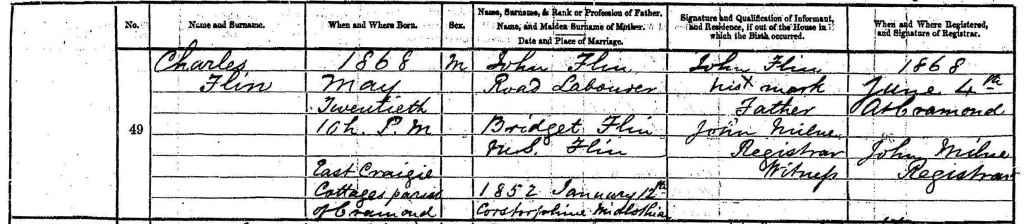
His birth was registered by his father, John, a few weeks later on 4 June. The registrar, John Milne, recorded Charles’s place of birth as ‘East Craigie Cottages parish of Cramond’. I was a bit confused by this as my grandfather, also Charles Flynn, was born at the same address, 30 years later, and I knew that East Craigie was on the other side of the River Almond from Cramond, in the parish of Dalmeny. Not only was it in a different parish, it was in another county. The River Almond formed the boundary between the counties of Midlothian (also known as Edinburghshire) and Linlithgowshire (or West Lothian).

Birth certificate of Charles Flin [Flynn], East Craigie, Cramond. National Records of Scotland, 1868 Cramond 679/33

So, why does the 1868 birth certificate indicate that East Craigie was in Cramond parish? Or, to look at it another way, why, if East Craigie was actually in Dalmeny, did the Cramond registrar register the event? Surely he should have pointed Charles’s father in the direction of the Dalmeny registrar.

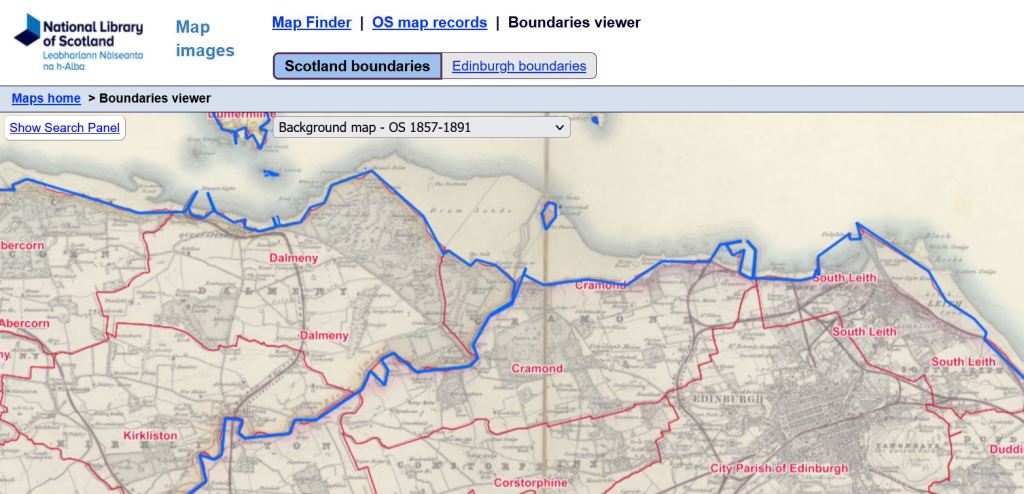
Other than posing the question on Twitter, I didn’t really give the matter much more thought, but then a few days ago, I noticed something on the National Library of Scotland’s maps website while looking at their boundaries viewer. The easternmost part of the county of Linlithgow/West Lothian – the part that included East Craigie – appeared to be part of Cramond parish. Cramond, in other words, seemed to extend over the River Almond and into Linlithgowshire. At least it did with the ‘dates of boundaries’ tool set to 1840s-1880s. If I moved the slider to the next available setting – the 1950s – the boundary of Cramond parish adjusted itself to follow the course of the River Almond.

National Library of Scotland – Boundaries viewer showing country boundaries (blue) and parish boundaries (red).

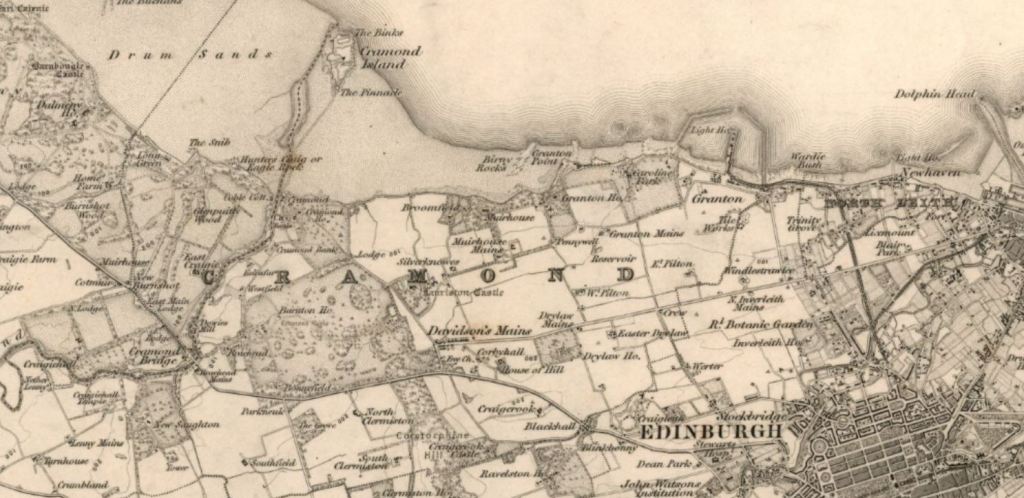
I checked a few more sources and quickly found confirmation that this part of Linlithgowshire had indeed once formed part of the parish of Cramond. The 6- and 25-inch Ordnance Survey maps published in 1856 showed the boundary between the parishes of Dalmeny and Cramond starting at the mouth of the Cockle Burn just to the east of Dalmeny House and running southwards across Dalmeny Park until it met the Queensferry Road before heading south-east to cross the River Almond at the old Cramond Bridge. On the 1857 1-inch map, the initial letter of the parish name was even printed within this section. The words ‘East Craigie’ can clearly be seen just above the letter ‘C’ of Cramond.

Ordnance Survey one-inch to the mile, Scotland, 1st Edition, 1856-1891. Sheet 32 (detail). National Library of Scotland

The entry for the parish of Cramond in the New Statistical Account of Scotland (published in 1845) simply states (in the section headed ‘boundaries’) that the parish was ‘bounded on the west by the parishes of Kirkliston and Dalmeny’ but then, in the following section on the botany of the parish it mentions:

The portion of the parish which stretches along the sea side from Wardie burn to the Cockle burn in Dalmeny Park

New Statistical Account of Scotland – Cramond, County of Edinburgh, NSA, Vol. I, 1845 p.590

I also found the family of Charles Rintoul listed in the 1861 census at East Craigie Farm: his 7-year old son, Robert, is recorded as having been born in ‘Linlithgow Cramond’.

It’s clear from all of this, therefore, that this part of Dalmeny Park, which was very definitely in the county of Linlithgowshire, had formerly formed part of the parish of Cramond and that when the Cramond registrar, John Milne, registered the birth of Charles Flin in 1868, he was doing exactly the right thing.

I was delighted to have solved the problem but there was still another question to answer. I knew that my grandfather was also born at East Craigie (in 1898) and, although his birth wasn’t registered, his older sister, Margaret, was. She was born on 26 March 1897 and her birth certificate records her place of birth as ‘East Craigie, parish of Dalmeny’. And the 1901 census returns for East Craigie confirm that the area was by then part of the parish of Dalmeny. So when did it change? When did this eastern section of Dalmeny Park become part of the parish of Dalmeny? I decided to see if I could find out…

I began by searching for references to Cramond and Dalmeny in the British Library’s British Newspaper Archive. I eventually found a useful source: each September, a notice appeared in the Falkirk Herald providing information about the registration of voters for the county of Linlithgow. Three courts were held each year (at Bathgate, Queensferry and Linlithgow) where people could go to revise and correct the list of voters. The parishes covered by each of the courts were specified and every year up to and including 1890, the Queensferry court was to deal with:

… the Parishes of Abercorn, Dalmeny, Ecclesmachan, Cramond, and Kirkliston (so far as the last mentioned Parishes are within the County of Linlithgow.)

Falkirk Herald, 20 September 1890, page 1, column c – British Library Newspapers

However, from September 1891, Cramond is no longer included:

… the Parishes of Abercorn, Dalmeny, Ecclesmachan, and Kirkliston (so far as within the County of Linlithgow).

Falkirk Herald, 12 September 1891, page 1, column e – British Library Newspapers

I now knew that the change had taken place between 1890 and 1891 and I was then able to search for relevant newspaper items in this time frame – and I soon found what I was looking for.

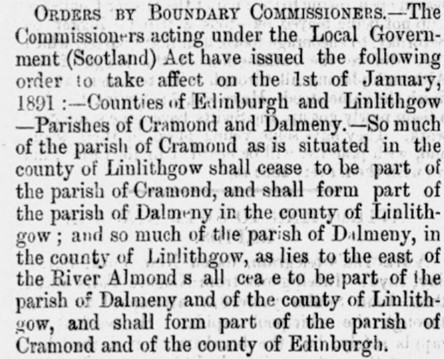
On 3 May 1890, the West Lothian Journal published the text of a draft order signed by the secretary to the Boundary Commissioners in Edinburgh, stating that:

… so much of the Parish of Cramond as is situated in the County of Linlithgow shall cease to be part of the Parish of Cramond, and shall form part of the Parish of Dalmeny in the County of Linlithgow.

West Lothian Journal, 3 May 1890, page 4, column a – British Library Newspapers

The draft order was evidently approved, and on 12 July 1890, the following announcement appeared in the West Lothian Journal:

West Lothian Journal, 12 July 1890, page 4, column a – British Library Newspapers

So, that was the answer. East Craigie ceased to be part of Cramond parish on 1 January 1891 – seven years before my grandfather was born. He and his uncle, Charles Flynn (Flin), were born in the same place, 30 years apart – but one of them was born in the parish of Cramond and the other, in the parish of Dalmeny.

In the greater scheme of things, this may not seem to be all that important but I always feel that it’s only by employing these investigative strategies, and attempting to get to the bottom of these aspects of our research that don’t quite seem to make sense, that we can begin to understand how our ancestors’ lives were affected by their political and social landscapes.

Apart from anything else, I for one, find this sort of micro-research utterly fascinating!

© David Annal, Lifelines Research, 24 July 2022
Posted in Document Sources, Local History, research, Soapbox | Tagged , , , , , , , , , , | Leave a comment

Transcripts and indexes

The release of the 1921 census returns for England and Wales earlier this year led to some (fairly heated) discussion on social media regarding the quality of the transcription provided by Findmypast, the National Archives’ commercial partners in the online launch. Findmypast even went as far as issuing a (partial) apology:

Due to the secure nature of the 1921 Census project, the period of time in which we have been able to access and review the data ahead of launch has been limited.

They went on to say that they had been “unable to conduct the same level of quality assurance checks we would normally apply”.

I wrote about the release (and the releases of previous decennial censuses) in an earlier blog post but one aspect that I didn’t touch on then was the question of transcription.

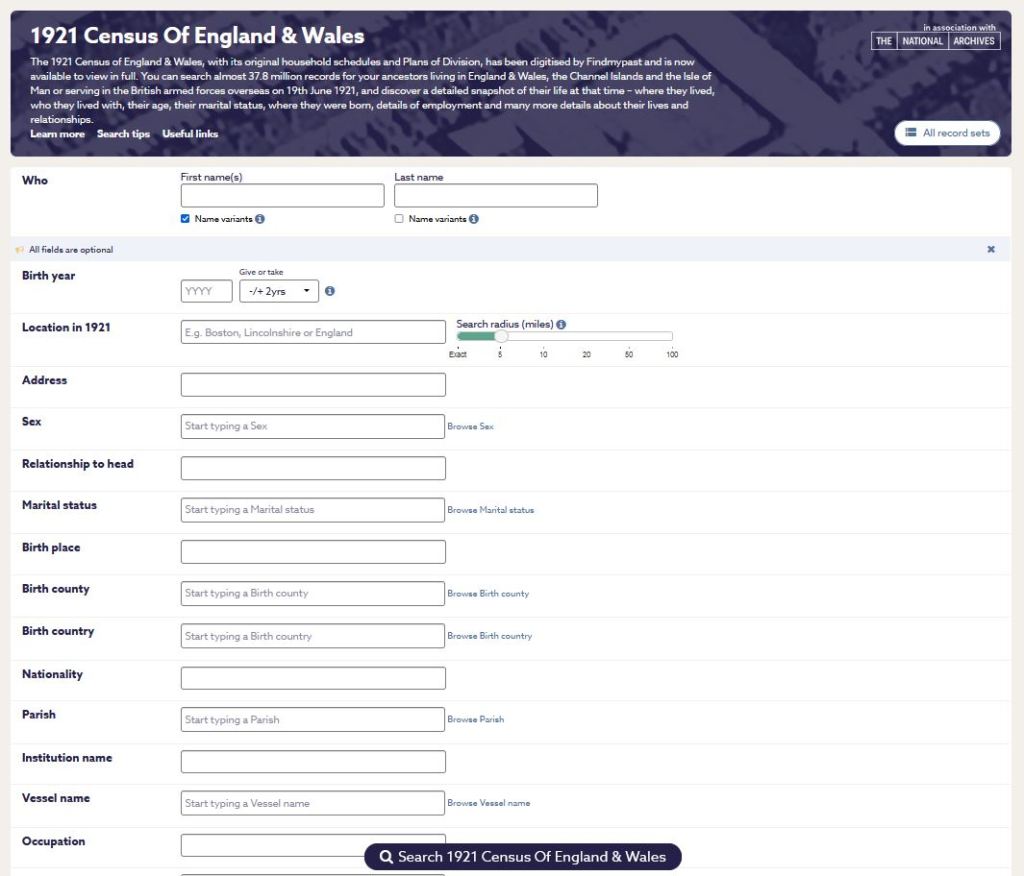
Findmypast offer two ways of accessing the 1921 census. After carrying out your search (you can search for ‘an ancestor’ or for ‘an address’) you’re presented with two options: you can either view the ‘Record transcript’ (for £2.50) or the ‘Record image’ (for £3.50).

1921 Census ‘home page’. Findmypast

Personally, I can’t see any point in paying £2.50 for the privilege of seeing what someone else thinks was written on a schedule when for just £1.00 more I can view the document itself and make my own mind up but we’ll leave that particular issue for another day. It’s the question of charging users to view what was inevitably going to be an imperfect transcript that got me thinking more generally about the whole process and practice of transcription: what is it and why do we do it?

I think it’s important to understand right from the start that transcribing a set of records and creating an index to a set of records are two very different disciplines with different ends in mind. So let’s look at the processes behind them and then we’ll come back and see how we can apply it all to the question of the quality of the transcription in the 1921 census.

Until fairly recent times, accessing original documents involved, by necessity, a visit to an archive or a library. The Latter Day Saints (in the shape of the Genealogical Society of Utah) led the way in the 1930s, by embarking on an extensive microfilming project. This allowed researchers for the first time to view original documents remotely (via their local LDS Family History Centre) or at least to view photographic images of them.[1]

There were, of course, other ways that researchers could access documents before the advent of microfilm, and for most of these we need to raise a glass of thanks to that Early Modern/Georgian/Victorian institution: the gentleman antiquarian. This isn’t the time or the place to consider the methods and behaviours of the antiquarians; they are an often-maligned group of men (and they were, I think I’m right in saying, exclusively male, middle-aged, well-to-do and white) but despite their sometimes questionable approach to ‘research’ and their occasionally selective approach to their work (their focus is undeniably on the records of those in the ‘upper echelons’ of society) it would be wrong to deny the crucial role they played in transcribing and translating thousands of medieval documents and thereby preserving them (or their contents, at least) for future generations of researchers.

V0006811 Antiquaries: twenty portraits of historians. Engraving by J. Credit: Wellcome Library, London. Wellcome Images images@wellcome.ac.uk http://wellcomeimages.org Antiquaries: twenty portraits of historians. Engraving by J.W. Cook, 1825. 1825 By: William Camdenafter: J. W. CookPublished: 1825 Copyrighted work available under Creative Commons Attribution only licence CC BY 4.0 http://creativecommons.org/licenses/by/4.0/

The work of the antiquarians was published in County Histories and in the journals of Historical Societies: parish registers, deeds, charters, wills and inquisitions post mortem were all grist to the antiquarians’ mills and we are their undoubted beneficiaries.

Increasingly, as the centuries went by, the custom of providing indexes at the end of these works developed – often separate indexes for the ‘personal names’ (index nominum) and the ‘places’ (index locorum) mentioned in the book. Of course, now, thanks to websites such as Google Books and the Internet Archive, we can not only read them, but search them for our ancestors’ names or for references to the places that they lived and worked in – whether the originals were indexed or not – but the point here is that, in the original works, the transcription and the indexing were two quite separate processes. First comes the work itself, then the names and other details are picked out, sorted into alphabetical order and linked (usually through page references) back to the original entry.

In many ways, the works of the antiquarians, are surrogates of the originals, effectively – for research purposes at least – replacing the documents themselves. After all, why go to all the trouble of seeking out an original document when you can read the text in a published book?

The post-war boom in local and family history research gave rise to a new phenomenon: the practice of indexing key genealogical sources for the benefit of the growing numbers of active family historians. Records such as census returns, monumental inscriptions, poor law records and wills became the focus of projects carried out by local and family history societies and for many years towards the end of the 20th century these locally produced indexes became vital resources for researchers, whether in printed form or on microfiche.

The indexes were largely produced by volunteers; volunteers who usually had a degree of local expertise which they could use to help them to interpret some of the trickier text. The importance of local knowledge when it comes to this sort of work cannot be overestimated.

As a researcher, working in the 1980s and 1990s, I benefited enormously from the work carried out by the various family history societies. I bought copies of census indexes (I even had one of those new-fangled, hi-tech microfiche readers in my home office!) and I used them to search for families, knowing that finding a possible hit was only the start of the journey.

Because these census indexes were not designed to replace the documents but rather to lead researchers to the original returns. Indeed many of them were simply surname indexes, providing nothing but the surname and a reference to the page/folio where the relevant entry would be found. Some included additional details such as first names and ages but they were never intended to act as a substitute for the records themselves. They were a means of access and nothing more.

In 1988 a more ambitious project was launched by the Genealogical Society of Utah in partnership with the Federation of Family History Societies (now the Family History Federation) with the aim of transcribing the whole of the British 1881 census. I plan to write in more detail about this project in a future blog post so I’ll just say here that the transcription was done by volunteers, mainly people with local knowledge, that the whole project took four years to complete, and that the ‘output’ was, inititally at least, published on microfiche, followed by a set of CD-ROMs.

University of Hertfordshire https://uhra.herts.ac.uk/bitstream/handle/2299/390/100251.pdf

Then along came the internet … and everything changed …

As I’m sure I’ve mentioned before, I was lucky enough to be there at the start of the genealogical digital revolution. I was involved in the National Archives’ plans to digitise the collection of Prerogative Court of Canterbury wills: in fact, I was one of a handful of people in a meeting at which it was decided to recommend that the PCC wills should be chosen as the first record set to get the digital treatment.

I was also actively involved in the 1901 and 1911 census projects so I think it’s safe to say that I have a fair understanding of how digitisation projects work.

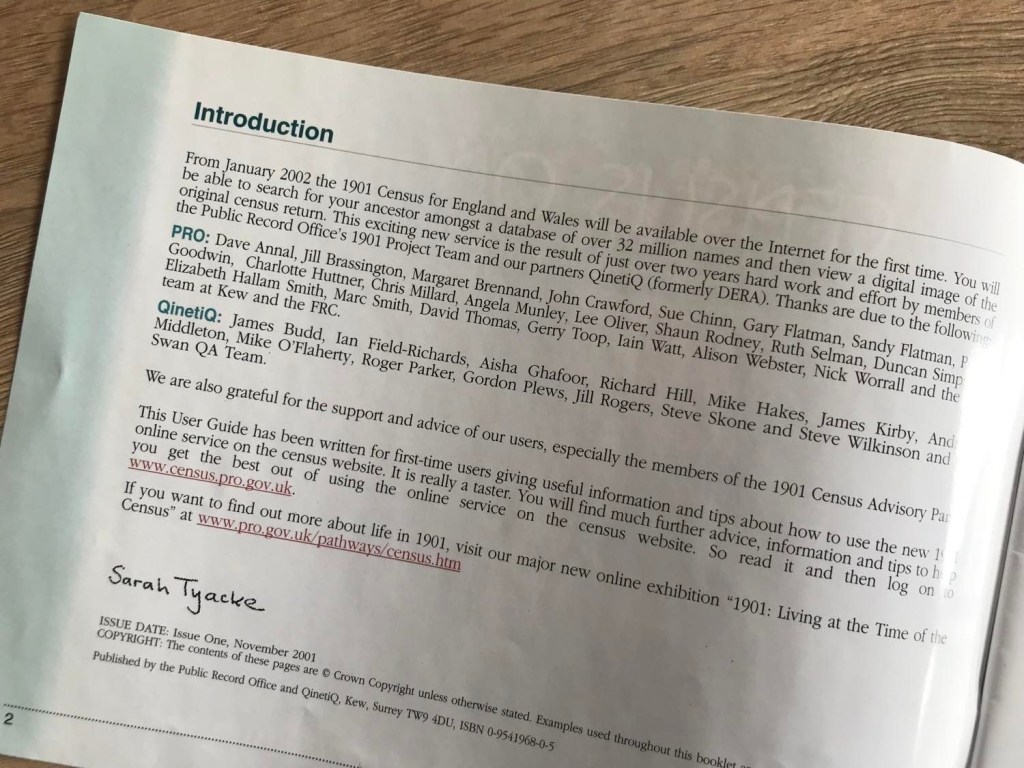
Introduction to the 1901 Census Online booklet. Public Record Office and QinetiQ (2001)

Since those early projects, things have moved on and a significant proportion of users of the vast online genealogical databases hosted by commercial organisations such as Ancestry and Findmypast have no experience of what went before.

The commercial companies have, over the years, increasingly adopted a position of transcribing virtually everything from the original record – in fact, this was the policy when it came to the ground-breaking online release of the 1901 census. Unlike the very rudimentary census indexes produced by family history societies in the late 20th century, the default position is now to capture everyone’s names, ages, relationships, marital status, occupations and birthplaces, not to mention all the information relating to the properties themselves. And you can see why you would want to do this: the more information you transcribe, the easier it should be to find the person you’re looking for. It makes a lot of sense, certainly from the users’ point of view, particularly (and this is a very important point) for those users whose primary interest in the documents is not family history but some other discipline such as local history, social history, house history or demography.

But then what happens is that the commercial companies, who have clearly invested a lot of time and money in having these essentially comprehensive transcriptions of the censuses carried out, lose sight of why they were producing the transcript in the first place – remember, it was all about helping the users to find their people! – and they see an opportunity to recoup some of that investment. Why not – you can imagine the executives suggesting in a boardroom meeting – why not charge people to view the transcript? Why not turn the transcript into a marketable item?

But as soon as you decide to charge people to view the results of your transcription, as soon as you put a value on the transcription as a separate product, you raise the expectations of the user that what they are going to get is necessarily an accurate, word-for-word copy of the original

Transcribing handwritten documents is a difficult task, particularly when, as is the case with our decennial census returns, the documents in question were written by thousands of different people, each, potentially, with their own idiosyncratic handwriting style. This is particularly true of the 1911 and 1921 censuses where the records we see are the schedules written by the householders themselves.

The idea that it might be possible to create a transcript which even approaches 100% accuracy, is a pipe dream. If you were to apply the necessary academic standards to the task (the use of genuine experts, including those with the necessary local knowledge, to carry out the transcription itself; rigorous supervision of the whole transcription process including double-keying throughout; access to relevant reference works; a team of suitably qualified editors to check everything and most importantly, lots of time) the cost would instantly make the entire project commercially unviable. And even then, it wouldn’t be anywhere near 100% accurate. It’s simply not possible to work out in every single case what a particular word or character was supposed to be.

When I worked for the Public Record Office (as it was then) on the 1901 census project, I was constantly told that an accurate transcription was deliverable – even if (as I recall) the target was 95% accuracy. But it wasn’t then, and it still isn’t now.

My personal experience is that because of the virtually comprehensive manner in which the data is captured it is almost always possible to find the person I’m looking for – however bad some of the transcription might be. The search functionality is so flexible that even if just one piece of data relating to an individual is transcribed accurately (perhaps their birthplace or occupation) that can be enough to allow you to identify them. And this is no different to countless other databases that we search every day.

1921 Census Advanced Search screen. Findmypast
https://search.findmypast.co.uk/search-world-records/1921-census-of-england-and-wales

So, as I see it, the problem with the 1921 census transcription is not that the work in this case isn’t up to scratch (that may or not be true) but that the commercial providers have raised the users’ expectations so far with the promise of what they call ‘a legible translation of the original record’ that when those expectations (inevitably!) are not met, the disappointment is naturally greater than it might be.

© David Annal, Lifelines Research, 22 May 2022


[1] Microfilm, Mormons and the Technology of the Archive, Hannah Little, eSharp Journal, University of Glasgow, Issue 12, Winter 2008. https://www.gla.ac.uk/research/az/esharp/esharp/12winter2008technologyandhumanity/

Posted in digitisation, Document Sources, research, Soapbox | Tagged , , , , , , , , , , | 6 Comments

Six Days, Six Stones – Part 6: Astbury

This the last of six blogposts written and published on six successive days, in which I take a look at a particular ancestral gravestone that my wife and I visited on our recent road trip. You can read the other five here: Part 1, Part 2, Part 3, Part 4 and Part 5.

Today we’re in the Cheshire village of Astbury, now on the outskirts of Congleton but historically the heart of the ancient parish of Astbury. We had no idea whether or not we would find any family stones there but I think it’s fair to say that we hit the jackpot with this one…

If you were to draw a triangle connecting the parishes of Macclesfield, Leek and Congleton you would cover an area which included the birthplaces of the majority of my wife’s English ancestors. Gawsworth, Marton, Eaton, Wincle, Buglawton, Rushton Spencer, Biddulph, Hulme Walfield and Sommerford Booths – all are there or thereabouts. Tracing their lives hasn’t always been that easy as they constantly flit back and forward across the Staffordshire/Cheshire county border.

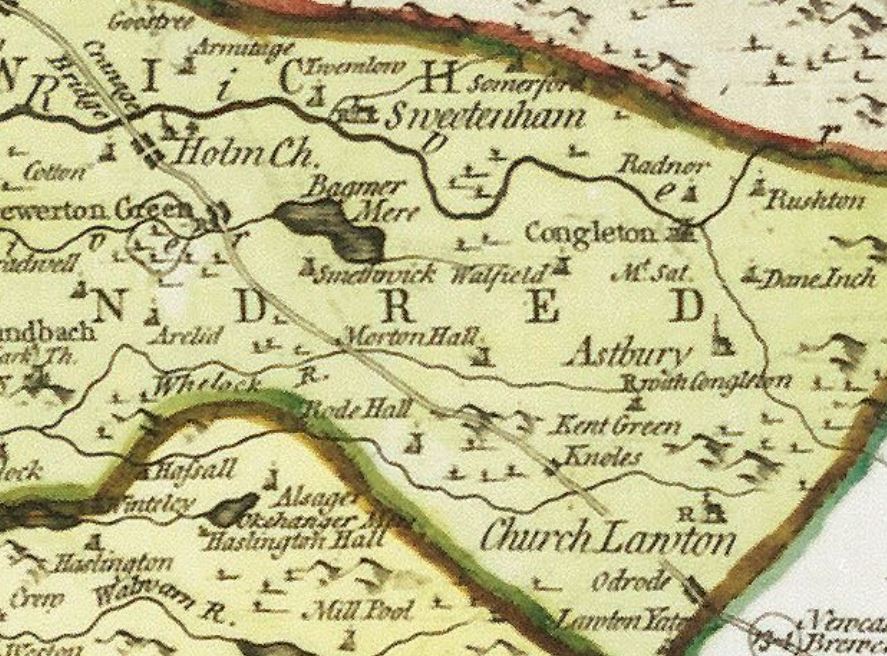
An accurate map of the county palatine of Chester : divided into its hundreds
London : sold by I. Hinton at the Kings Arms in Newgate street
[ca.1752 – 1765]

The parish of Astbury was formerly one of the biggest parishes in England. It included the chapelries of Buglawton and Congleton along with the townships of Davenport, Eaton, Hulme Walfield, Moreton cum Alcumlow, Newbold Astbury, Odd Rode, Radnor, Smallwood, Somerford and Somerford Booths – and most of those places feature in my wife’s ancestry.

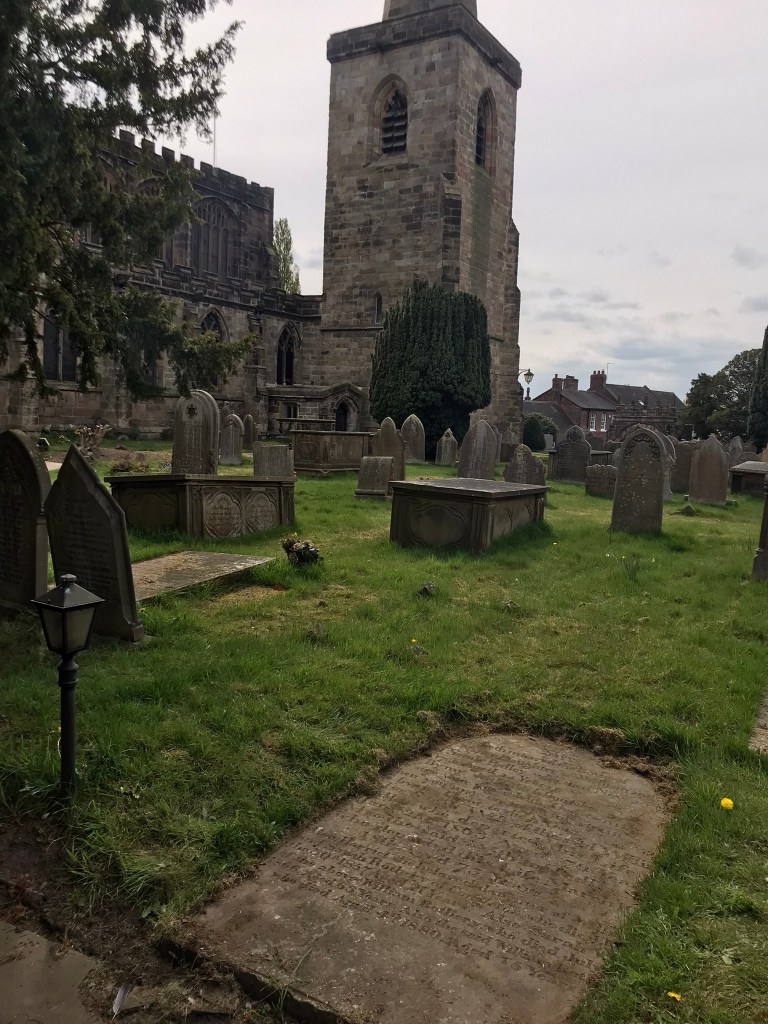
Pedley, Ford and Dutton were three of the surnames we were looking for when we set out on the daunting task of searching the hundreds of surviving stones in Astbury’s sprawling churchyard. Many of the stones are laid on their backs. Whether they were originally upright or whether they were designed to be laid flat in this way from the outset it’s difficult to say – I need to do a bit more research.

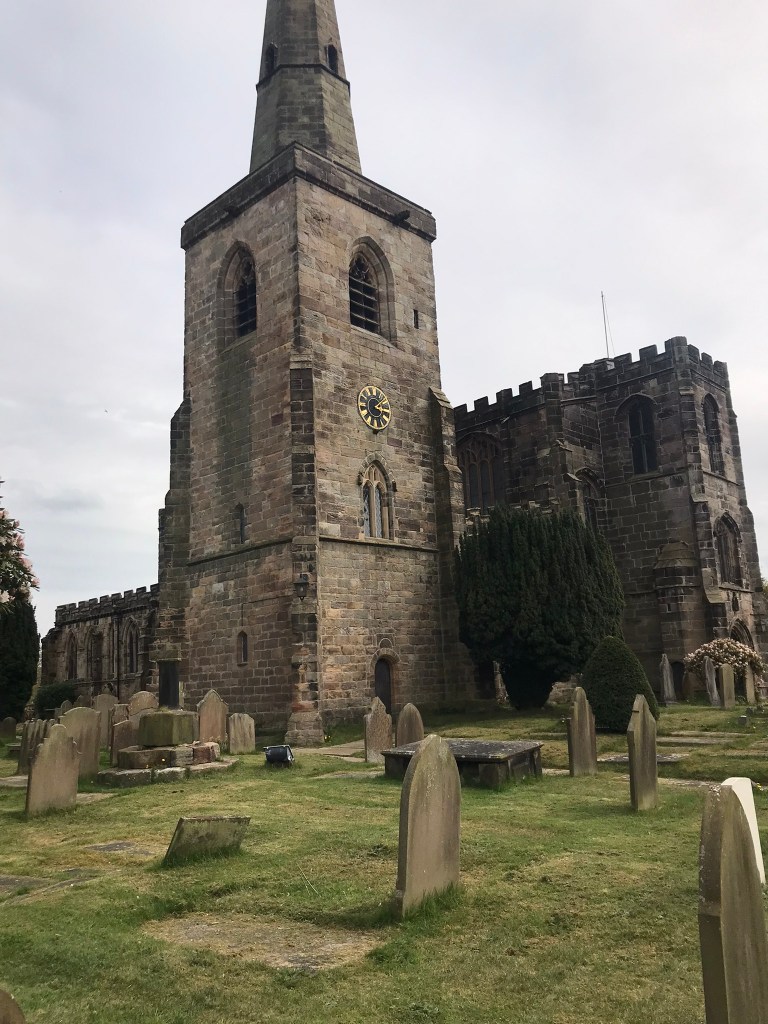
Churchyard, St Mary’s, Astbury, Cheshire

There are some pros and some cons when it comes to ‘flattened’ stones. The most obvious con is that they often become covered with grass clippings and mud and the general detritus of everyday life and can soon be lost beneath a layer of fresh turf. When we visited the churchyard at Marton we found that a number of the stones that had been transcribed quite recently by the Family History Society of Cheshire are now hidden under a thick layer of grass.

Of course, the flipside to this is that once the inscriptions are covered in this way, they’re being preserved for future generations – although you can’t see them! I guess it’s kind of a good news/bad news situation…

It didn’t take us too long to start finding some family graves – a Ford and a few Pedleys – but they weren’t direct ancestors and the inscriptions were proving very difficult to read. We were also painfully aware that many of the flattened stones were completely covered and that if what were looking for was on one of those stones we weren’t going to find it.

We decided to just keep wandering and see what we could see and we had just started out along a path which led beneath a semi-recumbent yew tree when a large (very large!) stone caught my eye – it was a Pedley stone and it looked like it was one of ours.

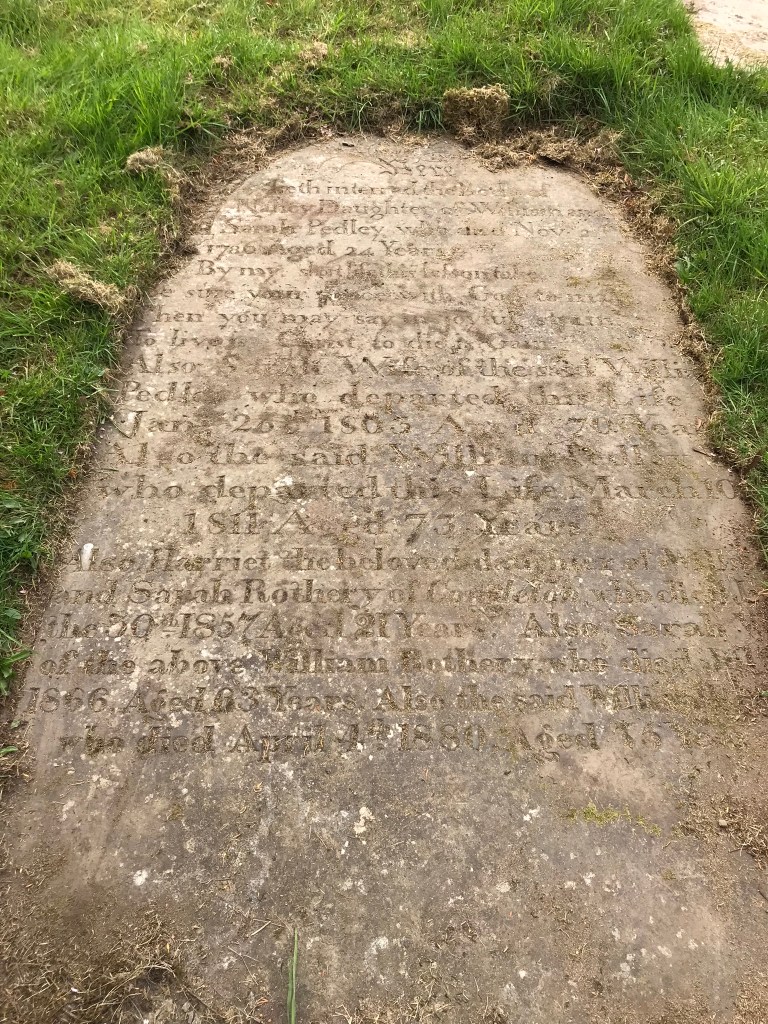
Pedley gravestone, St Mary, Astbury, Cheshire

I cleared away as much debris as I could, conscious of the fact that the grass was seriously encroaching on the stone, which was set an inch or two lower than the surrounding growth. The right edge, towards the foot of the stone was particularly overgrown and there were actually two bits we couldn’t get to. The rest, however, was fully legible:

Here
lieth interred the Body of
Nancy daughter of William and
Sarah Pedley who died Nov 25th
1786 aged 24 Years
By my short life this lesson take
be sure your peace with God to make
Then you may say in joyful strain
To Live is Christ, to die is Gain
Also Sarah wife of the said William
Pedley who departed this life
Jan 26th 1803 aged 70 Years
Also the said William Pedley
who departed this life March 10
1811 aged 73 Years
Also Harriet the beloved daughter of William
and Sarah Rothery of Congleton who died Ju..
the 30th 1857 aged 21 Years Also Sarah wife
of the above William Rothery who died July ..
1866 aged 63 Years Also the said William Rothery
who died April 4th 1880 aged 75 Years

Gravestone of William and Sarah Pedley, St Mary, Astbury, Cheshire

William and Sarah were my wife’s 5x great grandparents, born in the late 1730s. To find a stone as clear and legible as this for relatives who were born almost 300 years ago was an unexpected pleasure.

Who knows what other gems are in the churchyard at Astbury hidden beneath a couple of inches of turf. At least, if there are any there, we know that they’re being protected from the elements and from the ravages of time…

© David Annal, Lifelines Research, 7 May 2022

Posted in Local History, research, Stories, Surnames, Uncategorized | Tagged , , , , , , , , | Leave a comment

Six Days, Six Stones – Part 5: Macclesfield Cemetery

This is the fifth of six blog posts, written and published over six consecutive days, looking at some of the family graves that my wife and I visited as part of a recent road trip to celebrate our 40th wedding anniversary. You can read the earlier instalments here: Part 1, Part 2, Part 3 and Part 4.

The other five stones are all in churchyards (actually one of them was inside the church) but today’s stone is to be found in a large municipal cemetery.

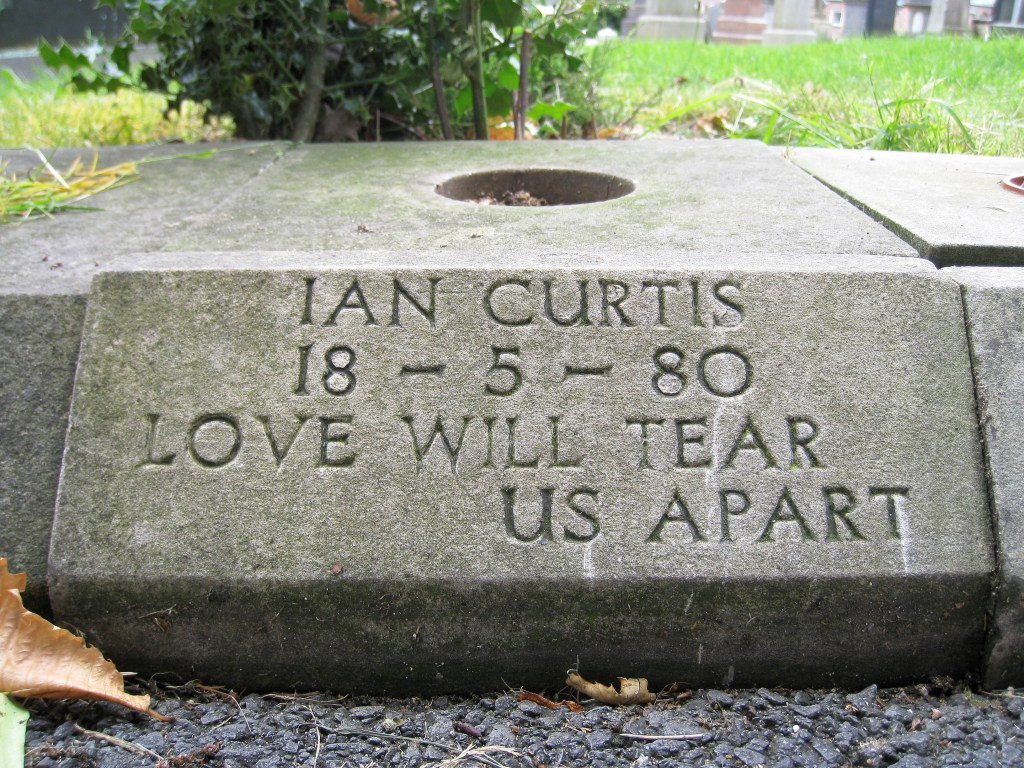
In 1866, the Macclesfield Municipal Borough set aside 68 acres of land to the north and west of the town to establish a public cemetery. Like many Victorian cemeteries, it was designed as a place of leisure and relaxation and it’s still a popular destination for an afternoon stroll today. The cemetery also attracts hundreds of visitors every year from all over the world, who come to see the grave of Ian Curtis, the former Joy Division singer, who was cremated at Macclesfield Crematorium following his death by suicide in 1980.

Ian Curtis’s memorial stone at Macclesfield Cemtery.
Bernt Rostad from Oslo, Norway, CC BY 2.0 https://creativecommons.org/licenses/by/2.0, via Wikimedia Commons

My wife and I had first visited the cemetery nearly 40 years ago but with no idea of where to look for possible family graves it was more an excuse for a stroll around a beautiful cemetery than a genuine attempt to carry out any sort of family history research.

This time we came properly perpared, having found references to two family plots (the Macclesfield Cemetery and Crematorium registers have recently been indexed and digitised by DeceasedOnline). The question was, were there any stones on the plots to commemorate my wife’s ancestors?

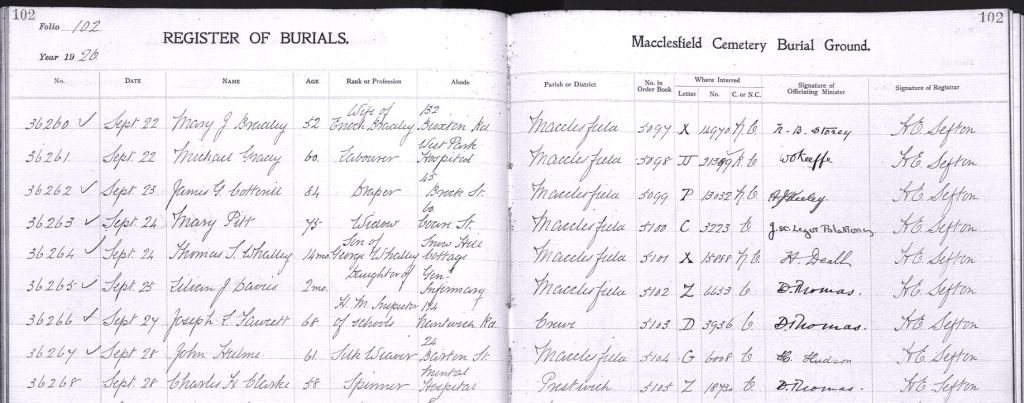
John Hulme burial, Macclesfield Cemetery, Macclesfield, 1926. East Cheshire Council (via DeceasedOnline)

We had two targets to look for – one for the Hulme family and one for the Bullocks – which turned out be in neighbouring sections: G & H. To be honest, we didn’t hold out much hope of finding anything at the Hulme plot. My father-in-law’s paternal grandparents were not particularly well off and it didn’t seem likely that they or any of their children would have been able to afford to have a stone erected. The Bullocks were a (small) step up the social ladder presenting a greater cause for optimism.

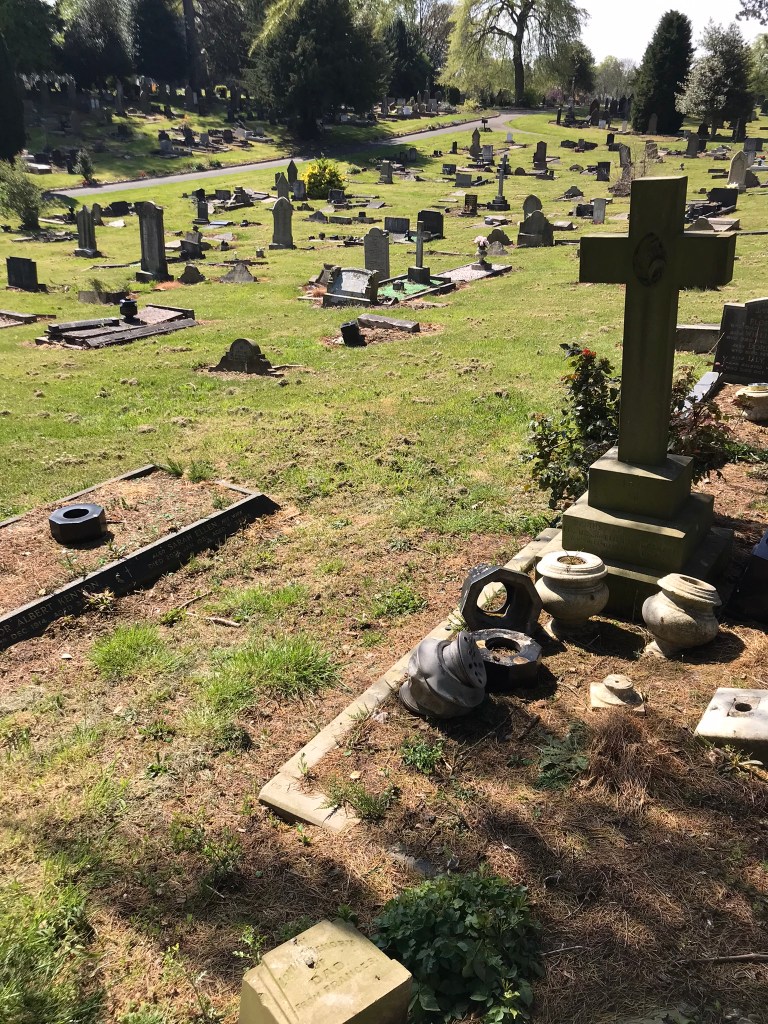
We knew that the Hulme plot was in section G, number 6008. Of course, we had no idea where in section G we would find the plot and there were no helpful numbers engraved on the backs of any of the other stones that we could find to help steer us in the right direction.

Section G, Macclesfield Cemetery, Macclesfield, Cheshire

So there we were, standing in Macclesfield Cemetery, in section G, finding names on the stones and looking them up on DeceasedOnline on our phones so that we could find out the plot numbers. Now why didn’t we think of doing that back in 1983!!??

We soon worked out that we were at the wrong end of the plot and gradually worked our way along until we found a grave which we knew, from its plot number, must be very close to the Hulme’s. The area we were in didn’t look too promising: there were very few stones around and those that we could see seemed a bit too recent … but then we turned into a new row, and there it was…

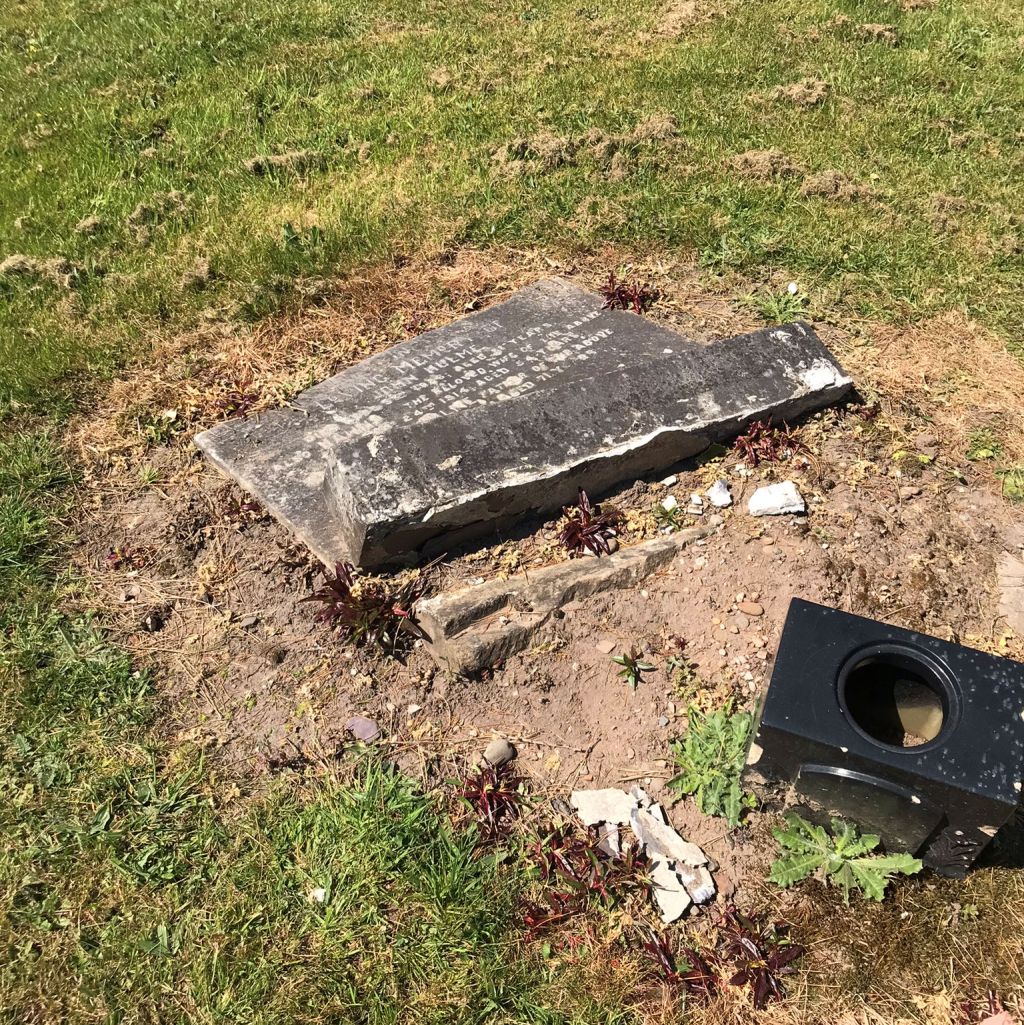
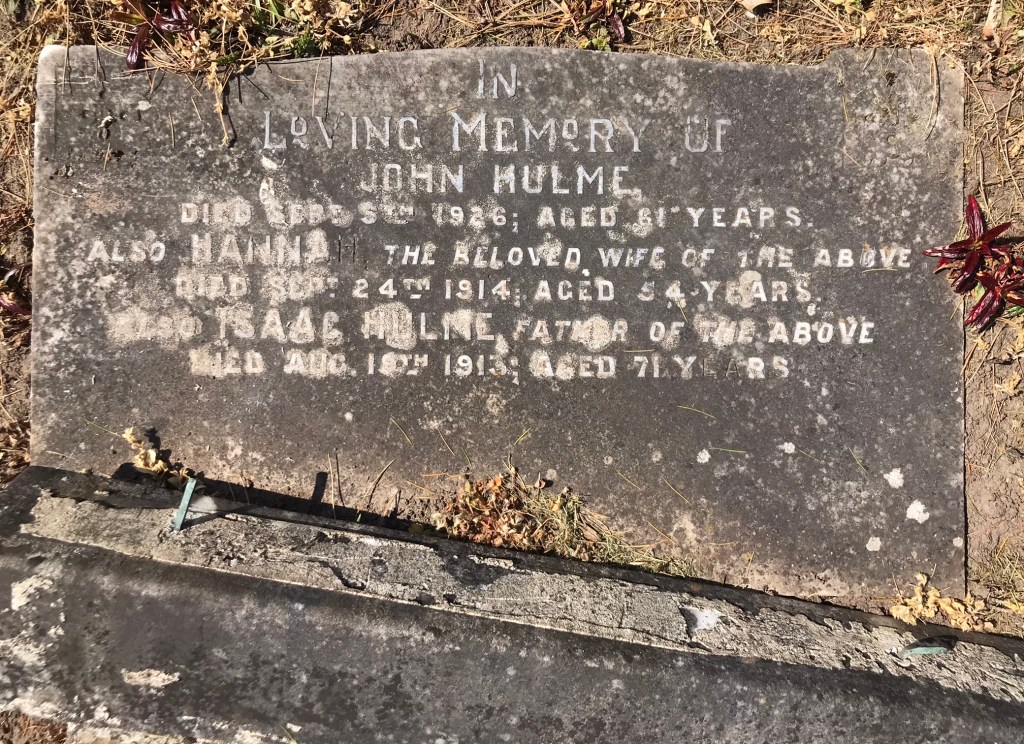
Gravestone of John and Hannah Hulme, Macclesfield Cemetery, Macclesfield, Cheshire. Plot G, Grave no. 6008

Lying on its back, its former base now lying partially on top of the stone itself, the whole thing had clearly seen better days. But it was there – and the text was fully legible:

IN
LOVING MEMORY OF
JOHN HULME
DIED SEPT 5TH 1926: AGED 61 YEARS.
ALSO HANNAH THE BELOVED WIFE OF THE ABOVE
DIED SEPT. 24TH 1914: AGED 54 YEARS.
ALSO ISAAC HULME FATHER OF THE ABOVE
DIED AUGUST 19TH 1913: AGED 71 YEARS

Gravestone of John and Hannah Hulme, Macclesfield Cemetery, Macclesfield, Cheshire. Plot G, Grave no. 6008

As you’ll see from the first picture of the plot, there’s a much more modern flower vase next to the grave. It’s unengraved but it’s perhaps a clue to the fact that the grave was re-opened following John’s death in 1926 – twice. His two daughters, Harriet and Gertrude May (‘Aunty Gertie’), were buried in the family plot in 1956 and 1969 respectively. It’s nice to know that the two of them, who never married and lived together all of their lives, were reunited in death.

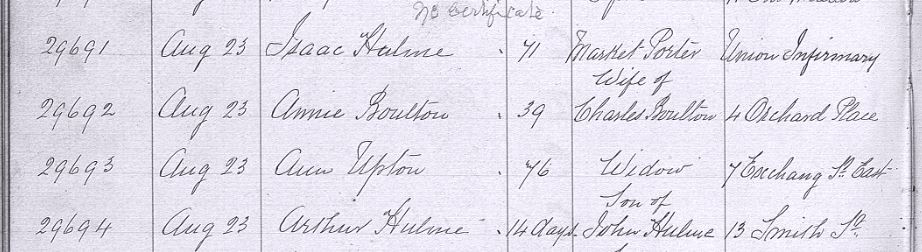
There’s another body in the grave which it seems appropriate to record here. On the same day that Isaac was buried (23 August 1913), and presumably as part of the same service, his great grandson, Arthur (the son of John’s son John Frederick – I hope you’re following this…) was also buried. Young Arthur had died the day after Isaac at just 14 days old.

Burials of Isaac and Arthur Hulme, Macclesfield Cemetery, Macclesfield, 1914. East Cheshire Council (via DeceasedOnline)

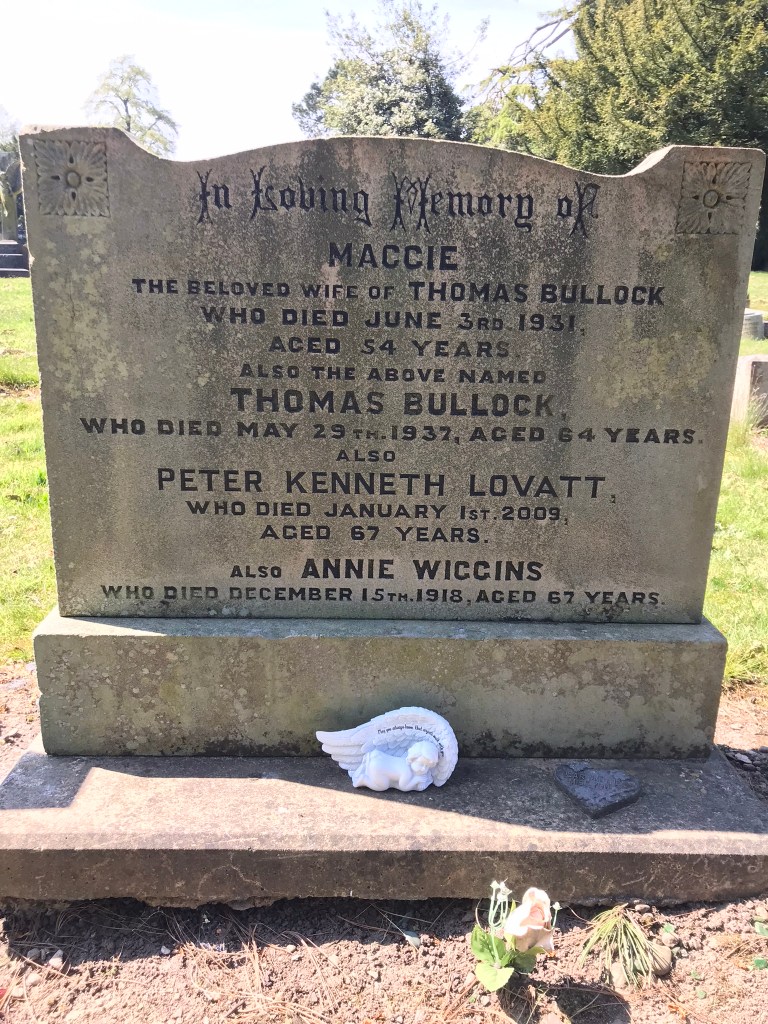
For the record, we quickly found the grave of my wife’s Bullock great grandparents, Thomas and Maggie. The stone, as I would have expected, was in far better condition and had been opened for the burial of their grandson, Peter Kenneth Lovatt, as recently as 2009.

Gravestone of Thomas and Maggie Bullock, Macclesfield Cemetery, Macclesfield, Cheshire. Plot H, Grave no. 6474

Returning to the Hulme gravestone, and returning to a recurring theme of these blog posts, the dates of death recorded for John and Hannah are wrong. John actually died on 25 September 1926 and Hannah on 5 September 1914. They somehow got them (almost) the wrong way round.

Remember, gravestones are NOT primary sources…

© David Annal, Lifelines Research, 6 May 2022

Posted in Document Sources, Local History, research, Stories, Surnames | Tagged , , , , , , , , , , | 1 Comment

Six Days, Six Stones – Part 4: Longnor, Staffordshire

This is the fourth of six blog posts written after a recent road trip during which my wife and I visited a number of ancestral burial places. You can read the earlier instalments here: Part 1, Part 2 and Part 3.

The Staffordshire Moorland town of Longnor was home to generations of my wife’s ancestors. Even today, it’s a small, relatively isolated community and it wasn’t until the early 18th century that the population of the parish climbed above a few hundred.

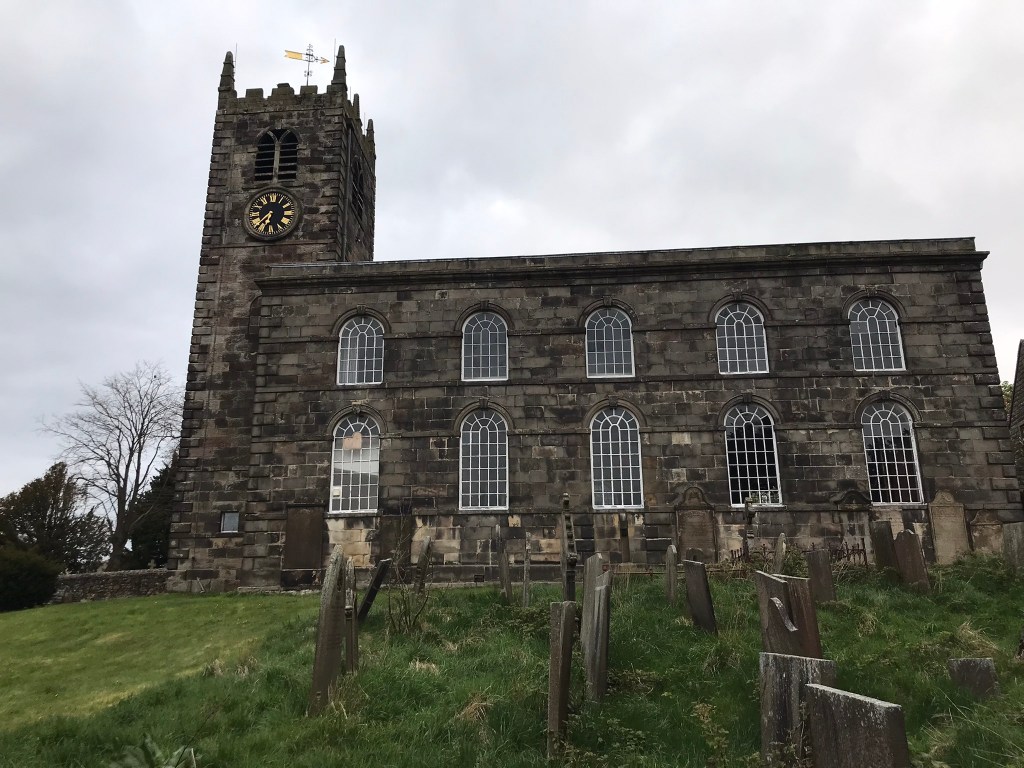
Historically, Longnor was part of the ancient ecclesiastical parish of Alstonefield but there was a church – a Chapel of Ease to be exact – at Longnor as early as 1223. As Alstonefield’s parish church lies some distance away, the inhabitants of Longnor would have been grateful not to have to make the seven mile journey there and back for their weekly worship, to get married or to have their children baptised. Most importantly, they were able to bury their loved ones close to their homes in their own community.

St Bartholomew, Longnor, Staffordshire

The earliest surviving parish register dates from 1691 – an earlier register is believed to have been lost – and in 1737, St Bartholomew’s, Longnor became a separate ecclesiastical parish.

Over the centuries, hundreds of my wife’s ancestors must have been buried at St Bartholomew’s. There are a few Hulme gravestones but, as far as we’re aware, no stones survive to mark the last resting places of any of her direct Hulme ancestors. However, large parts of the churchyard are very overgrown (or at least they were when we visited in April 2022) so it’s not impossible that somewhere in the darkest reaches of the burial ground there may be one one or two.

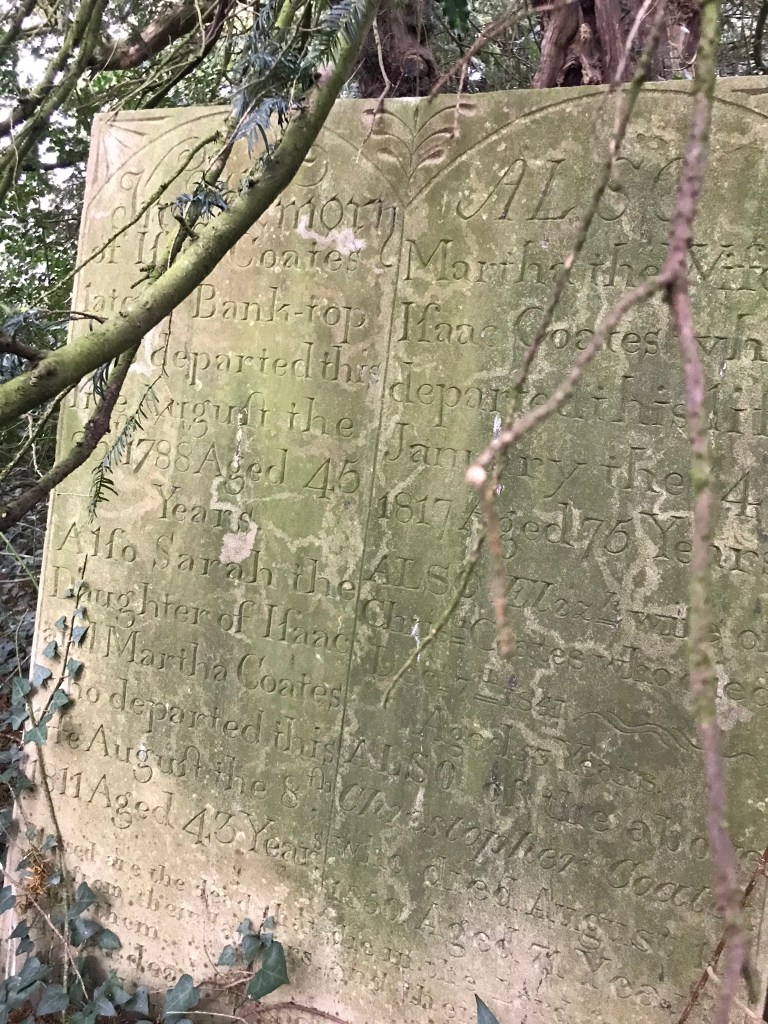
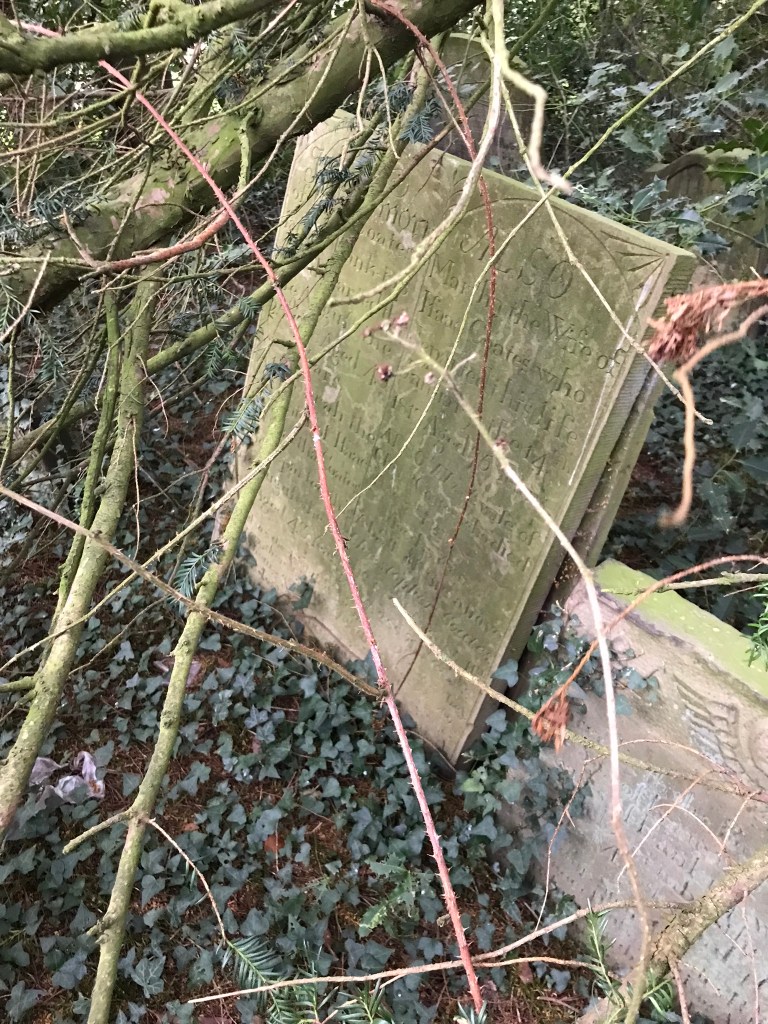
Diving deep into the most overgrown part of the graveyard last week, I found a stone commemorating the family of Isaac and Martha Coates, my wife’s 6x great grandparents. Considering its age and its current position in the middle of what basically amounts to a small forest, the stone is in remarkably good condition. I wasn’t able to take the classic ‘full face’ gravestone photo due to the presence of a fairly substantial tree just a few feet away, but I was still able to get enough shots to enable me to read all the crucial information.

The inscription reads:

In Memory
of Isaac Coates
late of Bank-top
who departed this
life August the
25th 1788 Aged 45
Years
Also Sarah the
Daughter of Isaac
and Martha Coates
who departed this
life August the 8th
1811 Aged 43 Years

ALSO
Martha the Wife of
Isaac Coates who
departed this life
January the 14th
1817 Aged 75 Years
ALSO Elizh. wife of
Christr. Coates who died
Decr. 7th 1841
Aged 53 Years
ALSO of the above
Christopher Coates
who died August 11th
1850 Aged 71 Years

Gravestone of Isaac & Martha Coates, St Bartholomew, Longnor, Staffordshire

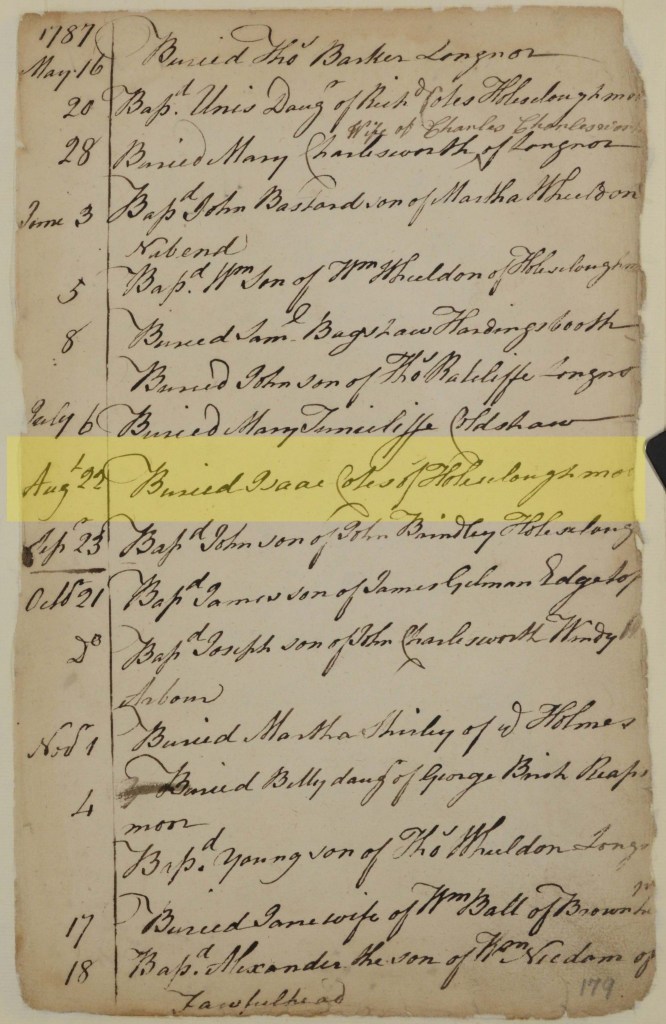
One thing that this exercise has brought to the fore is that gravestone inscriptions are NOT primary sources. We need to be careful about taking the dates and other details on trust. The inscriptions were oten made many years after the event and in this case, the memory of whoever provided Isaac’s details was somewhat lacking: the Longnor parish register clearly records Isaac’s burial on 22 August 1787 making his stated death date of 25 August 1788 questionable to say the least.

Burial of Isaac Cotes, St Bartholomew, Longnor. Staffordshire Record Office ref: D921/1/pt2

Perhaps the graveyard will be properly restored one day but even as it is today, it would be a major (dare I say?) … undertaking! And as each year passes the task will only become more challenging. Perhaps I need to visit in the middle of winter when the undergrowth (not to mention the overgrowth) is at its most penetrable.

Coates family gravestones in the churchyard of St Bartholomew, Longnor, Staffordshire

Meanwhile, I’ve got about 100 photographs to go through to work out which of them relate to my wife’s direct family…

© David Annal, Lifelines Research, 5 May 2022

Posted in Document Sources, Local History, research, Stories, Surnames | Tagged , , , , , , , , , , | 3 Comments

Six Days, Six Stones – Part 3: Key Hill Cemetery, Birmingham

The third of my six blogs posted in consecutive days, focussing on particular family gravestones, is a bit of a cheat. The other five are stones that my wife and I saw for the first time on our recent 40th Anniversary road trip: today’s is one that we’d intended to go and see but for one reason or another, we had to cancel our plans.

So, the images and the story behind this stone are the result of a visit I made to Key Hill Cemetery in Birmingham in June 2017. I’ll get back there one day…

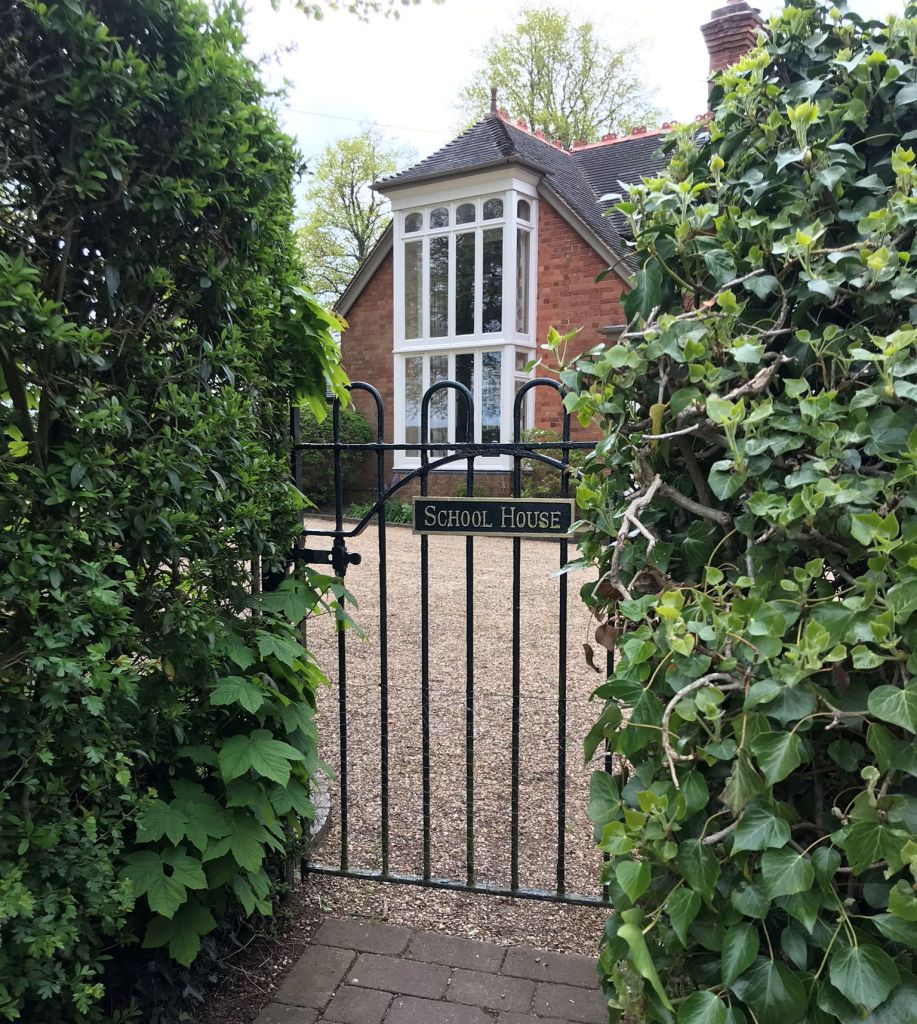
My 2x great grandfather, Thomas Port, died in Chaddesley Corbett, the Worcestershire village where he spent the last few years of his life, after retiring from his business as a soda manufacturer in Smethwick. Thomas’s daughter, Nellie, was the headmistress of the board school in Chaddesley Corbett and it seems that he and his second wife, Mary Ann, moved in to the school house sometime in the mid-to-late 1890s.

The School House, Chaddesley Corbett, Worcestershire

I first visited Chaddesley Corbett about eight years ago and spent some time wandering around the churchyard there hoping to find Thomas’s grave. My search was unsuccessful and a few years later I discovered that I’d been looking in the wrong place and that he, along with several other members of the family, was buried many miles away, in Birmingham.

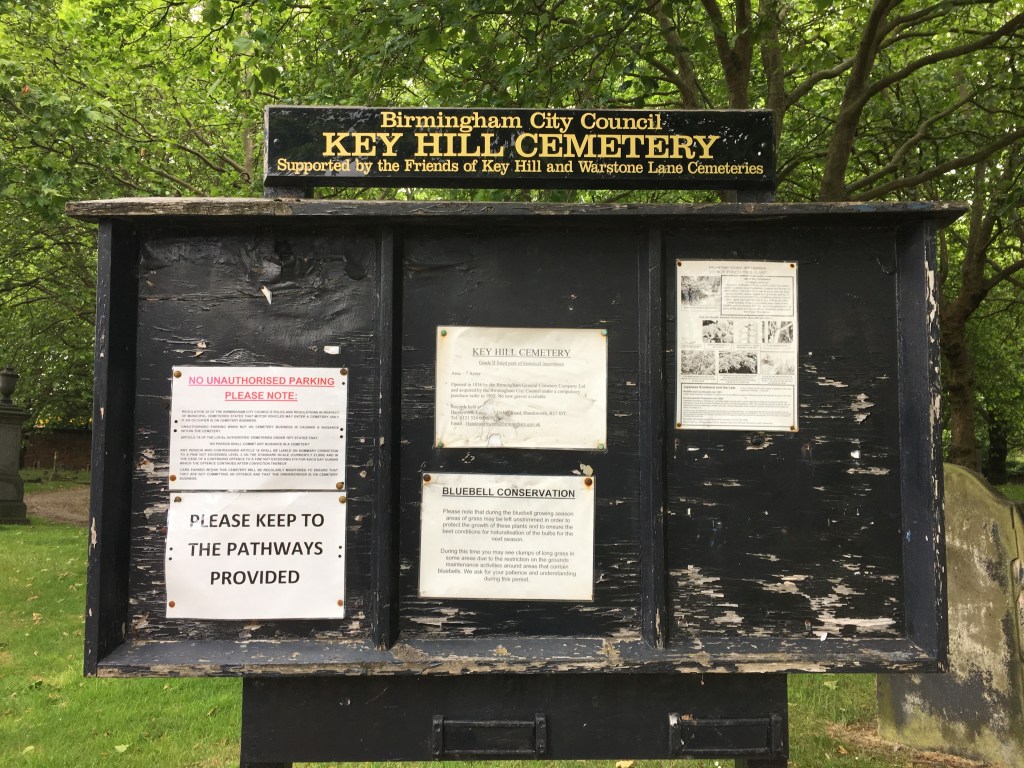
Key Hill Cemetery, also known as the ‘Birmingham General Cemetery’ was opened in 1836 to provide much-needed burial space for the growing Protestant nonconformist population in England’s second city and one of those nonconformists was my ancestor, Thomas Port.

Noticeboard, Key Hill Cemetery, Birmingham

Thomas had arrived in Birmingham in 1850 and the following year, his oldest daughter, Kate Elizabeth Mary, died of small pox. ‘Mary’, as she’s described in the cemetery’s burial register, was the first member of the family to be buried at Key Hill, on 14 October 1851. Young Mary was buried in a public grave but by the time that Thomas’s first wife Mary died in 1859, the family had its own plot: grave no.175 in section O.

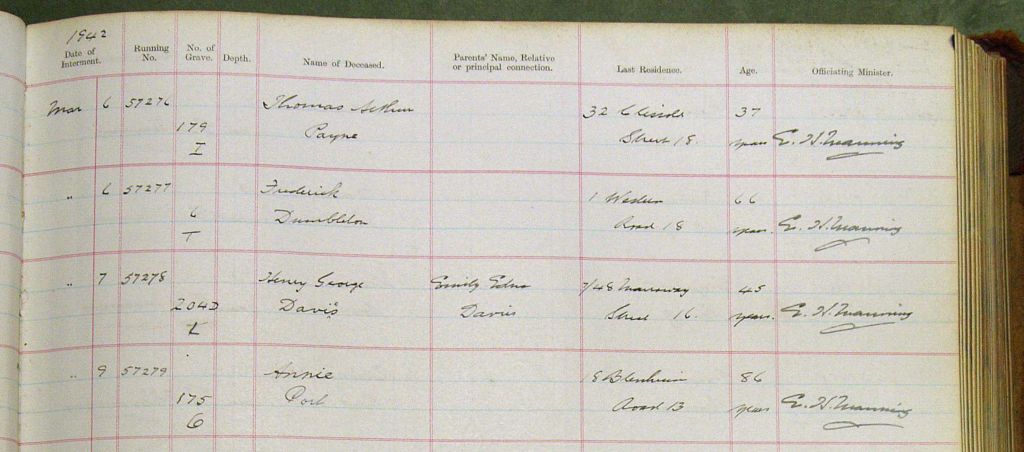
Between 1860 and 1895, five more of Thomas’s children were buried in the family plot at Key Hill, before Thomas joined them on 23 January 1900. Mary Ann died in November 1904 and it was to be another 37 years before the grave was opened once more – and for the last time – for the burial of Annie, Thomas’s third daughter on 9 March 1942.

Burial of Annie Port, Key Hill Cemetery, Birmingham, 1942

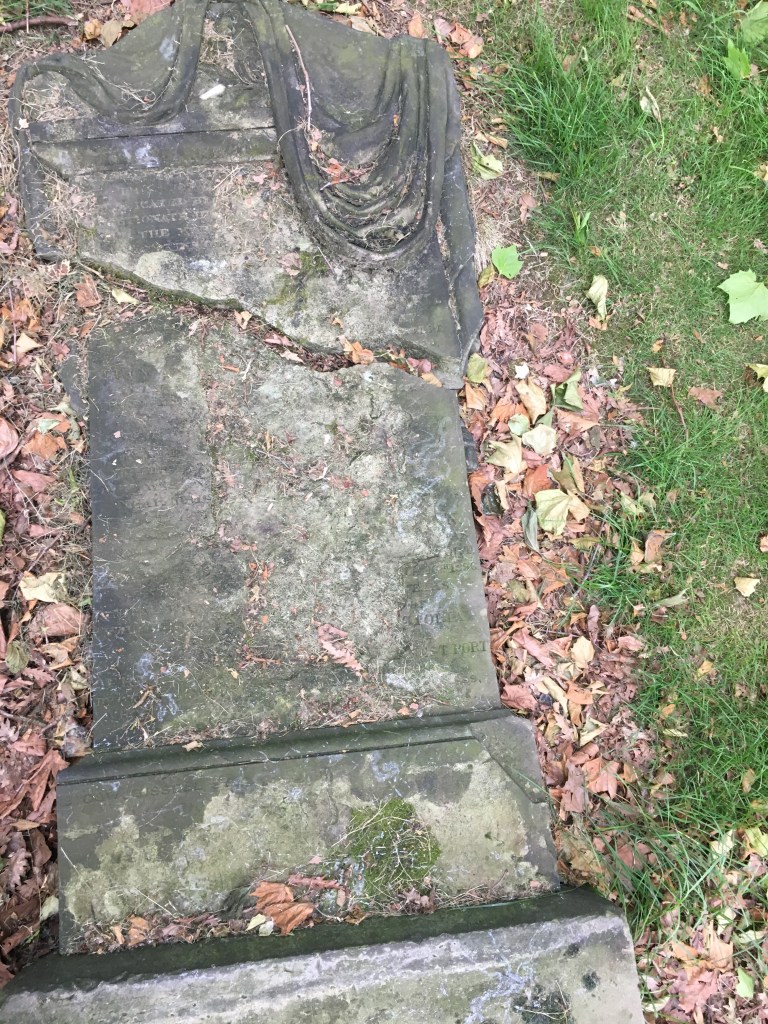
When I visited Key Hill Cemetery back in 2017, I was armed with the grave number and a good idea of where in the cemtery I might find the Port family plot. I was therefore quickly able to find the stone but also quickly disappointed to find that it was not in a good state. At some time in the 75 years since Annie’s burial in 1942, the stone had fallen and was now broken into a number of pieces.

Port family gravestone, Key Hill Cemetery, Birmingham

Large parts of the inscription are worn away or entirely missing but I’ve been able to piece some of it back together again. I was particularly pleased to note that Thomas’s oldest daughter, who had been buried in a public grave in 1851 is commemorated, along with her siblings.

My main reason for wanting to revisit the grave was to get better photos of what remains but that will have to wait for another day. It’s good to know that there is a stone, however badly damaged it might be and who knows…? Maybe one day I’ll be able to get it restored to its former glory…

Follow the links to read Part 1 and Part 2.

© David Annal, Lifelines Research, 4 May 2022

Posted in Document Sources, Local History, research, Stories, Surnames | Tagged , , , , , , | 7 Comments

Six Days, Six Stones – Part 2: Lacock, Wiltshire

This is the second of six blogs, written and published in six consecutive days, each one focussing on a particular family gravestone which my wife and I visited on our recent 40th Wedding Anniversary road trip. You can read Part 1 here.

Today, we’re in the quintessentially English picture book village of Lacock, in Wiltshire…

While my Port ancestors were busy in Oxfordshire, working as innkeepers and yeomen farmers, another branch of my family, the Trumans, were doing similar things in Wiltshire. Most of my direct Truman ancestors seem to have been butchers, but there were also bakers, and quite possibly, for all I know, the odd candlestick maker in amongst them too.

Elizabeth Truman, my 4x great grandmother, who was later to marry Samuel Port in London just after he’d completed his apprenticeship, was born in Lacock, and baptised at the wonderfully-dedicated parish church of St Cyriac in March 1754.

Her father, Joseph Truman, died when Elizabeth was just a few years old and by the early 1770s, the family were in London: or, at least, some of them were. Joseph’s younger brother, Benjamin, remained in Lacock where his life is commemorated on a very impressive tomb.

Gravestone of Benjamin Truman, St Cyriac, Lacock

Thanks to the extensive archive of the Talbot family of Lacock (catalogued by the Wiltshire & Swindon Archives) we get occassional glimpses of Benjamin and we learn that he was a butcher: at least we learn that in a bundle of ‘Bills for John Talbot for Lacock household and estate’ dating from 1739 to 1744, there’s a ‘Receipted bill from Benjamin Truman for meat.’ And the Talbot archive includes several similar bills, the latest dating from 1761.

Another bundle of bills, with a range of dates from 1745 to 1767, includes a ‘Receipted bill from Benjamin Truman for beef and powder.’ The Oxford English Dictionary includes the following definition of ‘powder’:

b. A preparation used in food or cooking as a seasoning, flavouring, colouring, preservative, etc.; formerly spec. powdered salt, spice, or other condiment, for seasoning or preserving food (also figurative) (obsolete).

Oxford English Dictionary online. Accessed 2 May 2022

There’s also a defintion of ‘powder beef’ which seems to be relevant:

Benjamin’s gravestone provides us with a one-stop Truman family tree.

The text on the main panel reads:

Here
Lieth Interred the Body
of BENJAMIN TRUMAN
who died August the 24th 1777
Aged 69 Years
Also SARAH his wife who died April
the 4th 1762 Aged 46 Years
Also MARY TRUMAN Spinster
died March the 30th 1792
Aged 54 Years

Gravestone of Benjamin Truman (detail), St Cyriac, Lacock

Recorded on the other panels (some of which are not quite so legible) are Benjamin’s son, James Truman (c.1755-1796) and his wife Ann (c.1755-1804), and their son William (c.1779-1837) and his wife Mary (c.1768-1833). Three generations of the family all recorded on one stone covering 128 years!

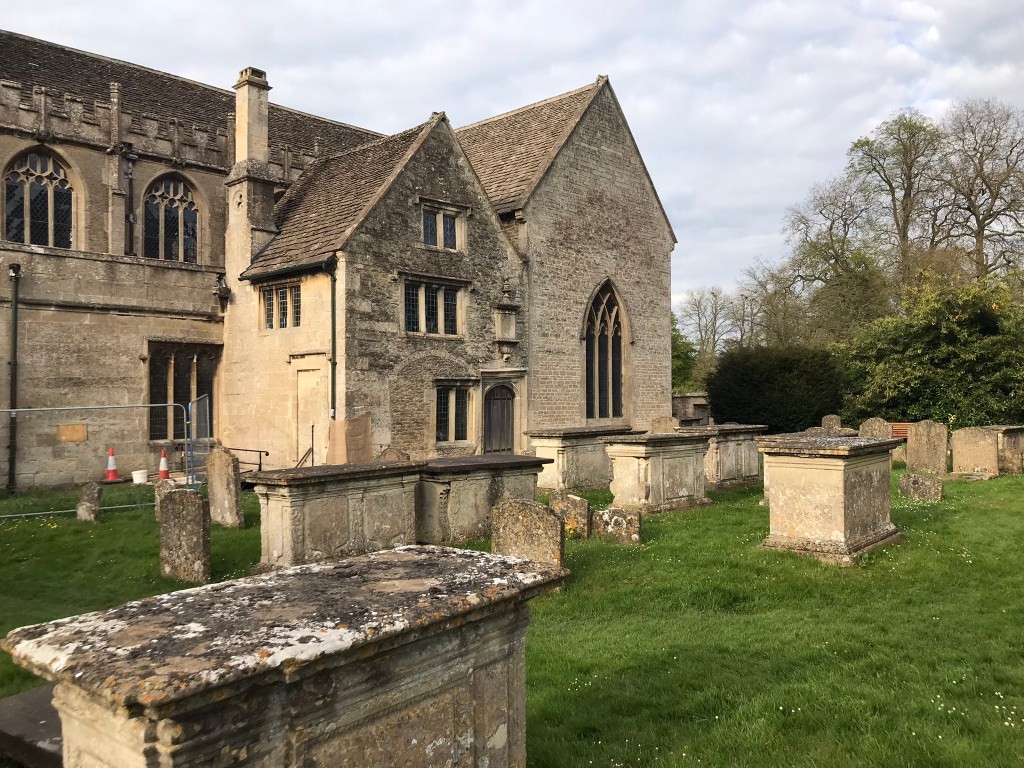
As far as I’m aware, Benjamin is the only relative of mine commemorated on a (surviving) chest tomb and my reaction when I first saw an image of the memorial online was to assume that Benjamin was a man of real importance – I even discovered that the mounment itself is a Grade II listed building! – but standing in the churchyard at Lacock last week and looking around, it soon became clear that chest tombs were two-a-penny at St Cyriac’s.

Chest tombs and other monuments in the churchyard of St Cyriac, Lacock, Wiltshire

So perhaps Benjamin wasn’t so important after all. As always in these matters, context is everything…

© David Annal, Lifelines Research, 3 May 2022

Posted in Document Sources, Local History, research, Stories | Tagged , , , , , , , | 4 Comments

Six Days, Six Stones – Part 1: Dorchester, Oxfordshire

To mark our 40th Wedding Anniversary, my wife and I arranged a six-day road trip, stopping off at various places connected with our families. Liz, my wife, is an enthusiastic family historian herself so she was very much a partner in planning the week on the road.

We were particularly keen to visit the places that our ancestors had lived and worked in, to walk for a moment in their footsteps and to try, as far as this sort of thing is actually possible, to picture what life must have been like for them. But we were also keen to find their last resting places and with that in mind we visited no fewer than 13 burial places in our six days away. (Who says family historians don’t know how to have fun!)

We set off last Monday, and, now home and recovering from the whistle-stop nature of the trip, my plan is, over the next six days, to post a blog a day, each one focussing on one of the more interesting gravestones that we found.

Most of my ancestors were labourers who worked on the land: from the Orcadian farmer/fishermen to the hinds of the Scottish lowlands; from the Manx hill farmers to the poorest of them all – the victims of the Irish potato famine, the majority of my ancestors would have frequently worried about where the next meal was coming from and many would have lived with the ever-present threat of the workhouse looming over them. Some of them, it’s true, were relatively well-off, owning small pieces of land and even occassionally, leaving a will, suggesting at least a degree of comfort, but there’s one branch of my family which sits significantly higher on the social scale.

My grandmother was the result of a relationship between her mother and her mother’s employer: a man from, it’s fair to say, a somewhat different social class. So it’s perhaps not too surprising that it’s amongst his ancestors that I find most of the wills, property records, some fascinating Chancery cases and … some remarkable gravestones.

My 4x great grandfather, Samuel Port, was born in Shirburn, Oxfordshire in 1754. I get the impression that his father, Thomas, had ‘come down in the world’: his 17th century ancestors had been amongst the wealthiest inhabitants of the Oxfordshire town of Dorchester, running the biggest inn in the village and sending their children to the prestigious Dorchester Grammar School. Thomas had moved the short distance to Shirburn where he worked on the Earl of Macclesfield’s estate and it was there that he married Jane Franklin and that their four children were born.

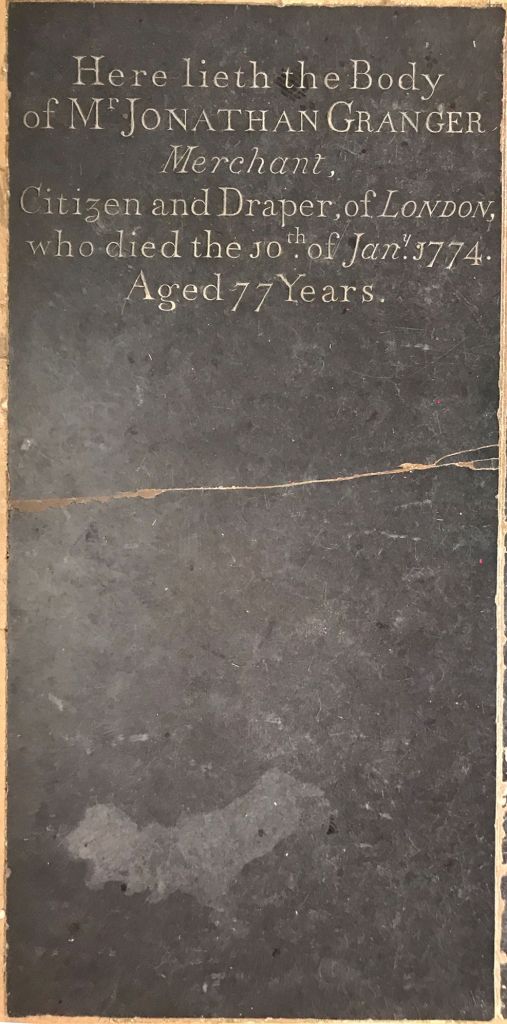
The oldest son died young, and the other two married and stayed in the area, but Samuel was to have a very different future. On 25 October 1769, aged 15, he was apprenticed to a man called Jonathan Granger, Citizen and Draper of London.

A Londoner by birth, Jonathan Granger was a wealthy and influential man. He was made a Freeman of the City of London in 1719, and in 1755, he was one of 12 ‘Common Councilmen’ who, along with the Alderman, were responsible for the government of London’s Tower Ward.

Despite being a member of the Drapers’ Company, Jonathan was a wine cooper by trade and it was this trade that Samuel Port was to learn from him. The apprenticeship indenture indicates that no fee was paid to Jonathan by Samuel’s parents which seems unusual until, that is, we discover that Jonathan was married to Samuel’s great aunt, Mary.

Apprenticeship indenture of Samuel Port to Jonathan Granger, 25 October 1769.
London Metropolitan Archives ref: COL/CHD/FR/2/1046/13

Samuel’s apprenticeship was supposed to last the customary period of seven years, however, on 10 January 1774, just four years and two months into his term, his master died and Samuel was ‘turned over’ to William King, one of the executors named in Jonathan Granger’s will. The will stretches to eight pages and is so full of additions and amendments (not to mention ramblings!) that it’s quite difficult to make full sense of it, but Samuel is clearly named as a beneficiary, along with several other Port relations, including his father, Thomas.

In one of the (slightly) more coherent sections of his will, Jonathan leaves instructions regarding his burial:

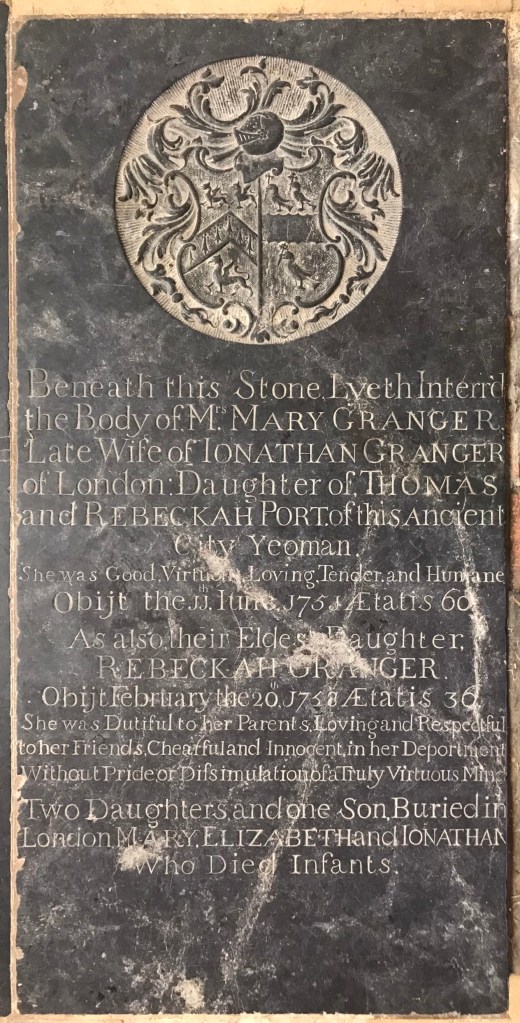
… my Body to be decently interred according to this my Will herein after named … and also my Funeral Expences which I desire may be small with decency not to exceed three Coaches with the Hearse To carry my Body to Dorchester in Oxfordshire there to be interred by my beloved Wife Mary and Daughter Rebecca Granger which is to be found in the Entrance of the said Church with the Inscription on a Stone to whom they belong and desire the further Inscription may be added on my Account after my Intermnent if room at the bottom of same Stone if not on one other Stone to be laid over my Body …

Will of Jonathan Granger of Saint Dunstan in the East, London. Proved in the Prerogative Court of Canterbury, 7 February 1774. The National Archives ref: PROB 11/995

Jonathan’s beloved wife, Mary (née Port) had died over 22 years earlier and his daughter Rebecca some seven years after that, and we can assume that it was Jonathan who had arranged for the remarkably detailed and ornate stone to be laid over them. The stone survives today in almost perfect condition – perhaps slightly scuffed in places – but given that it’s now 264 years since ‘Rebeckah’s’ name was added, it’s remarkable how legible the text is. Much of it looks like it must have looked the day it was carved.

The inscription in full reads:

Beneath this Stone Lyeth Interr’d
the Body of Mrs MARY GRANGER
Late Wife of IONATHAN GRANGER
of London Daughter of THOMAS
and REBECKAH PORT of this Ancient
City Yeoman.
She was Good, Virtuous, Loving, Tender and Humane
Obijt the 11th Iune 1751 Ætatis 60
As also, their Eldest Daughter
REBECKAH GRANGER
Obijt February the 20th 1758 Ætatis 36
She was Dutiful to her Parents, Loving and Respectful
to her Friends, Chearful and Innocent in her Deportment
Without Pride or Dissimulation, of a Truly Virtuous Mind
Two Daughters and one Son, Buried in
London. MARY, ELIZABETH and IONATHAN
Who Died Infants.

Gravestone of Mary Granger, wife of Jonathan Granger and of their daughter, Rebecca Granger, Ss. Peter & Paul, Dorchester, Oxfordshire

The stone lies today in the south aisle of the church (now known as the People’s Chapel). Technically, it’s a ledger stone, and it, along with scores of other stones (some of which appear to have formerly stood outside in the churchyard), forms the floor of much of the church today.

Immediately to its left lies another stone, almost exactly the same size and colour, which, in much the same lettering, records the death and burial of Jonathan. The room at the bottom of the original stone was evidently not felt to be sufficient to record Jonathan’s details:

Here lieth the Body
of Mr JONATHAN GRANGER
Merchant
Citizen and Draper, of LONDON,
who died the 10th of Jany. 1774
Aged 77 Years.

Gravestone of Jonathan Granger, Ss. Peter & Paul, Dorchester, Oxfordshire

I had known of the existence of these stones but this was the first time that I’d seen them in the flesh (as it were) and I have to admit that I found the experience quite moving. It’s so far removed from the sorts of graves that I usually find for my ancestors – Mary’s has even got heraldry!

But there’s one problem with the stone. And it’s quite a big problem…

Mary is described – very clearly – as the daughter of Thomas and Rebecca (‘Rebeckah’) Port. But she wasn’t: she was the daughter of John and Rebecca Port.

John Port had married Rebecca (surname unknown) sometime around 1675. They went on to have three children – John (baptised 1678 at Great Hasely – died young), Thomas (baptised 1680 in Dorchester – Samuel’s grandfather), John (baptised 1683 in Dorchester) – before John senior died sometime in early 1685/86.

On 10 March 1685/86, letters of administration were granted to John’s widow and relict, Rebecca Port, and an inventory was compiled, listing John’s “goods and stock credits & chattles” which came to a total of £314 1s 4d – a not-inconsiderable sum for the time.

Four months later, Rebecca gave birth to a daughter, called Mary. The Dorchester parish register records the baptism of:

Maria filia Reb: Port Vid. de Dorches: bapt: Jul: 27: 86

Baptism of Mary Port, daughter of Rebecca Port, widow, of Dorchester, baptised 27 July 1786, St Peter & St Paul, Dorchester, Oxfordshire.
Oxfordshire History Centre ref: PAR87/1/R1/1

So, Mary was evidently born after her father died. I don’t know when Rebecca died (there’s a gap in the Dorchester burial register between 1678 and 1719) but if she died shortly after John, it’s conceivable that the children never knew their parents and we can begin to understand how their father’s name might quickly have been forgotten.* And then, when Mary died, nearly 65 years later (she was older than the 60 years stated on the stone) the wrong name was recorded on her memorial.

It’s perhaps a lesson to us that memorial stones – even the most detailed and informative – aren’t always as accurate as we would like them to be. I tend to treat them as mini-biographies, rather than primary sources.

* On checking my notes more carefully, I realise that the widowed Rebecca married a man called Timothy Smyth on 15 August 1687 and that she seems to have died a few years later. The gap in the parish register is partially filled by some Bishops Transcripts but these are also a bit patchy. There are two burials of women called Rebecka Smith, one on 1 July 1689/90 and another (undated) in 1691/92. The BTs give no further details but one of them is probably our Rebecca.

© David Annal, Lifelines Research, 2 May 2022

Posted in Local History, research, Stories | Tagged , , , , , , , , | 6 Comments