A slight, dapper man, with a small, neatly trimmed moustache, well turned out, sometimes carrying a cane and, more often than not, sporting plus fours and a natty pair of argyle socks, his eyes always staring directly into the camera. It’s difficult to escape the conclusion that his is a confident, out-going personality, that he’s someone who’s up for it, whatever ‘it’ might be; that his capacity for adventure and going just a little bit too far is boundless. There’s something bohemian about him, as if he’d stepped straight out of a P G Wodehouse short story, although he would have been one of Bertie Wooster’s less-well-off friends, who’d been forced to work in his uncle’s office as a junior clerk.
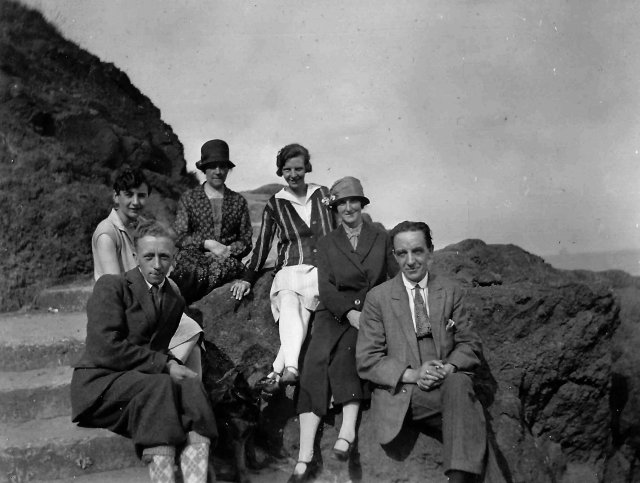
He’s such a ubiquitous presence in my grandma’s photos from the late 1920s and early 1930s that I’ve often wondered if there was some sort of romantic connection between them. So, who was he and how did my grandma (Margaret ‘Maggie’ Howland) come to know him? It’s a question I’ve wrestled with on numerous occasions over the 40 years or so since I first had access to my grandma’s extensive photo collection. I can easily recognise several of the recurring faces, in particular, those of her best friends, Mary Kinaird Miller and Christine Peace Hope. Mary (‘Mary Pancake’ to me and my brothers, thanks to her ability to make the best drop pancakes ever known to mankind) and ‘Ina’ are the two who appear most frequently in the photos and they both remained close to Maggie well in to their eighties.
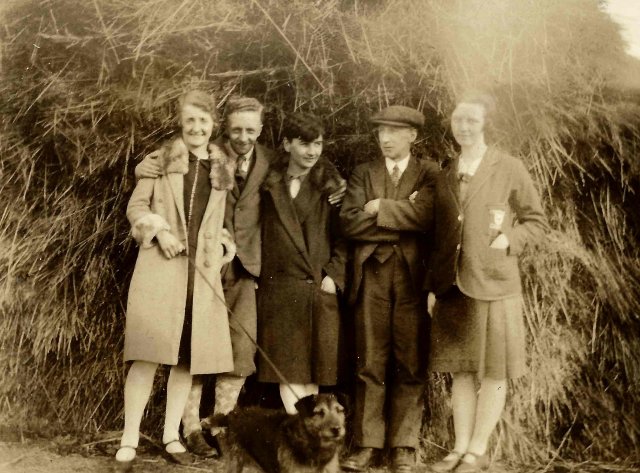
L to R: Mary Kinnaird Miller, the mystery man, Margaret Howland, unknown man, Christine Peace Hope. © The Author
Christine and my grandma seem to have been inseparable in their late teens and early 20s, always together, dressed slightly daringly in close-fitting dresses, and wearing their hair in styles that their parents surely wouldn’t have approved of. Mary’s husband, Duncan McKechnie, a man from the Western Isles who might, on the surface, have appeared quite stern but in reality was one of the most gentle, funny and kind men you could hope to meet, is a regular in the photos and as the 1920s turn into the 1930s, another man, William Annal, begins to appear more often. By 1931, he and Maggie were married.
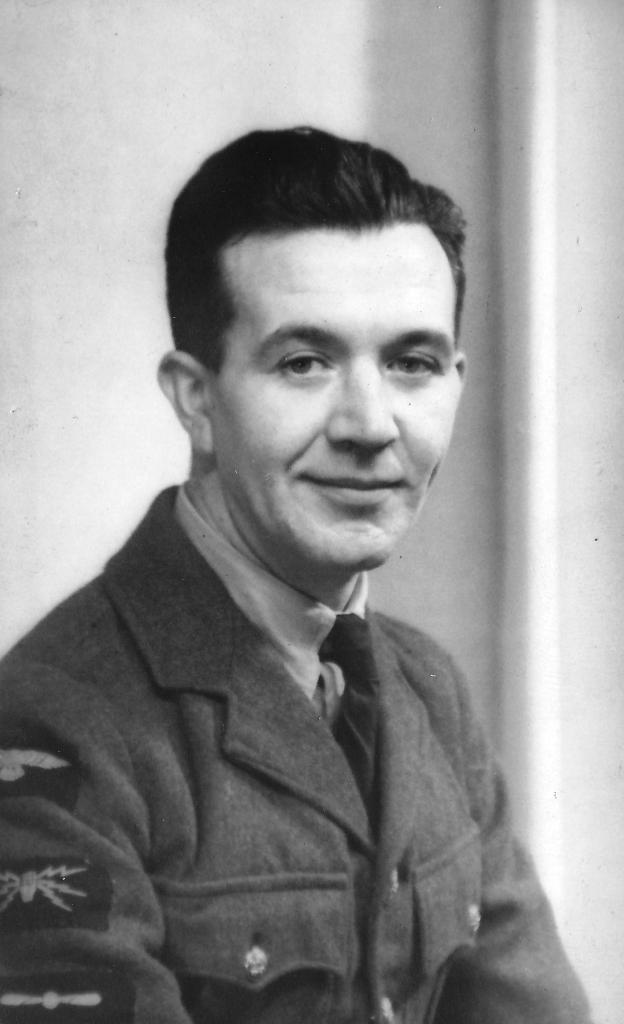
I inherited my grandma’s photos when we cleared out her house in the late 1980s, after she moved into a care home. I treasure them, not just for the rich genealogical archive that they represent but also for the memories they provide of people that I knew when they were much older and the glimpses they give me of people who I never knew. My grandfather, for example, died in 1953, nearly eight years before I was born but there he is in the photos, a real, living, breathing person, with deep, thoughtful eyes and a friendly smile. I get the feeling he would have been a great grandad.
© The Author

But let’s get back to the question of the identity of the dapper man in the plus fours and the argyle pattern socks. There’s no one alive today (at least not in my immediate family) that I can ask about him. Of course, I could have asked my grandma but I didn’t so there’s little point in dwelling on that, other than to say that it’s always a good idea to ask people these questions while they’re still alive…
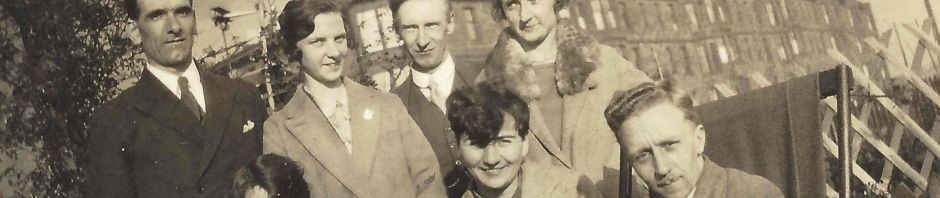
I’d examined each of the photos featuring our bohemian friend for clues and there was only one that seemed at all likely to produce any useful diagnostic results. It’s one of my favourite family photos although it only features one family member – my grandma herself. Maggie is at the centre of the group, here seen sporting an Eton Crop-style haircut which must have tested her mother’s patience to the extreme. Three more of the subjects are known to me; Ina (of course) and Mary are both in the group, second and fourth from the left in the back row respectively. Duncan McKechnie is there at the back on the left, in a classic Duncan McKechnie pose; shoulders back, head up, staring at something unknown off to the right, hair blowing in the wind, with a hat, apparently hanging in the air above his left shoulder. In fact, on closer inspection, the flying hat is suspended on the top of a garden trellis and when we explore the rest of the image, we can quickly see that the photo was taken in a garden or an allotment.
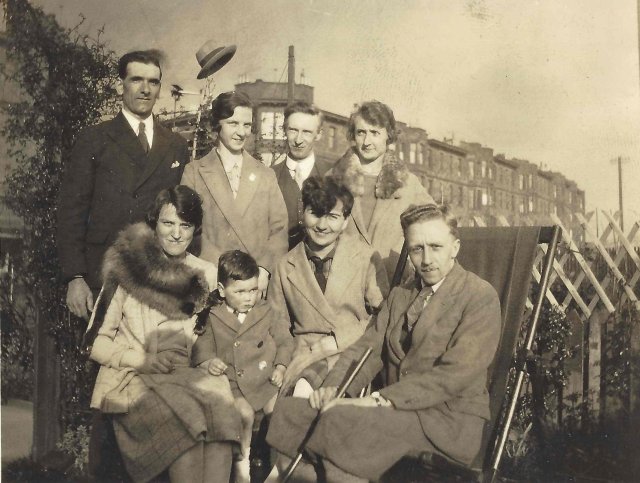
The other four people in the photo have always been unknown to me; the man in the back row, third from the left, the woman with the fur stole and the young boy at the front on the left and finally the dapper man, leaning slightly forward in his deckchair, plus fours showing well, cane in hand and a gentle smile on his lips, all topped off by an outrageous hairstyle.
The whole thing is very ‘posed’ but in a tasteful, stylish way. There’s so much to take in but with our genealogical detective hat on, the key aspect of the photo is the distinctive building in the background. For years, I had no idea where it had been taken; the building meant nothing to me but after posting the image on a few Edinburgh Facebook Groups I got a response, from a second cousin of mine as it happens (William Annal’s sister’s grandson, Gordon Watson), who knows Edinburgh much better than I do. Gordon recognised the building as being on the east side of Lochend Road near Hermitage Park, in the northeast of Edinburgh, formerly part of the Burgh of Leith.
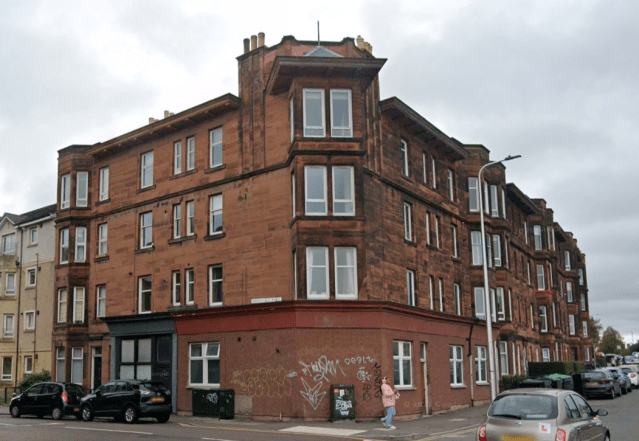
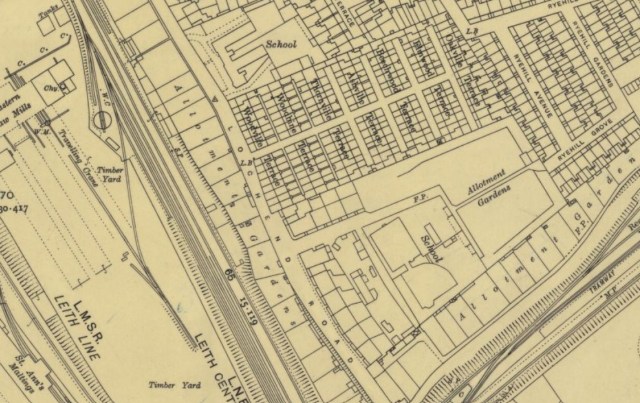
A quick glance at the area on Google Maps confirmed that Gordon was spot on and when I looked at a contemporary (1933) map of Lochend Road my reading of the photo’s setting was confirmed by the discovery that this part of the west side of the road was taken up with ‘Allotment Gardens’. I’d answered one major question regarding the photo but I hadn’t got any closer to identifying the mystery man. I wondered about the possibility of finding records listing the people who were renting the allotments in Lochend Road in the late 1920s to see if there was a name that I recognised but I didn’t get very far with that and once more I put the matter to the back of my mind.
That breakthrough occurred about two years ago and I hadn’t really given it much thought since but I’ve just spent the last week up in Edinburgh and it came to the surface once again following a remarkable discovery. My brothers and I have begun the long process of clearing my dad’s house (he’s just gone into a care home – can you see a pattern developing?) and while dealing with the hard practicalities of what to do with the accumulation of 40 years’ worth of clutter can be quite challenging, there’s always the possibility of coming across bundles of letters, old documents and, of course, family photos – or at least that’s what our inner family historians are always hoping for.
I wasn’t expecting much in the way of old photos – after all, I’d already inherited more than my fair share – but we came across the odd bundle, most of which were copies of ones that I’d seen before. So, when one of my brothers handed me a small pile that he’d just found in the bottom of a drawer, I didn’t hold my breath. The one at the top of the pile was instantly familiar to me; it was a studio portrait of my grandma and grandad on their wedding day (5 September 1931), flanked by the best man (my great uncle John Annal) and the maid of honour, yes, you’ve guessed it, Christine Peace Hope.
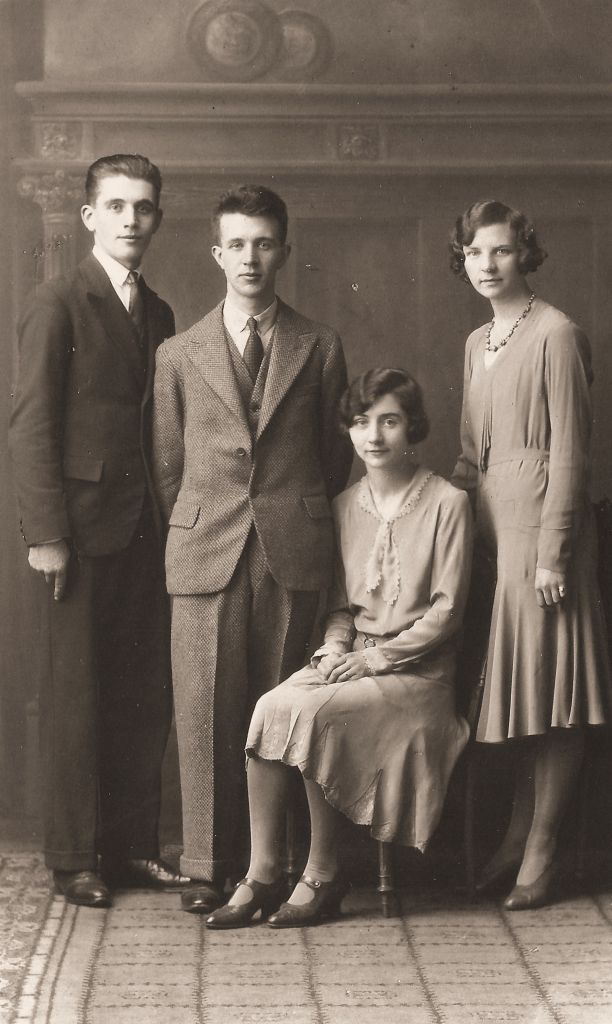
L to R: John Annal, William Annal, Margaret Howland, Christine Peace Hope. © The Author
The next item was a small passport-sized photo of my grandad in later life which again, I’d seen before, but then my eyes fell on the final photo in the bundle. It was very similar to the wedding photo that I’d just been looking at – a sepia-toned, formal studio portrait of a wedding group – but it was one that I had definitely not seen before. The bride and groom I instantly recognised as Mary Kinnaird Miller and Duncan Robertson McKechnie and they were similarly flanked by their best man and maid of honour. I didn’t recognise the latter but the best man jumped out at me – a slight, dapper man with a small, neatly trimmed moustache! There was no doubt whatsoever that this was our mystery man although he was lacking the trademark plus fours and argyle pattern socks (a fiercely creased pair of Oxford bags almost covering the inevitable spats stood in for them).
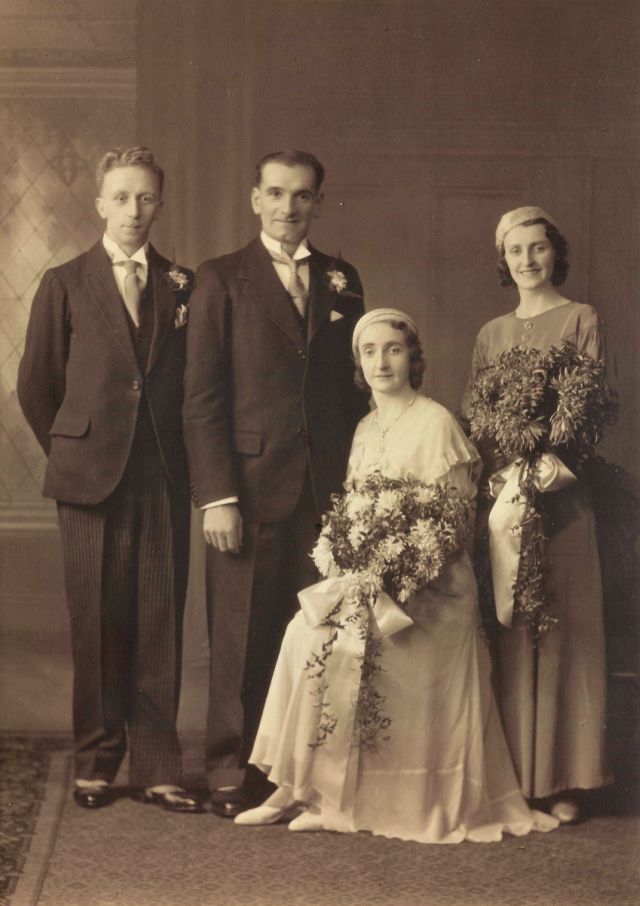
I could now turn to Mary and Duncan’s wedding certificate (they were married on 29 December 1933) and discover the names of the two witnesses. I wasn’t surprised to see that the maid of honour was Mary’s sister, Margaret; the second witness signed his name as ‘Wm. A M Hope’. And it didn’t take me long to find out that William Andrew Melville Hope was Ina’s brother!
This then was our man. I found out that he worked as a shop assistant in a fashionable gents’ clothiers in Edinburgh (I’ve now got images in my head of Paul Whitehouse’s ‘Suit You’ character from the Fast Show). I also know that he moved to Sanday in Orkney, marrying in 1935, getting a job as the Registrar of Births, Marriages and Deaths for the island and dying there in 1963.
The final piece in the jigsaw came when I noticed that both Ina (in 1931) and William (in 1933) had given their address as 20 Woodbine Terrace, Leith. The Hope family, it turns out, had lived just a minute’s walk from the allotments in Lochend Road.
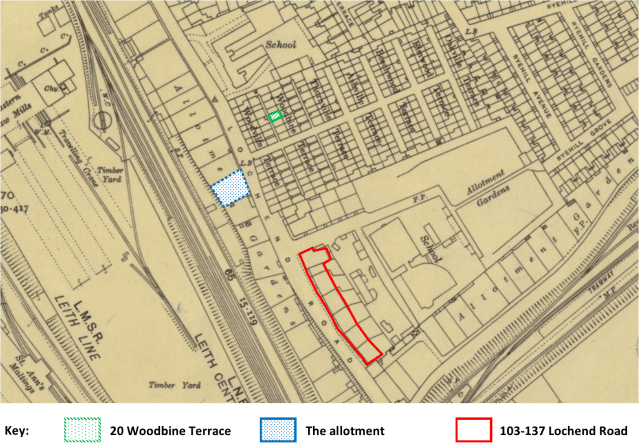
I’m fairly sure that the unknown man in the back row of the photo taken in the allotment is William and Ina’s brother, Andrew Cecil (he was a year younger than William) but I’d love to know who the woman and the young boy are. Give me another thirty years and I’ll see what I can find out…
© Lifelines Research, 24 January 2026


 Lifelines Research
Lovely & great old photos!
LikeLike
Persistence personified. A trait every family historian hopes lies within their DNA. Thanks for sharing.
LikeLike
How very satisfying for you, after so long, to be able to make that link – and so interesting, too. There’s a lesson there for all of us long-term family historians, never give up, keep plugging away and one day a brick may just fall out of that wall!
LikeLiked by 1 person
Excellent detective work, Sherlock!
LikeLiked by 1 person